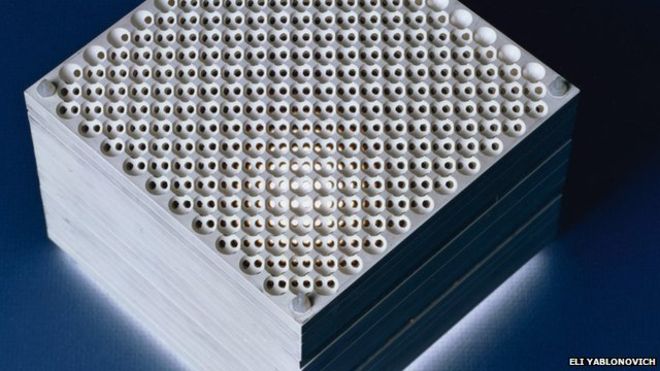
Photonic crystals can manipulate light in the same way that a semiconductor like silicon can steer electrical current. PHOTO: Eli Nablonovich
The US physicist who first discovered “photonic crystals” which can repel, trap and steer light is to receive the Newton Medal, the BBC has revealed. This is the highest honor given by the Institute of Physics in London. Prof Eli Yablonovitch of the University of California, Berkeley, proposed and created the crystals in the 1980s. Photonic crystals are periodic dielectric structures that have a band gap that forbids propagation of a certain frequency range of light. This property enables one to control light with amazing facility and produce effects that are impossible with conventional optics. Butterfly wings and the colorful plumage of peacocks and some parrots all contain examples, which were only understood after Yablonovitch and his fellow physicists fully described photonic crystals in the 1980s.Even the chameleon was recently shown to produce – and control – its color using the shape of photonic crystals.
Yablonovitch ‘s seminal description of photonic crystals was published in 1987 when these materials had never been manufactured, and were not known by that name. It is the second most-cited paper ever published in the prestigious journal Physical Review Letters. Surprisingly enough, the same concept was described in a second paper three weeks later by Sajeev John, now a professor at the University of Toronto. The crystals are now used in data processing and in wave guides for laser surgery; they have also been discovered in bird feathers and the skin of chameleons.
Both researchers built on an idea put forward 100 years earlier in 1887, by British physicist Lord Raleigh. He suggested that a material with a repeating, regular structure – such as a crystal – could block light of particular wavelengths.
This happens, Raleigh calculated, because if the light has a wavelength that is similar to the size of the repeated units in the structure, then the waves reflected off its internal surfaces will interfere and cancel each other out. That produces a “stop band” (later called a “photonic bandgap”) – a range of light wavelengths that will be repelled by the crystal.
“[Lord Raleigh] developed the idea of the one-dimensional photonic crystal,” Prof Yablonovitch explained. “That’s something that we’ve lived with for over 100 years. But over that entire period, no-one really thought of extending Raleigh’s idea into two and three dimensions.”
BBC brings you more.
 Organikos