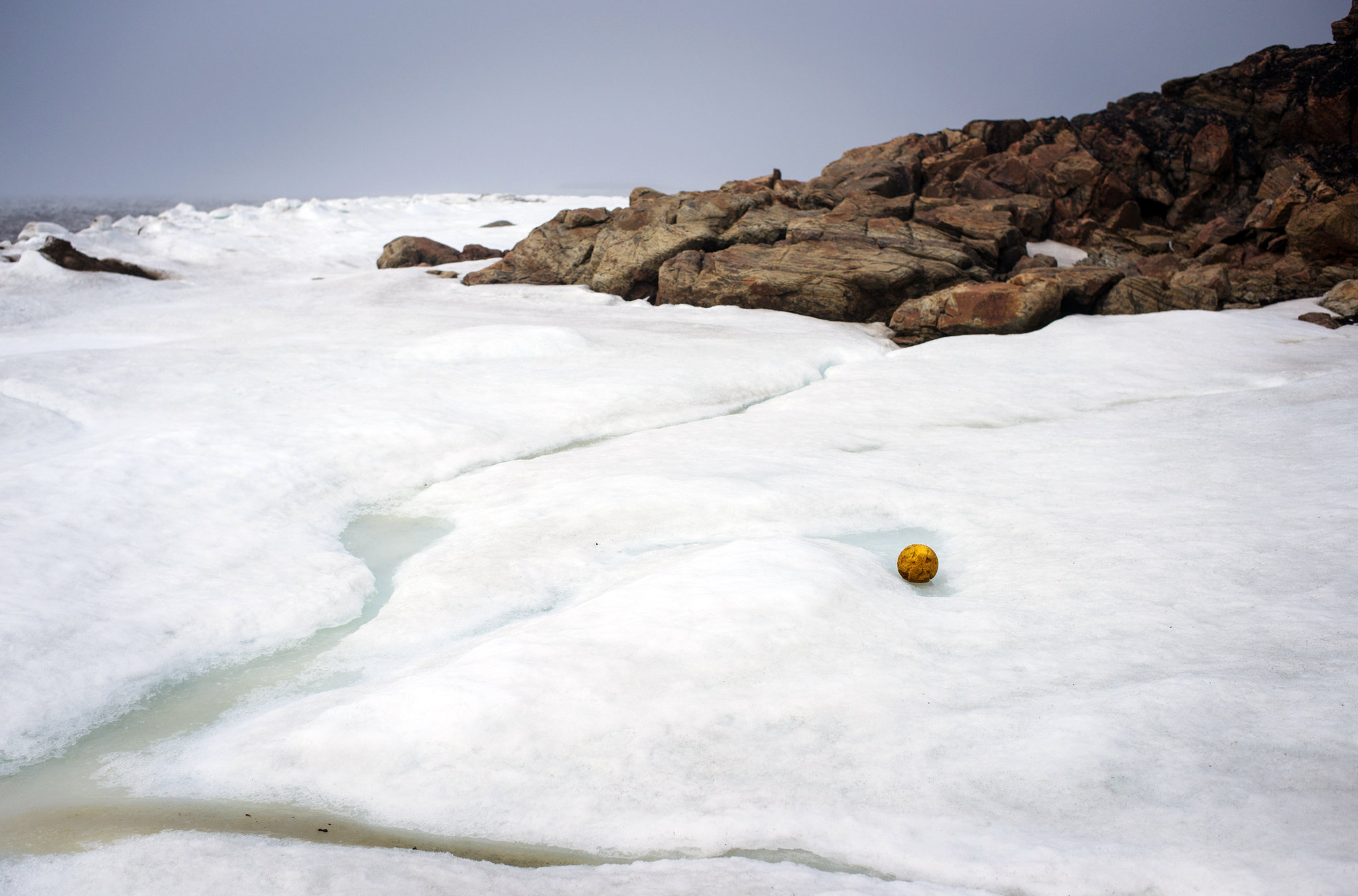
Even in late June, ice clotted Frobisher Bay in Iqaluit, where teams from across Nunavut met to compete in a soccer tournament.PHOTO: Ian Willms for The New York Times
Sports, like most aspects of life, are not easy in the Canadian Arctic. But a major youth tournament recently revealed soccer’s importance to the area. Sports, like everything in the Arctic, demand constant, patient improvisation. Nunavut makes up about 20 percent of Canada’s land mass and is more than twice the size of Texas, but it has only an estimated 36,000 inhabitants, predominantly Inuit. There are no roads connecting the 25 communities in this vast territory. Every trip requires a snowmobile, a dogsled, an all-terrain vehicle, a boat or an airplane. Contingencies must be made for immense distance, mercurial weather, extravagant costs and geographic paradox. Soccer is best played on plush grass, but nearly all of Nunavut is tundra. So the sport has adapted.
The transition for many Inuit to community living from a nomadic lifestyle has grown increasingly traumatic since the 1970s and ’80s. The suicide rate in Canada’s far north is 10 times higher than the national average. Soccer has served as a bridge for the Inuit to the broader Canadian culture, and also to their forebears, who played a similar game with a ball made from seal skin.
“This is a new age for our culture”. “We aren’t like before, living in igloos, hunting without guns. Everything is coming to us from the big cities and has brought us into what the world is now.”
The New York Times brings you an excellent read on how soccer is changing young minds in Canada’s far north, saving lives, and is igniting dreams. More power to this beautiful game.
 Organikos