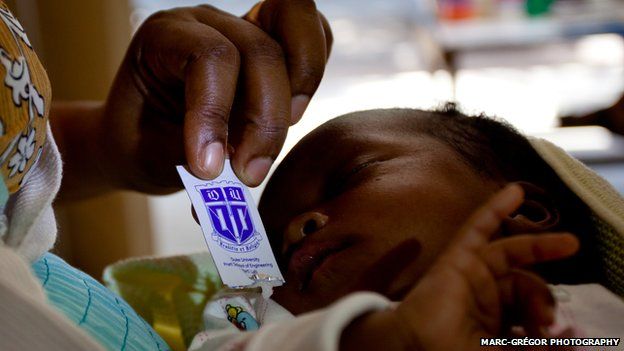
An HIV positive mother in Moshi, Tanzania, giving her baby antiretroviral medicine from the sachet
Inside a foil sachet, which looks more at home in a fast-food restaurant, an exact dose of antiretroviral medicine is helping to protect newborn babies against the threat of infection from their HIV-positive mothers. According to the UN, mother-to-child transmission in the developing world creates 260,000 new infections in children every year. Thanks to a program involving the Ecuadorian government, the VIHDA foundation in Guayaquil and Duke University in North Carolina, at least 1,000 babies have been born without the infection from HIV-positive mothers.The program is enabling newborn babies to take their medicines efficiently – via a pouch that looks just like the small ketchup sachets you get at fast food restaurants. Only in this case, they are filled with antiretroviral drugs, which protect against HIV.
Rosa’s baby was bornat South America’s biggest maternity hospital, the Enrique Sotomayor Hospital in Guayaquil – just like 20% of Ecuadorian children. She has received free psychological and medical support since she tested positive for HIV three years ago. Rosa has been able to try different methods of giving the antiretroviral medicine to babies, who have to take them during their first four weeks of life.
“We used to get a small bottle with a dropper, but that spilled and it was difficult to measure the dose”, she tells the BBC. The same thing happened with syringes and spoons, she says. “But now with the pouch it is easy to put all the liquid in the baby’s mouth without spilling or spoiling it.” As well as giving the exact dose, the pouch avoids contact with the air, enabling the medicine inside to be preserved for up to a year without degrading.
The pouch was researched and designed by a group of students, most of them from Ecuador, at the Pratt School of Engineering at Duke University. But it only reached the wards of the hospital thanks to Humberto Mata, who was born there 47 years ago. A car parts seller and former politician of the Guayas State, Mata created the VIDHA foundation with his husband to prevent children from getting HIV.
The Harvard graduate says he is part of the 1980s generation, when thousands of young Americans died of AIDS. “I buried many of my friends”, he says. After that experience, Mata did some research and found out that babies with HIV were not being treated as well as adults with HIV. “So we became the bridge between the public sector, which pays for the drugs, and the hospital, where a huge number of cases are gathered in the same building,” Mata says.
The BBC brings you more here.
 Organikos