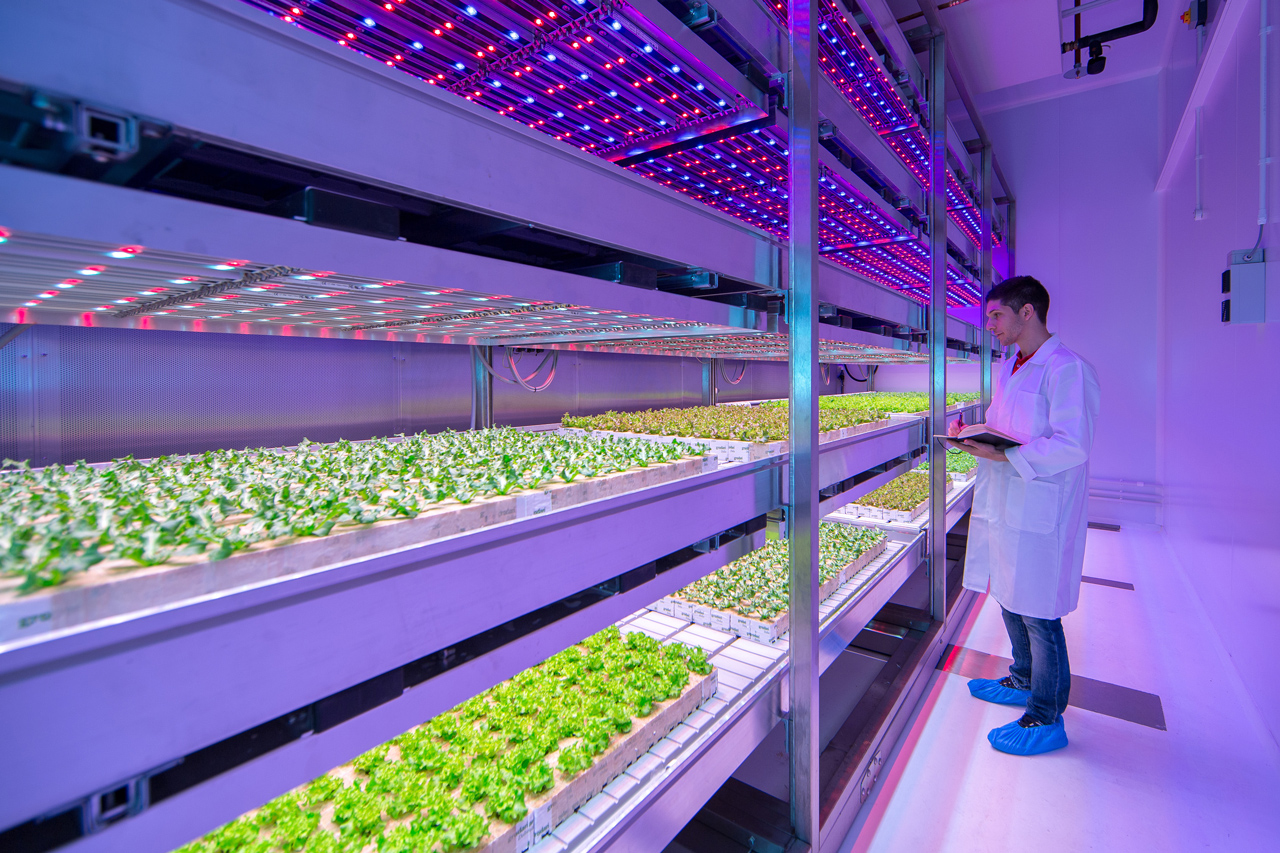
In this huge urban farming lab, LED “Recipes” grow juicier tomatoes and sweeter basil. PHOTO: Co Exist
Behind a vault-like door, the long, windowless room has the same purple glow as the cabin on a Virgin America flight. Instead of passengers, the space is filled with row after row of plants, each growing under a carefully calibrated series of red and blue lights. White-coated researchers walk by studying each leaf of lettuce or kale. Welcome to the GrowWise Center, one of the largest homes for urban farming research in the world.
The new Netherlands-based lab belongs to the lighting company Philips, which realized several years ago that its LED lights could help shape a new path for farming.
“We took LED lights, a new technology, to see how we could apply it in agriculture,” says Gus van der Feltz, Philips global director of city farming. “Could we make a difference and improve the way plants are grown? As it turns out, we can.”
If you’re going to grow food indoors—especially in a windowless warehouse like the 30,000-square foot Green Sense Farms, one of Philips’ customers—you’ll need light. The LEDs provide a substitute for the sun, but they also go further; Philips designs “light recipes” that can make particular crops grow faster or produce more nutrients.
“We can tailor these recipes to the photosynthesis response of the plant,” says van der Feltz. “By being able to tweak the spectrum—the color the plants see—and put the lights exactly where they need it, we can dramatically increase yields and improve fruit density and quality.”
By changing the mix of lights, tomatoes can grow with more vitamin C. Basil gets tastier. The lights can be used as a supplement in more traditional greenhouses, but are even more effective in a closet-like vertical farm with no natural light.
Read more here.
 Organikos