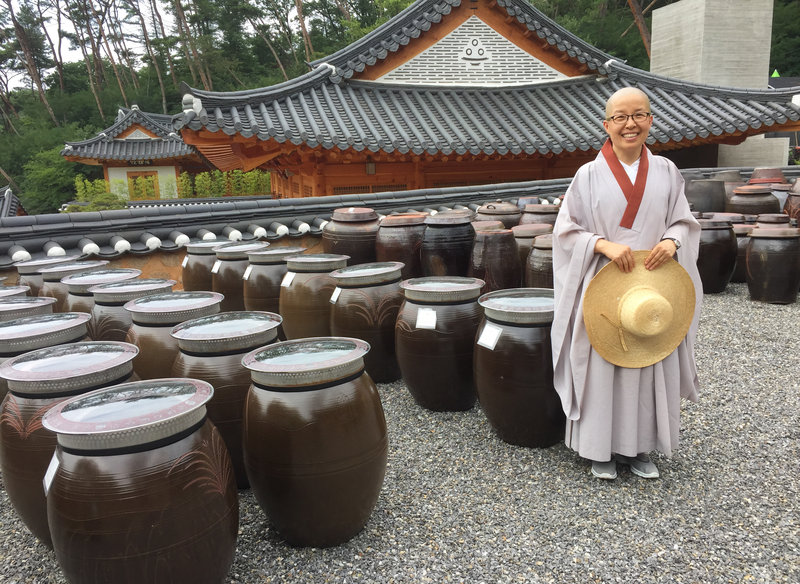
Sun Woo directs the visitor program at Jinkwansa, a Buddhist temple outside Seoul famous for preserving the art of Korean temple food. Behind her are giant jars filled with fermented soybeans. PHOTO: Ari Shapiro/NPR
When it comes to faith matters, it’s interesting to see how matters of divinity are linked to food. One interpretation of it could be the need to connect the intangible with the tangible. And no better universal language than food as a medium to impart lessons for the soul. While most Hindu temples distribute prasad, churches have the Eucharist, Jewish rituals revolve around the seder meal and so on. The Buddhist temple at Jinkwansa too has a food tradition, one that goes back 1,600 years and is renowned for its detoxification power.
Jinkwansa is famous for two reasons. First, it’s run entirely by women. Then, the place is renowned for preserving the ancient art of Korean temple cuisine.
“You can’t understand monastic culture without understanding monastic food,” says Gye Ho, the Overt Nun who runs this temple. She has been a practicing nun for more than 50 years. Like all of the nuns here, Gye Ho has a shaved head and wears traditional gray robes. “The food creates the entire human being,” she says. “It shapes our mind and body.”
Gye Ho explains that for the nuns, cooking and eating are spiritual as well as physical practices. “We prepare our food with a clear mind,” she says. “We recognize that the best sauce in the world is the heart that we put into our cooking.” She says everything here is natural; while the rest of South Korea uses metal chopsticks, those at the monastery are made of wood. At the risk of sounding impolite, I finally ask this aged nun, “Do you ever just crave french fries or chocolate?”
“Everyone has cravings,” she replies. “When I have them, I focus my mind by making noodles.”
Read more of this food connection, courtesy NPR, here.
 Organikos