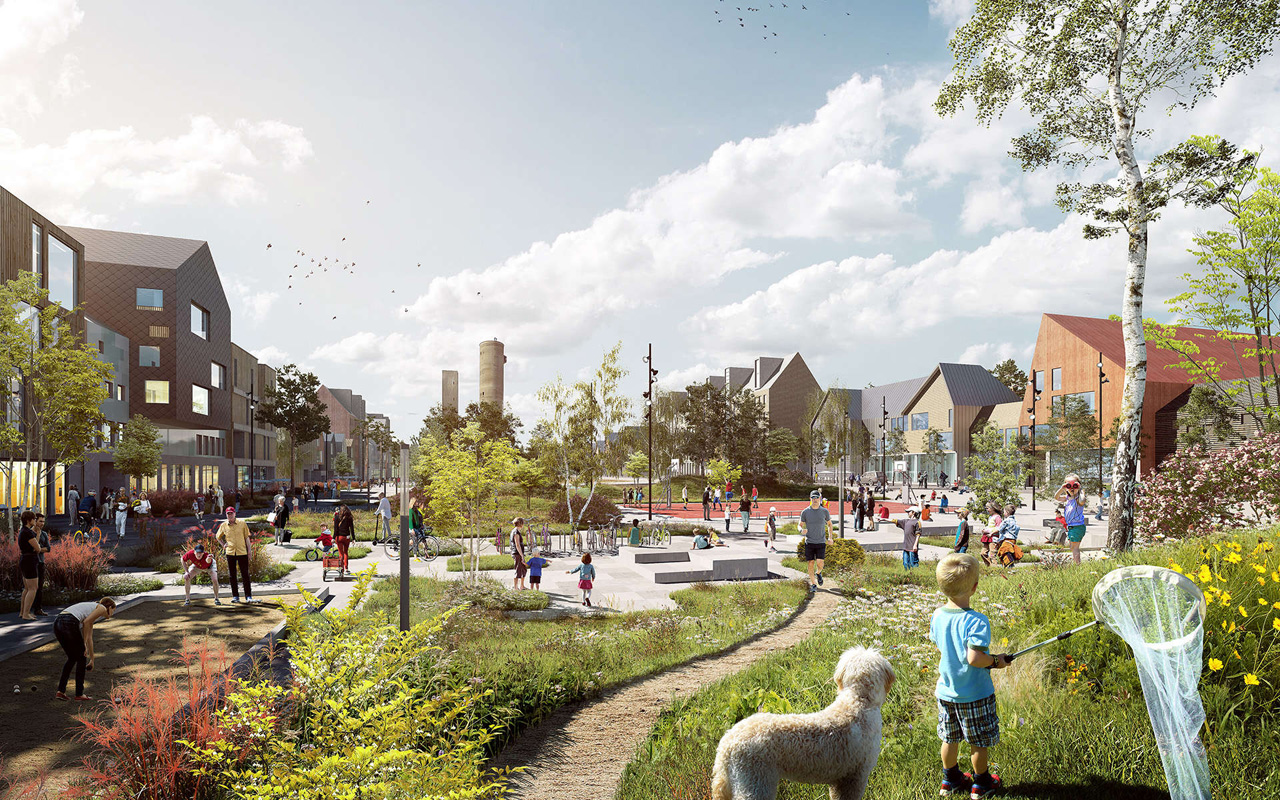
Kiruna is Sweden’s northernmost city, and soon, it’s about to pick up and move two miles to the east, thanks to a mine. PHOTO: Co Exist
Kiruna is home to the world’s largest underground iron ore mine, LKAB, supplying iron ore pellets to the steel industry in Europe. In most places, ore is extracted in opencast mines but not in Kiruna. The ore body in Kiruna is four kilometers long and 80 meters wide and stretches for at least two kilometers in the ground. For the moment, they mine at 1 km deep in Kiruna but they plan to mine until at least 2030 because they don’t know the extent of the ore body. But the city is sinking.
To be able to extract iron from the ore body, the miners have to dig deeper and deeper with an angle of 60° towards the city. All vibrations resulting from the explosions are leading to fissures and cracks that are starting to appear in the ground. The more they dig, the more vibrations they create. Now, the mining company that first brought people to the area will buy up the entire city center, knock it down, and rebuild it three kilometers away. The final cost is unknown, but the city of Kiruna says that the company has already designated 6 billion Swedish Kronor (around $700 million) for the project.
Either the mine must stop digging, creating mass unemployment, or the city has to move – or else face certain destruction. And the town has decided to pack its bags. Kiruna is not the only place LKAB is having to spend money in order to move neighbourhoods away from a mine. Roughly three miles away from Gällivare, Kiruna’s closest neighbour, is Malmberget. LKAB has another major iron ore mine there, and its impact on the environment is forcing a similar process of relocation. Buildings have been moved in a piecemeal way for 50 years as a result of a huge hole opening up in the centre of the town. But the plan is for Malmberget to be relocated “almost completely” to neighbouring Gällivare.
Read more on how Kiruna will move safely out of the chomping zone of the mine by 2033 here and here.
 Organikos