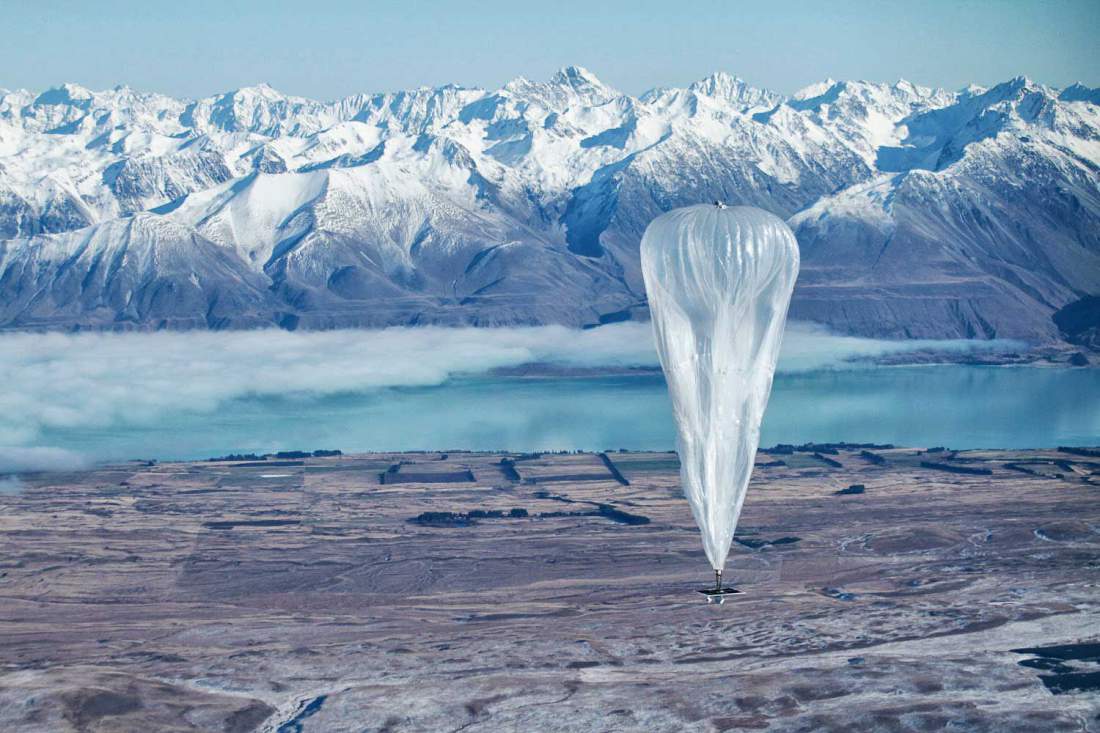
In this June 10, 2013 photo released by Jon Shenk, a Google balloon sails through the air with the Southern Alps mountains in the background, in Tekapo, New Zealand (AP Photo/Jon Shenk)
Technology juggernaut Google changed the way we search with its proprietary algorithims. But the company is constantly working on technologically impressive, forward-leaning projects that have the promise to push broadscale change for billions of people around the world. Project Fi, self-driven vehicles, the delivery system named Project Wing and the three-dimensional mapping system named Project Tango later, Project Loon is here.
Only about 1 in 5 people in Sri Lanka are connected to the Internet today. With the help of Google’s balloon-based Internet network, Project Loon, 100% Sri Lanka residents will almost immediately be plugged in. Instead of spending many years and even more zillions of dollars laying cables, Sri Lanka and Google will put the Internet in the air, floating 12 miles above the Earth, and beaming down connections to every town and village.This is Project Loon’s first mass deployment, after trials in New Zealand and Brazil. On June 28th, Google signed an agreement with the Sri Lanka government that will let local telcos connect to the balloon network.
Sri Lanka’s population of 21.6 million people has 20.32 million mobile cellular subscriptions, but only 4.486 million people, or 21.9 per cent, have Internet.
“Hopefully in a few months every person and every device on the island will be covered by 3G. Service providers will enter in to agreements with ‘floating cell towers’ that will be shared bringing down transmission costs leading to further reductions in cost of service provision,” said Sri Lankan Deputy Minister of Policy Planning and Economic Affairs, Harsha de Silva in a post on Facebook.
Project Loon sees a network of balloons sent 20 kilometres above the Earth’s surface, each consisting of a balloon envelope, solar panels, and electronics.Powered by the solar panels, the electronics both operate the balloon and make sure it adjusts for changing winds as well as communicating with other balloons and Internet antennae on the ground. Using wireless technology, the balloons communicate with telecommunication companies to distribute their cellular spectrum, boosting Internet reception.
Read more here.
 Organikos
Pingback: More Internet, More Power | Raxa Collective