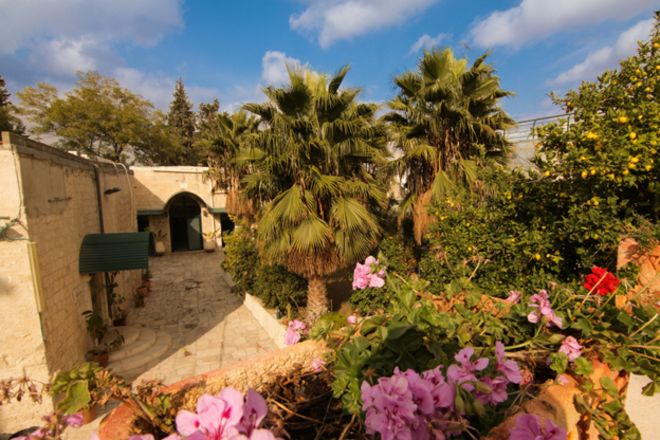
There is a little corner of Jerusalem that is forever India. At least, it has been for more than 800 years and its current custodian has plans for his family to keep the Indian flag flying for generations to come. PHOTO: BBC
For close to a century, many generations of an Indian family have been looking after the Indian Hospice, a symbol of India’s heritage, in the old city of Jerusalem.The Indian Hospice was born in 1924, with Sheikh Nazir Ansari, a police inspector’s son from Saharanpur in Uttar Pradesh, becoming the first Indian to look after the hospice, situated opposite Herod’s Gate in the old city. Since then generations of the Ansari family have kept the Indian flag flying in a situation which is “politically fraught where every inch of territory is claimed or counter-claimed”.
From the roof he flies an Indian flag, its saffron and green visible over a city that remains as volatile as ever. Sheikh Munir, though, is not easily intimidated. “I am not afraid. I am satisfied for the future, that we, the Ansari family, are serving. After me, my elder son, Nazer, should replace me as Sheikh of the zawiyya [lodge].”
I ask if Nazer, who works overseas, is interested in taking over. Sheikh Munir hesitates. From a frame on the wall, his father looks down silently. The old man raises his hands, palms up.
“It’s not a question of interested.”
BBC brings you the history in detail:
Around the year 1200, little more than a decade after the armies of Saladin had forced the Crusaders out of the city, an Indian dervish walked into Jerusalem.
Hazrat Farid ud-Din Ganj Shakar (or Baba Farid, as he is better known) belonged to the Chisti order of Sufis, a mystical brotherhood that still flourishes today across India, Pakistan, and Afghanistan. Later accounts of his life said that he spent his days sweeping the stone floors around al-Aqsa mosque, or fasting in the silence of a cave inside the city walls.
No-one knows how long Baba Farid stayed in the city. But long after he had returned to the Punjab, where he eventually became head of the Chisti order, Indian Muslims passing through Jerusalem on their way to Mecca wanted to pray where he had prayed, to sleep where he had slept. Slowly, a shrine and pilgrim lodge, the Indian Hospice, formed around the memory of Baba Farid.
More than eight centuries later, that lodge still exists. And although it stands inside Jerusalem’s walls – perhaps the most fiercely contested stretch of ground anywhere in the world – it is still in Indian hands.
The current head of the lodge, 86-year-old Muhammad Munir Ansari, grew up there in the years before World War Two, when Palestine seemed to end just outside the gate.
“All the residents were Indian. I felt as if I was living in India. Whenever we entered the Hospice – Indian state!” he says. “At that time people came by ship. They used to bring food, rice, even their salt. Salt! All from India. As soon as you entered the gate, the smell of Indian food, they were washing their clothes, hanging them here in the courtyard.”
The war cut off the flow of pilgrims and brought an end to the colourful scenes of Munir’s childhood.
The lodge became a leave camp for the Indian Fourth Infantry division, whose soldiers had only just left when the first Arab-Israeli war broke out in 1948. By the time Munir succeeded his father as Sheikh – head of the lodge – in 1952, the building was scarred by shelling and overrun with Palestinian refugees.
But worse was to come.
Read more here.
 Organikos