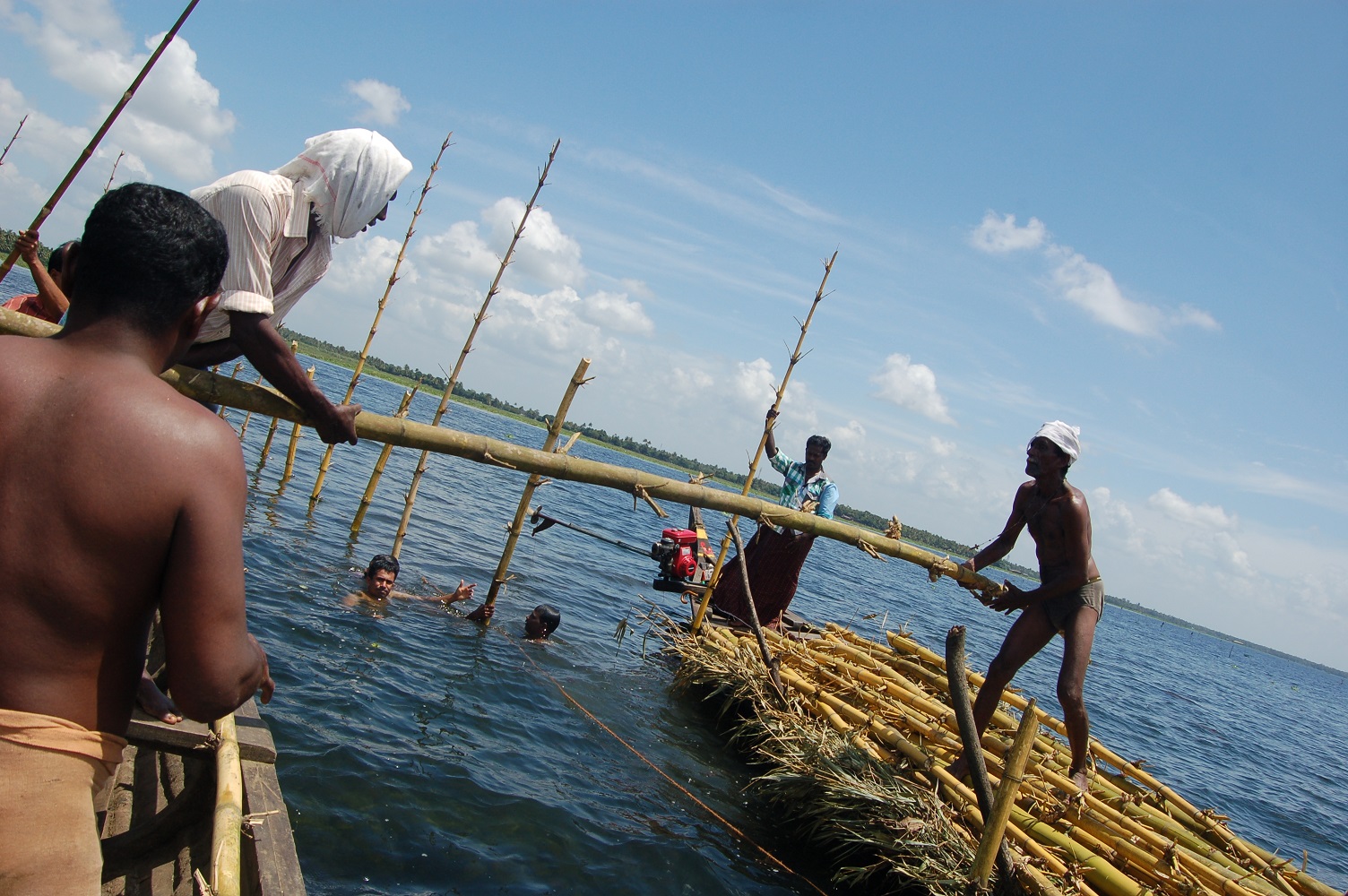
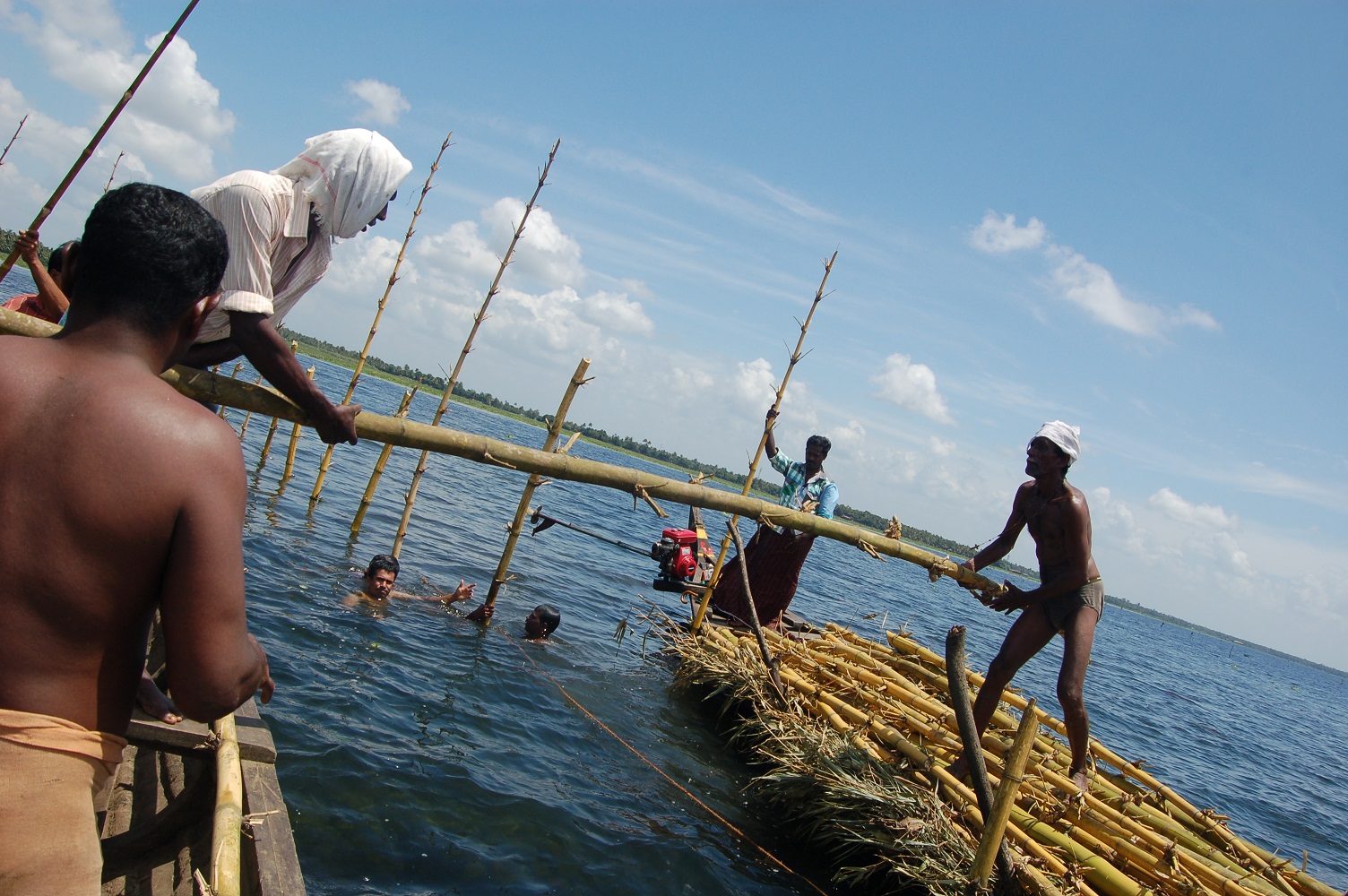
A fish sanctuary in the making on Lake Vembanad, Kerala, India. PHOTO: Scroll
We love the backwaters. Period. Every single time one of our Xandari Riverscapes houseboats puts out into these deep waters, our hearts swell with pride. Responsible showcasing the charm, the timelessness of these waters and its people brings us much joy. And when we come across conservation efforts to maintain the quintessence and soul of this stretch of paradise, we can’t help but let you know.
Spread over 36,000 hectares and three districts in Kerala, this is the kind of landscape that gives conservation ecologists a blinding headache – a resource-rich, highly-productive area that is pulled apart in several directions (waste-dumping, tourism, livelihoods, water security) and depended upon by conflicting communities who have no other alternatives. Lakes have been straddling this intersection all across India – from Chilika in Odisha, to the Bengaluru urban lakes, to Loktak in Manipur, to Vembanad.
Such heavy-use landscapes outside protected areas, however, also might hold answers to the future of conservation. Whether it is a large lake system, or forest fragments that serve as the refuge of a few species or a corridor for wild animals, or a forest fringe, or large agricultural swathes that also host biodiversity, a section of conservationists believes that the future lies in teamwork between nature and mankind.
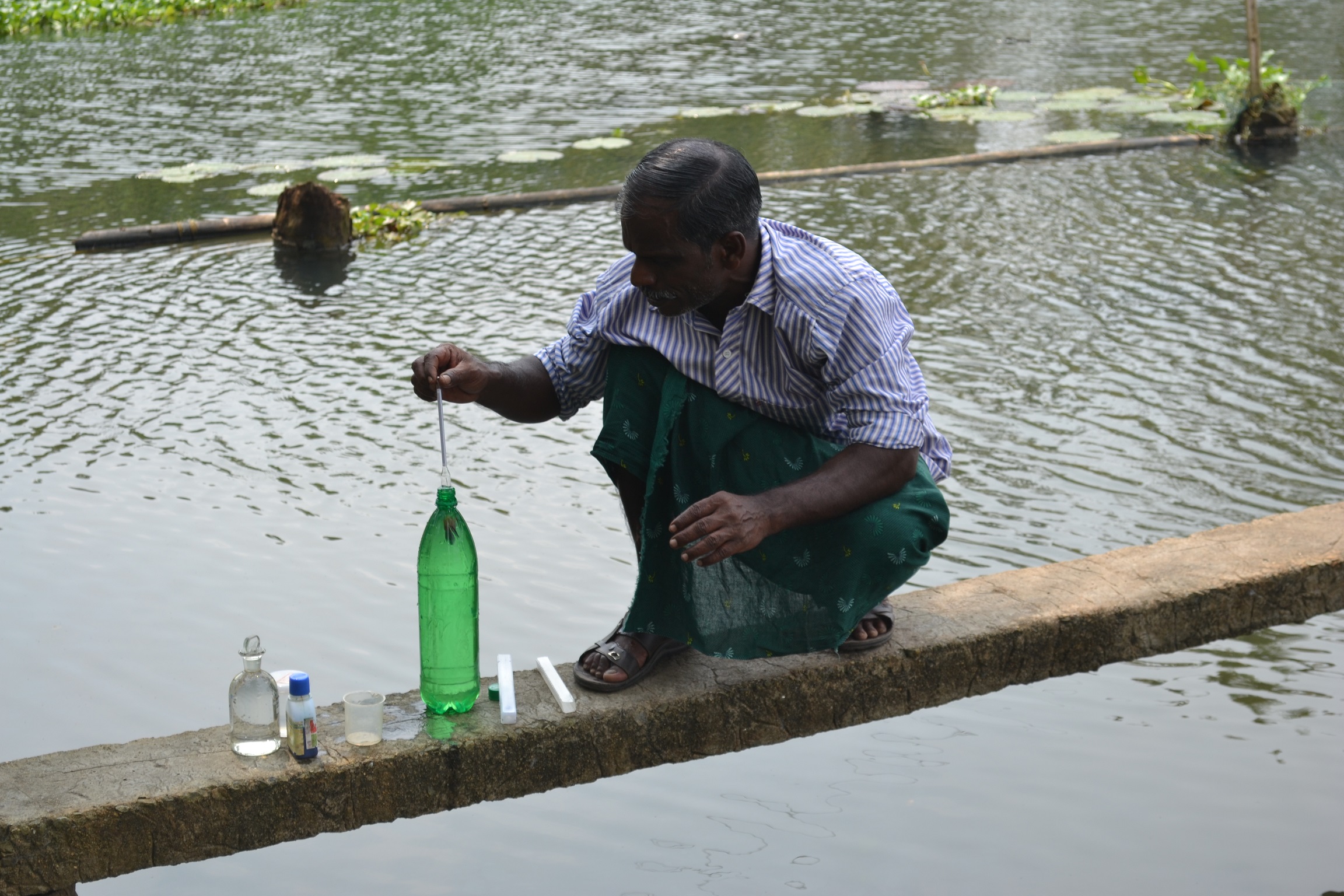
The little bottles tinkled against each other as Poovu, 59, secretary of Federation of Lake Protection Forums, walked to the canal to test the water’s pH level. He was demonstrating his water quality kit. Three years ago, Poovu learnt how to test the lake’s water for pH, salinity, total dissolved solids, dissolved oxygen – markers that informed him of the water quality, especially salinity.
Water quality monitoringIn the late 1970s, the lake was physically divided into two parts, north and south, to be controlled by the Thanneermukkom Barrage. The gates, when closed, separate the southern part (132 sq km), towards Alleppey, to reduce the salinity and help paddy cultivation that needs freshwater. But the reduced salinity adversely affects the catch of several species such as freshwater prawns, shrimps and clams, and reduces natural flushing of the lake. Pavithran blames the barrage for the change in ecology and catch. Between fish counts in the early 1970s and now, species diversity has fallen from 150 to 70.
Meghanathan KV, president of the black clam marketing society at Muhamma, panchayat member (Mannancherry) and block Congress committee president, says, “There was no problem before the barrage. The barrage is highly politicised as the paddy farmer group is more powerful and organised.” The timing of opening and closure of the gates is critical – it remains open in the monsoon to let the extra water from upstream rivers drain out into the sea and closed otherwise to prevent ingress of seawater (October to March). The timing is also the conflict – the farmers want it closed, the fishermen don’t.
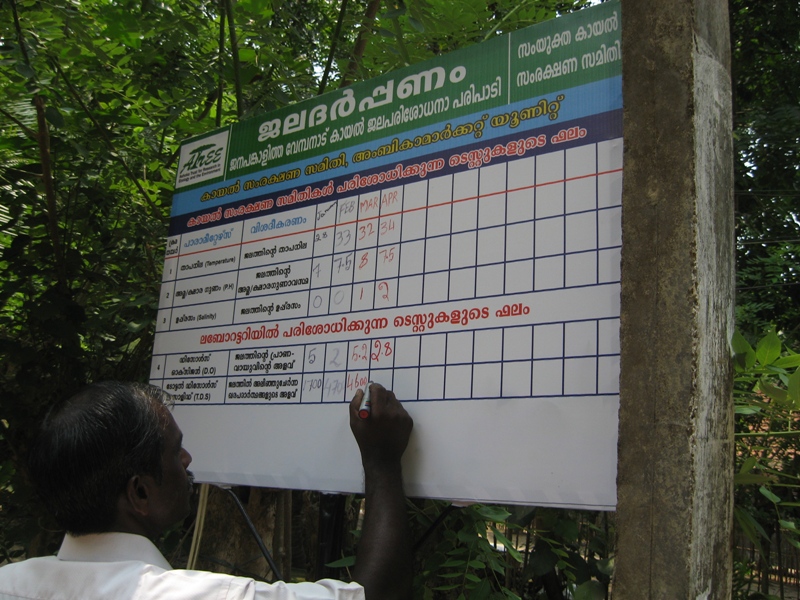
Some years ago, Atree, a Bengaluru-based conservation research institute, introduced the water quality programme, called Jaladarpanam, that is practiced by Poovu. It empowered the fisherfolk with data to fight for their right. Poovu and the Lake Protection Forums (Kayal Samrakshana Samithi) used this information of reduced salinity and increased pollution to send press releases to local papers and lobby the collector and the barrage committee, and succeeded. Meghanathan says it has at least made the barrage open on time and not as late as April.
Water quality monitoringSharing a lunch of Karimeen and sardines, Poovu, a quiet, reflective person, remembers how clear the lake is when the barrage opens, and how abundant the clam catch. “The testing gave a new ideology to people,” he says. “People should know how salinity affects them and they made awareness their resource. The water quality boards led to discussions. Even the collector was not aware of it.”
A sanctuary for fish
Another ideology changed within the fishing community in the 15 Lake Protection Forums of 250 members each. The falling catch, over-fishing, dredging, disappearance of mangroves, unethical practices made the exploiters turn into protectors. Atree in its work with the Forums did not want to impose solutions from outside, instead it wanted the community to find its own. They found one answer in fish sanctuaries.
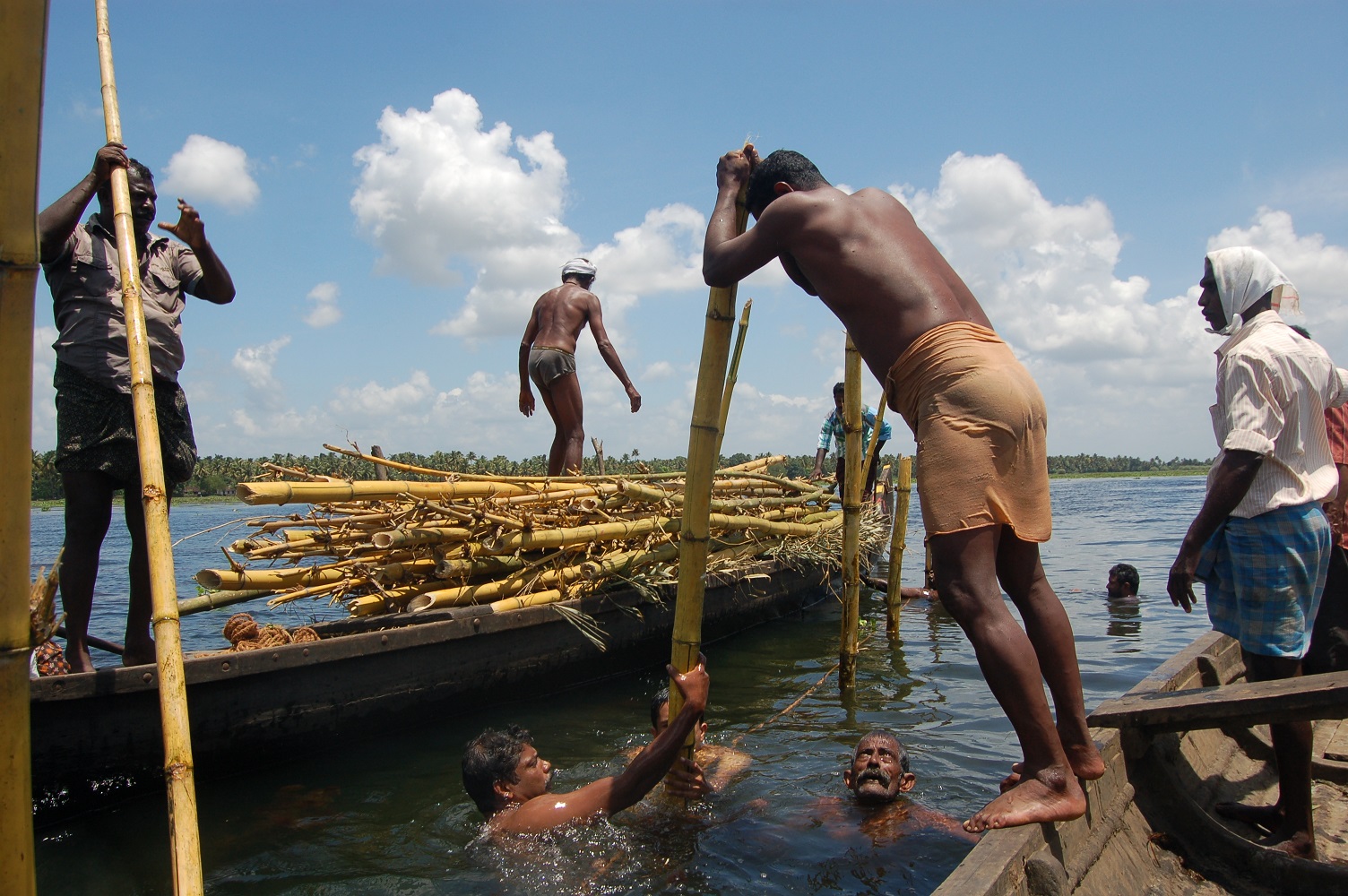
A fish sanctuaryRajapen, 51, has been fishing since he was 11. For those 40 years, he knew and practiced a method of fishing known as Paddal fishing or bush-bark fishing. It involves sinking bundles of foliage of mango and cashew, which over time create a plankton bloom, providing the right conditions for fish to feed, breed and hide their babies. Fishermen would then encircle these microhabitats and catch everything. Priyadarsanan Dharma Rajan, a senior fellow with Atree who spearheads the lake programme, says that it was an elderly fisherman who turned the idea on its head, transforming its function from hunting to harbouring. These paddals, if kept in a safe area, turn into fish harbours, called Matsyathavalam (fish shelter). These modified structures were placed on the lakebed and protected by bamboo fencing. These shelters are declared as non-fishing zones and Lake Protection Forum members take turns to keep vigil.
A fish sanctuaryRajapen rows out his boat and points at one. From the boat it just looks like a submerged bamboo Stonehenge but underneath the water, rich fish life writhes and grows. The boat bobs gently as a large white motorboat passes. Rajapen says these are the kind of boats he has to protect his fish babies from. The shelter now provides him and other fisherfolk from his village, Varanam, with sufficient catch. They use large mesh nets to trawl in the adult fish, and even giant prawns. Back on shore, the path is cobbled with clam shells; so ingrained that it feels like a mosaic underfoot. Rajapen stops and says, “What we are doing is pretty small. We realised that we needed to do this because our lives were getting affected. Bad fishing practices are still rampant but we fight against it.” The Lake Protection Forums have managed to reduce baby clam fishing, dredging and regulated fish net size. Poovu also published a book on ethical practices for the fisherfolk. Jojo TD, project coordinator with Atree, says that it matters who says it, “When someone like Poovu, also a fisherman, writes and tells them about it, they say, ‘It is our Poovu’s book’. The sense of pride comes from within. It is not an NGO coming with a brochure.”
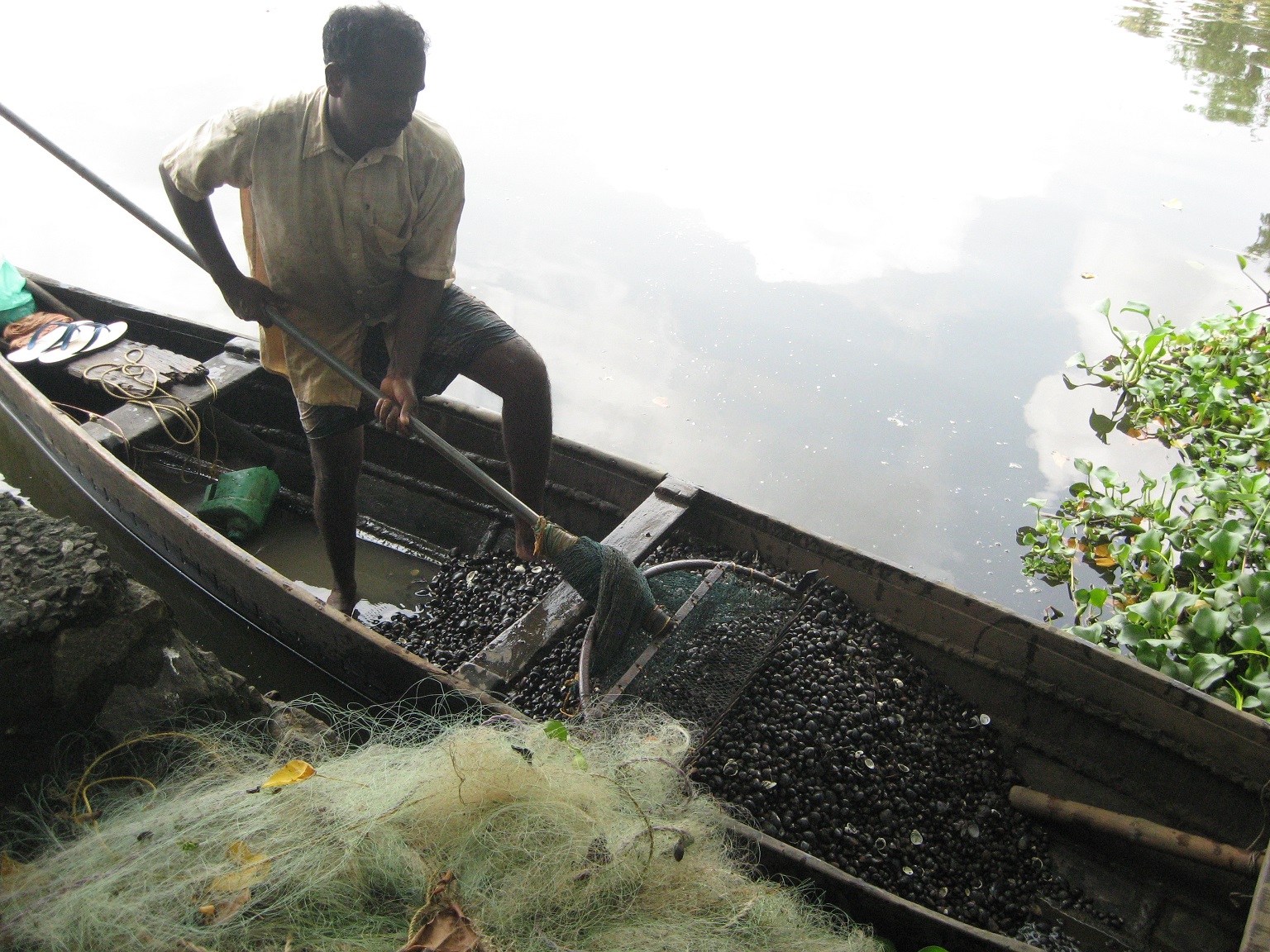
Clam processingThe dredging fight got much worse last year when groups came with mechanised dredgers to harvest clams in large numbers. Ecologically, clams play an important role in flushing the lake of impurities. Over-harvesting has an impact on water quality and the ecosystem. Dinesh, 45, a fisherman from village Kannankara, says that it started last year in June. “Mechanised dredging is illegal,” he says. “Water becomes acidic and fish die. Clams start bursting out of their shells. And they did it at night.” The Lake Protection Forums came out together to oppose the dredging, called the police, involved the local government and filed cases, which are still on. For now, the dredgers have left. Dinesh says neither political parties nor trade unions saw to their problems. “What’s the point if they don’t help? I think they can come back but we have to stick together to remain confident,” he says.
More conservation efforts and photographs here.
 Organikos
Unfortunately it is not only a problem of Kerala’s backwaters… salinity is only one of many problems characteristic of fresh water. There is the low pH due to the acidic rain without forgetting the unbreakable pH acido particles of plastic (oceans, seas, etc.)
If man does not begin seriously to consider with profound respect nature (flora and fauna)… we also talk of atmospheric warming, we self annihilate. And this is sad. :-)claudine
I love the backwaters, and hope fervently that the efforts of so many are successful.