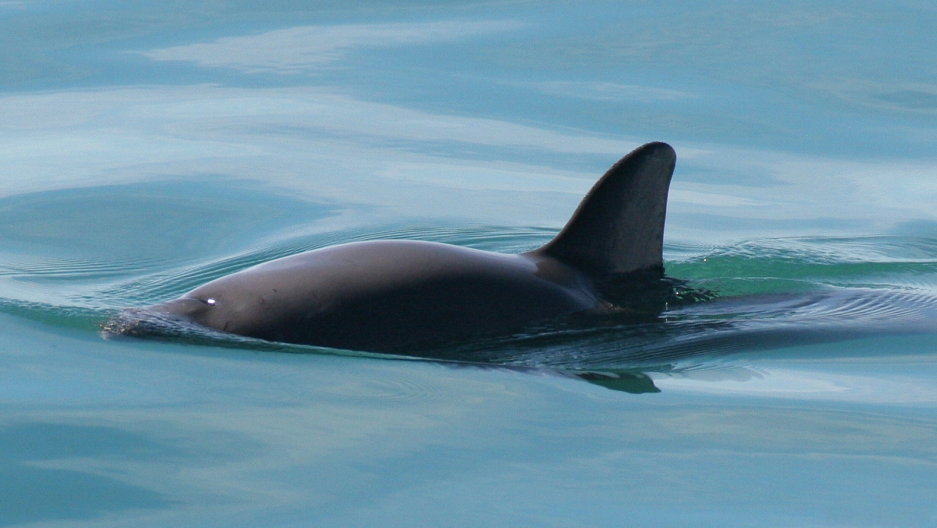
Vaquitas are considered the smallest and most endangered cetacean in the world. Credit: Paula Olson/Wiki Commons
The world’s most endangered marine mammal is a small porpoise called the vaquita — Spanish for little cow. The vaquita has been under threat for years, but now the poaching of a rare fish may be driving the tiny Mexican porpoise to extinction.Scientists estimate that fewer than 100 vaquita porpoise exist today, all of them in the upper Gulf of California. Vaquitas are small porpoises with big eyes and a permanent grin. None have ever survived in captivity. Poachers are killing the vaquita, but they are actually targeting another endangered fish, the totoaba.
The vaquita lives only in the Gulf of California off the coast of Mexico. For years, Mexican fishermen have accidentally caught the five-foot porpoise in gillnets set for fish and shrimp. “This has driven the population from a size of about 500, 20 years ago to less than 100 today,” says Duke University professor Andy Read.
But now the critically endangered vaquita faces another threat — fishing nets set illegally to catch a protected species called the totoaba. The totoaba is a large sea bass, or croaker, and its swim bladder can fetch up to $8,500 per kilo in Chinese medicine markets.
Mexican law protects the endangered croaker, but with so much money at stake poachers continue to fish for totoaba. Read says that’s a problem on two fronts. The totoaba population cannot withstand the current fishing rate, and the vaquita seems particularly vulnerable to entanglement in illegal totoaba nets. “So a fisherman that might catch four or five totoaba in his net, might also catch one of the last vaquitas as well,” he says. “We’re worried that that bycatch of vaquitas is going to drive them to extinction.”
Read more here.
 Organikos