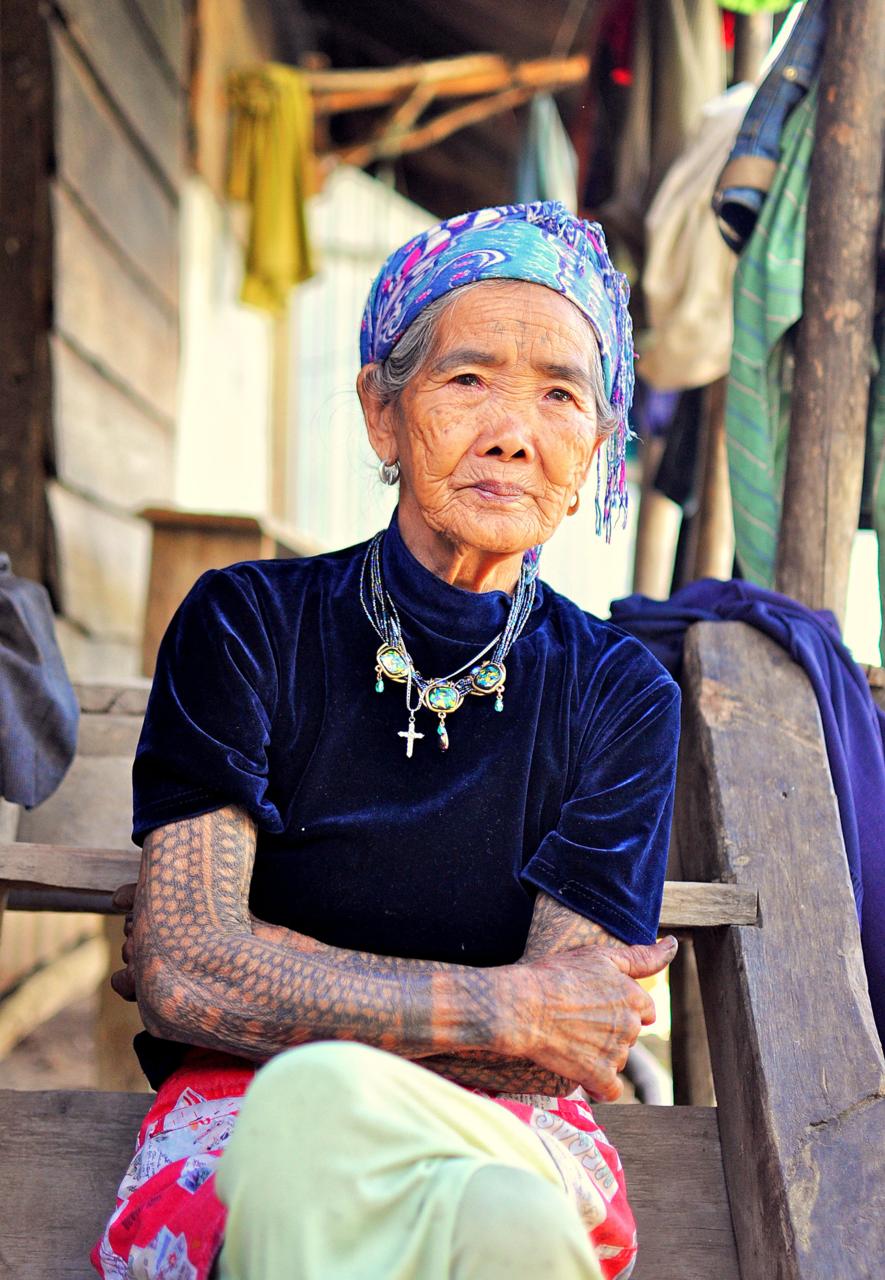
A dying Filipino tattoo tradition is being revived – and forever changed – by the international travellers seeking to get inked by its last tribal artist, 97-year old Apo Whang-Od. (Credit: Travel Trilogy)
Winging it on a cliche, we’ll say tattoos are forever. And in the far flung, rustic town of Kalinga, Apo Whang-Od prays it continues to be so. As the last tattoo artist in the Kalinga region, she carries forth the 1,000-year tradition of batok. And the pressure to see to it that she bequeaths the legacy to a worthy successor.
Every Kalinga village used to have a mambabatok (a master tattooist) to honour and usher in life’s milestones. When women would become eligible for marriage, they would adorn their bodies with tattoos to attract suitors. When headhunters prepared for battle, an inked centipede would be their talisman, or when they returned with a kill, an eagle would commemorate their victory. “Tattoos are one of our greatest treasures,” Whang-Od said. “Unlike material things, no one can take them away from us when we die.”
Mambabatoks can only teach within their bloodline, so without any children, Whang-Od would have been the last mambabatok in the Kalinga province. But a decade ago, she began training her great niece, Grace Palicas, to be her apprentice. At the tender age of 10, Palicas was put into intense training to learn the archive of ancient designs and the necessary coordination and finesse to tattoo at 100 taps per minute. Most importantly, Whang-Od explained: “For Grace to become a good mambabatok, she will need passion and patience.
“I want people to know that the traditional tattoo is not just a graphic – every design represents something,” said Whang-Od speaking to Erminger on my behalf. “I want people to have tattoos not just to be in fashion, but because the design you choose means something about you.”
Read the complete story on BBC Travel here.
 Organikos
I really wish that Apo Whang-Od would be recognized as one of Philippine’s National Artists to place prestige on the ancient art and culture which she was able to preserve and even perpetuate by training her great niece. She’d deserve the national recognition.