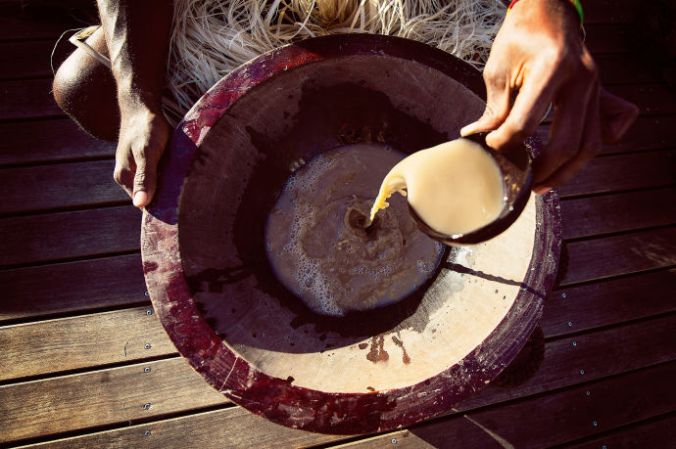
In an increasingly health-conscious New York, some would-be boozehounds are turning to kava, made from a South Pacific-originated plant, as a substitute for alcohol. PHOTOGRAPH BY KIRSTIN SCHOLTZ / WSL VIA GETTY
Never heard of it before, but now it is on our agenda:
“ALCOHOL IS SO 2014. TRY KAVA,” suggests a sandwich board on Tenth Street between First Avenue and Avenue A, in the East Village. Whether by design or not, this block has become a retro-futurist downtown cornucopia of health, wellness, and New Agey philosophy. It is home to, among other establishments, a lush and gaudy store that peddles healing crystals; the beloved Russian and Turkish baths; a store called the Molecule Project, which sells artisanal tap water squeezed of any impurity; and a place named Body Evolution, which boasts the “largest and most fully equipped GYROTONIC® studio in Manhattan.” And then there is Kavasutra, the block’s newest addition, specializing in drinks made from the root of a South Pacific-originated plant called kava. Designed like a real bar but booze-free, Kavasutra is a New York City experiment that asks its patrons to imagine the possibility of a cosmopolitan social life without alcohol.
This is an especially tall order. If you live in a city and are not a hermit, chances are your life necessitates a lot of drinking. Even if you are exceptionally self-disciplined and can limit yourself to one or two drinks, chances are you are still subjecting yourself to the risk of a hangover on a routine basis. Drinking is meant to be a ritualized opportunity to unwind, but it also produces the unintended stress of dealing with the side effects of booze. Unsurprisingly, alcohol has a profound and documented cumulative effect on work: a 2015 report from the C.D.C. estimated that drinking (and subsequent hangovers) created a drop in productivity that cost the U.S. economy ninety billion dollars in 2010.
In the midst of any socio-professional drinking session, you often find yourself completing some crude cost-benefit analysis: How many drinks can I consume tonight without functioning poorly tomorrow? How can I loosen up right now without sacrificing tomorrow’s daytime productivity? Kava bars—of which there are now two in New York City—exist, ostensibly, to hack this problem. Kava drinks, used for centuries in ceremonial contexts throughout the South Pacific, are created by grinding the root of the plant into a powder and mixing it with water. Kava is legal and unregulated, and can be ordered online in the form of pills, which makes it popular among curious thrill-seeking college kids and vape connoisseurs. Its advertised effects are about the same as a cocktail: kava is a sedative used to relieve anxiety and relax the muscles. But, unlike alcohol, kava allegedly doesn’t interfere with any cognitive abilities, and, if you hydrate properly, it won’t give you a hangover.
I visited Kavasutra on a recent Monday evening. The tiny, dimly lit bar, which can hold about twenty people, was packed despite the early hour. Patrons jockeyed for the attention of the lone bartender, who wore a T-shirt that said “RELAX.” A mix of reggae and contemporary pop played over the speakers, and a stomach-churning nature documentary (about insects) played on a giant TV behind the bar.
Read the whole post here.
 Organikos