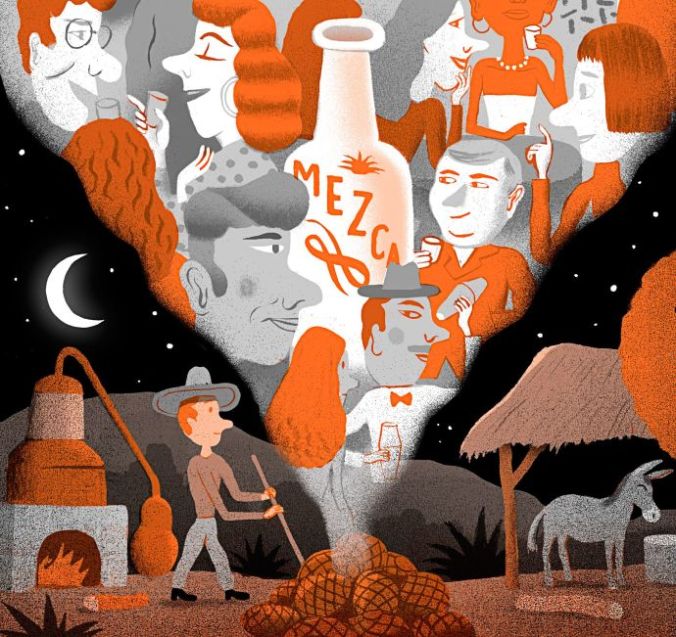
“Mezcal makes you cry, sing, dance, hug the neighbor you just met an hour ago.” ILLUSTRATION BY BJORN LIE
One more gem from the magazine issue that most recently also brought you this, and this:
Mezcal Sunrise
Searching for the ultimate artisanal distillate.
BY DANA GOODYEAR
Bricia Lopez is the mezcal queen of Los Angeles. Five years ago, Lopez, who is thirty-one and imposingly savvy, persuaded her father to let her build a mezcal bar at Guelaguetza, the restaurant that he opened when the family moved north from Oaxaca, a center of mezcal culture, in the mid-nineties. He didn’t know if Americans would like mezcal, or if Mexicans would admit that they did. But he decided to trust Bricia, and she focussed her offerings on premium mezcals—high proof, small lots, no worm. At that point, there were only a handful of brands on the market. Since then, mezcal imports have spiked, and labels have proliferated. Lopez now carries thirty. When I visited her at the bar the other day, she was in the midst of a renovation, doubling its size.
Some of Lopez’s earliest memories of life in Mexico involve the barbecue-sauce smell of cooked agave that pervaded her father’s tourist shop, where she and her brother sat on a cement floor, racing worms and tying little packets of sal de gusano to bottles of the family mezcal. Her job, at six, was to run out to the square and draw the tourists in. She is still an expert marketer: many influential L.A. bartenders thank Lopez for giving them their first taste of quality mezcal, in the form of a small bottle, sourced from Oaxaca by her dad and sealed by her with wax that she bought at Staples. Her identity is so deeply intertwined with the spirit that people call her Goddess Mayahuel, the Aztec deity of agave, whose children are sometimes figured as four hundred drunken rabbits. She prefers to keep her references bicultural. Around her neck, she wears a gold necklace that says “Mezcalifornian,” in gangster script.
Mezcal is a distilled spirit, and can be made from some thirty varieties of agave, or maguey. It is typically produced by farmers using a laborious and antiquated method, at primitive distilleries known as palenques, and sold or shared in villages to mark births, funerals, and everything in between. Contrary to popular belief, it does not induce hallucinations. Originally, “mezcal” was a generic term, like “wine,” for a spirit produced all over Mexico. Tequila, a two-billion-dollar global business, is just a style of mezcal; developed in the state of Jalisco, it is made from a single variety, the blue agave, using a largely industrialized process, and consumed on spring break in the form of slammers. Often mixed with other alcohols and enhanced with caramel coloring, tequila can also pick up flavors from the wood in which it is aged—sometimes spent whiskey barrels bought from the United States.
Traditionally, the agaves used for mezcal are roasted in an underground pit, wild-fermented in open vats, and distilled to proof, yielding a punchy, petroly, funky spirit that is thought to be a uniquely eloquent expression of terroir. Regulations allow the proof to fall between 72 and 110—but hard-liners hold that anything lower than 90 isn’t “real” mezcal. There is scarcely a serious cocktail menu in a major American city that does not feature a mezcal drink—at least three have been named for Lopez—and more and more restaurants offer lists of obscure varietals, at twenty to thirty dollars for a two-ounce pour, as if they were wines from the Loire. Lopez’s father, like many of his compatriots, is stunned by the turn in mezcal’s fortune. In his time, producers emulated tequila and did what they could to compete with it, adding a worm for flavor and to distinguish their bottle on the shelf. Now tequila companies are looking for mezcal and emphasizing the simplicity and rusticity of their product whenever possible. “We tried to sophisticate mezcal, but it turned out that people like traditional things the most,” he told me.
The mezcal boom coincides with the popularity of farm-to-table food, the rise of the craft cocktail, and the advent of the bartender as an advocate for environmental and social justice. Lopez told me, “Mezcal hits every magic word—artisanal, organic, gluten-free, vegan. It comes from a small village, and you have to drive there to get it. It’s made by a family. It automatically became cool when knowing what you eat became cool. Tequila got to the point where it’s like Tyson chicken—that’s Cuervo. Now I want to know my chicken’s name. That’s mezcal.”
Mezcal’s ascent is both a victory for those who love it and a cause for concern. The grains for whiskey are planted and harvested each year; grapes are perennials. But most agaves—succulents, kin to asparagus—resist domestication. Espadín, one of the easiest to grow, takes up to a decade to mature, and each piña—the usable core, stripped of its spiky blades—yields only about ten bottles of mezcal. Prized wild varieties can take longer and yield less. Tobalá, a tiny, feisty plant that grows under oaks on high-altitude slopes and secretes an enzyme that breaks down granite, needs as many as fifteen years, and gives up about two bottles of mezcal per piña. Tepeztateripens over a quarter century. The desire to consume a botanical time capsule is fraught; every precious sip both supports a traditional craft and hastens its extinction. “I truly believe mezcal will be big everywhere, because it’s delicious,” Josh Goldman, a Los Angeles bar consultant, told me. “Though there may be a subconscious thing going on—see it or eat it before it’s gone.”…
Read the whole article here.

