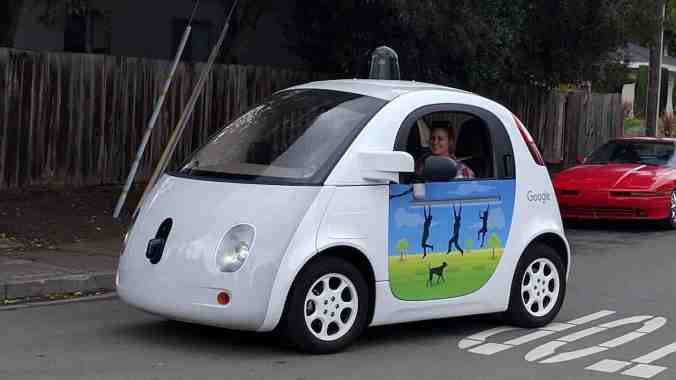
A Google self-driving car. Photo © Grendelkhan / Wikimedia through a Creative Commons license
From Cool Green Science:
Why Driverless Cars May Make Cities Sprawl Even More
But from my research into urban planning and sustainability, I have become convinced there is a potential downside to the driverless car. What if driverless cars, far from being a technology that reduces the dependence of our society on cars, actually increases it? Environmentalists have been pushing for the last few decades for a vision of walkable, denser, hip cities. This is good for the planet (less greenhouse gas emissions, less sprawl) and good for us (more walking and biking leads to less obesity). What if the driverless car takes us away from the vision, toward more sprawl?
Urban historians have learned that over centuries, the amount of time spent traveling by people in cities has been relatively constant. In a medieval city, people walked everywhere, and so most people’s daily routine took them at most only about 3-4 kilometers from their home, perhaps an hour walk.
The increase in horse-drawn carriages over the 18th and 19th centuries made longer distance travel possible, while the rise of street cars in the 19th and early 20th centuries led to new neighborhoods at a lower density that were farther from the urban core. This, of course, was followed by the era of mass car ownership; highways dramatically increased the distances we can travel. Over all those technological changes, though, the amount of time we spent commuting didn’t change much. For most people, a commute of more than an hour one way starts to feel onerous.
Cities develop in a pattern and at a density that is a result of this fundamental tradeoff. Life in the center city is often expensive, loud, and dirty, and the suburbs or edges of a city may seem cheaper (at least in terms of the cost per square meter of housing) and greener.
In the U.S., there are other advantages to the suburbs; the schools are often better and the municipal governments are sometimes more functional. But people’s time is finite, so living far out from the city has its limits. Based on their preferences, people choose some point along this tradeoff from center city to suburb, and the aggregate preferences of lots of people determine how dense or sprawled out our cities are.
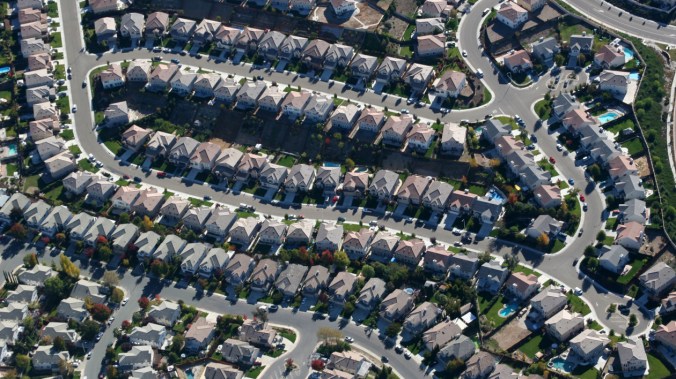
Antioch from above. Photo © Shawn Clover / Flickr through a Creative Commons license
Driverless cars, if they were truly autonomous, would begin to alter this equation. The time in the car could be spent for something pleasurable like reading a good book (indeed, that is one of the things I love about commuting by metro in Washington, DC). Or for workers whose white collar job involves sending emails or calling in to phone meetings or editing documents on a computer, the time in the car could become part of their work day.
The Internet hasn’t stopped these workers from needing to meet face to face, occasionally. There is a lot of evidence that the Internet didn’t let people entirely leave urban areas, since they need to be close enough to make it into the office sometimes. But how many more white-collar workers will be willing to accept a longer commute once they realize that time in the car can be productive time, rather than a soul-sucking commute?
Driverless cars may free a fraction of workers to live farther out, where land is cheaper. They’d be willing to “drive” more miles on average. Seen in its historical perspective, the Google car is not a revolutionary technological change, but part of a century-long shift toward people travelling on average more kilometers a day.
A lot has been written about millennials and their desire to live in cities, to reject the rather staid life in a car-centric suburb for a more active, walkable life in an urban center. Indeed, my family in a way is at the front end of that wave — we have chosen to live in Washington, DC, within walking distance to a subway, rather than farther out in the suburbs.
But there are still tradeoffs — we live in a small apartment rather than a stand-alone house, and while the schools are improving in DC they are still not as good as the richer suburbs. Even a change in average preferences of a generation, like millennials, doesn’t erase this fundamental tradeoff of city life…
Read the whole article here.
 Organikos