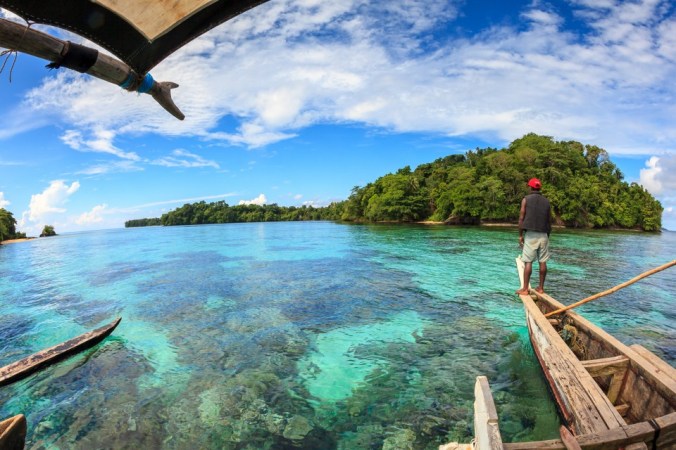
Tane Sinclair-Taylor
Thanks, as always, to Mr. Yong and his team at Atlantic Monthly:
Why Some Coral Reefs Are Thriving
Not all of the world’s reefs are in bad shape—and a few of the healthiest are managed by humans.
by Ed Yong
In 1990, Jerry Sternin from the global charity Save the Children traveled to Vietnam to fight malnutrition. His strategy was simple. He looked for ‘bright spots’—mothers whose children were bigger and healthier than average, even though they were just as poor and disadvantaged as their neighbors. And he asked: what were they doing differently?Sternin found that these mothers, rather than feeding their children twice a day, divided the same amount of food into four smaller portions. They also supplemented that food with ingredients that were traditionally ignored, like shrimp, crabs, and sweet potato greens. When Sternin encouraged an entire village to do the same, he cut childhood malnutrition by 65 percent. His program would eventually expand to 2.2 million Vietnamese people across 265 villages.
When Joshua Cinner first heard this story in 2012, he immediately thought of applying the same approach to coral reefs. The planet’s reefs, home to a quarter of its marine species, are in bad shape. Beset by rising temperatures, acidifying waters, hurricanes, disease, and more, their growth rates have plummeted by 40 percent since the 1970s, and lush underwater wonderlands have turned into spectral bleached barrens. Just this year, the iconic Great Barrier Reef has witnessed the worst bleaching event in recorded history.
Amid the gloom and tears, Cinner and his colleagues went searching for bright spots. Mimicking Sternin, they looked for reefs that house more fish than expected, relative to other reefs facing comparable pressures. And their surprising results are upending traditional assumptions about what makes a healthy reef.
Contrary to what you might think, the bright spots weren’t all remote reefs, where humans were absent or fishing was banned. Instead, most were home to lots of people, who rely heavily on the corals and who frequently fished. They weren’t leaving the corals and fish alone; instead, they had developed social norms and institutions that allowed them to manage the reefs responsibly.
“Reefs are hugely threatened. I saw my own field site melt down and completely die,” says Julia Baum from the University of Victoria. “The danger is that we lose hope, or we feel like there’s nothing to be done. That’s why this study is so important. It shows that the end state of people relying on and using coral reefs doesn’t have to be reef degradation.”
“It’s really nice when you can shine a powerful analytical light on what’s going well,” says Nancy Knowlton, a self-described ocean optimist based at the Smithsonian Institution. “We want to start talking about things that are going well in conservation.”
Cinner, a social scientist by training, began by asking his marine biologist colleagues for their data. “I asked 30 reef scientists to give me their life’s work, and if you’ve ever met a scientist, you know that can be like pulling teeth,” he says. “But my dad’s a dentist, so I’m okay with that.”
He ended up with data on 2,514 reefs from 46 nations. His team then created a mathematical model that predicts how many fish a site should have given 18 factors, including water depth, population size and growth, tourism, fishing, whether the reefs were protected, and more. Finally, they identified 15 bright spots and 35 dark spots, which departed substantially from those predictions. These were not the reefs in best or worst condition, but the ones that most defy expectations…
Read the whole article here.
 Organikos
I love this idea of using ‘bright spots’ as inspiration, instead of focusing on the problems and reinventing the wheel to try and turn things around. For sure, somewhere, the solution is already happening. Inspiring – I’m gonna go read the full article…thanks for sharing 🙂 Harula x
Yes – we all need this type of inspiration! Thanks for commenting Harula.