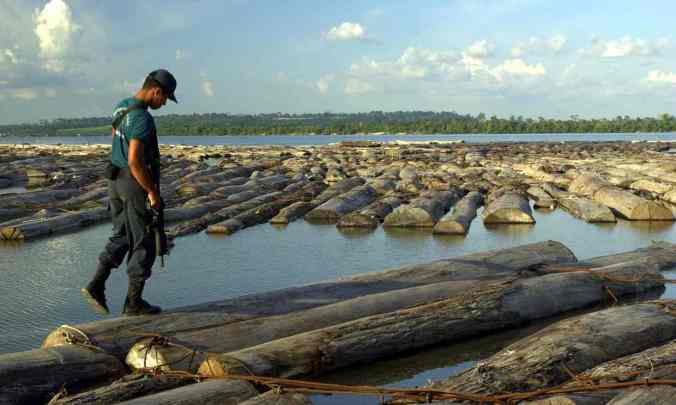
An armed officer inspects a seizure of thousands of illegal mahogany logs in Brazil. Photograph: Dado Galdieri/AP
Thanks to the Guardian for this reminder that we consumers need to do our caveat emptor duties when buying wood products:
Deforestation is rife in the Amazon, Colombia and the Philippines, say environmental groups
British shoppers could be unknowingly buying wooden furniture, flooring and even food items that are byproducts of destructive illegal logging in the Amazon, environmental campaigners are warning.
Friends of the Earth is calling on ministers to make companies reveal the source of their products in order to stop the black market trade. Last week human rights watchdog Global Witness revealed that 185 environmental activists were killed in 2015, many of whom had been trying to stop illegal logging in the Amazon. An estimated 80% of Brazilian hardwood is illegally logged.
Vast areas of forest in Brazil, the Philippines and Colombia are cut down by criminal gangs. Multinational companies then use the land for palm-oil production, mining or cattle-grazing, while the wood is sold off, according to Patrick Alley, co-founder of Global Witness.
Local activists – often villagers or indigenous people – are at the forefront of campaigns against these activities, but they are attacked and harassed by security forces and the gangs, Alley said. The worst-hit country was Brazil where 50 activists were killed last year, mostly in Amazonia; 33 died in the Philippines and 26 in Colombia.
Friends of the Earth campaigner Alison Dilworth said companies and governments often did not acknowledge that local communities had any rights to their land.
“The outrages committed against environmental activists in many parts of the world shows how threatened the environment is from large-scale deforestation and illegal logging,” she said. “It’s time governments pressed for more supply-chain transparency so we can identify which companies and what products on supermarket shelves are directly implicated with deforestation and human rights abuses.”
Yet it is very difficult for consumers to establish whether or not a product contains palm oil from looking at the packaging.
“What’s lacking here is due diligence by companies on their supply chains,” Alley said. “It’s too easy for companies not to ask questions about the land they are using. They should include due diligence on what happens to local people in the area where they operate.”
Richard George, Head of Forests for Greenpeace UK, said it remained almost impossible for consumers to tell whether hardwood had been obtained legitimately.
“There has been a strong link between commodities like palm oil and tropical timber, land-grabbing and the murder of environmental activists,” he said…
Read the whole article here.
 Organikos