Credit Ping Zhu
A writer who captures the nuanced relationship between conservation of nature and culture has our attention:
The Lost Cultures of Whales
By
Aboard the Balaena, Caribbean — I am alone on deck, my headphones filled with the sounds of the deep ocean. I have been tracking the sperm whales since 4 a.m. Now the island of Dominica imposes its dark shape in front of the rising sun.
“We have whales!” I shout down to Hal Whitehead, who founded the Dominica Sperm Whale Project with me a decade ago. He puts the kettle on and asks who it is as he comes on deck.
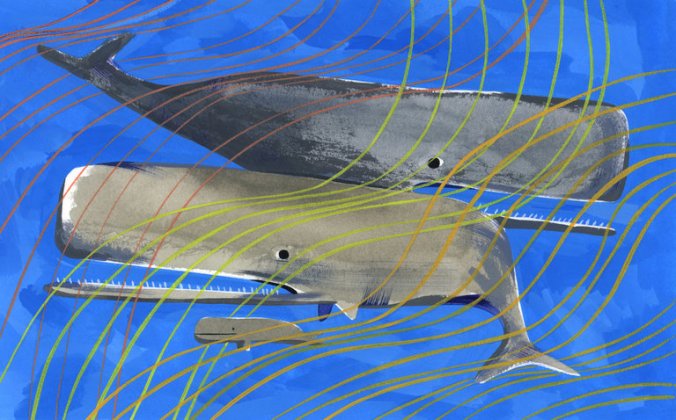
I tell him it’s Pinchy and her calf, Tweak. Tweak is making small suckling dives alongside his mother. Then Pinchy dives, and we move the boat into the calm spot she left behind — the “flukeprint.” We are collecting the whales’ skin and fecal samples and recording the sounds they make on a hydrophone, an underwater microphone. Soon after Pinchy dives, we hear the clicks of her codas — whale social calls; she is talking with Tweak. Then the echolocation starts as she hunts for squid. Tweak slides below the surface in search of his babysitter, Fingers, who is Pinchy’s aunt. Hal and I have breakfast, then wake the crew.
The whale families we work with, members of the Eastern Caribbean Clan, are shrinking. Their population is declining by as much as 4 percent a year, as we reported last week in the journal PLOS One, largely a result of climate change and the increasing human presence in these waters. (Whales can be hit by ships or become entangled in fishing gear.) We are not just losing specific whales that we have come to know as individuals; we are losing a way of life, a culture — the accumulated wisdom of generations on how to survive in the deep waters of the Caribbean Sea. They may have lived here for longer than we have walked upright.
Sperm whales live rich and complex lives in a part of the world we find difficult to even explore. And many aspects of their lives appear remarkably similar to our own. Grandmothers, mothers and daughters babysit, defend and raise calves together. Family is critical to surviving in the open ocean, and each has its own way of doing things. The whales live in communities of neighboring families in a multicultural oceanic society.
Behavior is what you do, culture is how you do it. All sperm whales do the same things — feed, swim, babysit, defend, socialize — but how they do them is different around the world. Just as humans use forks or chopsticks, they, too, differ in how they eat, what species of squid they eat, how fast they travel and where they roam, their social behavior, and probably many other ways we still do not understand.
They seem to mark these cultural differences with different dialects — or distinct sets of codas. Families that share the same dialect we call a clan. The whale families in the Eastern Caribbean Clan use 22 different coda patterns. When two sperm whale families meet at sea, they need a way to recognize one another; those from a similar culture are more likely to cooperate. It turns out that sperm whale families in the same clan will spend time together, while families that speak different dialects, from different clans, will never interact.
Whales’ codas appear to broadcast their identities. One coda pattern distinguishes individuals, a set of others identifies their families, and a special one marks the cultural clan. The 1+1+3 coda (click pause click pause click click click) is unique to the Eastern Caribbean, is made by all the whales in the Eastern Caribbean Clan, and has remained identical for at least 30 years. Calves spend at least two years learning to make it correctly. And they learn to produce it with great fidelity, which most likely ensures that their clan membership is recognizable over their large geographic ranges and across the diversity of other whales they encounter.
The whales in the Caribbean are distinct, and they appear to identify themselves as distinct. Unfortunately, as a result of a changing climate and human impacts, these urban whales, who live in nearshore waters, are at risk. One in three baby whales born off Dominica will not survive to its first birthday. Tweak’s cousin, Digit, had just begun hunting on her own when she got rope from a fishing net tangled around her tail; now she can no longer dive as well, and is struggling to survive.
Losing a large number of individuals is a tragedy, but what happens when we lose an entire whale culture? What do we lose when we lose a way of life?…
 Organikos