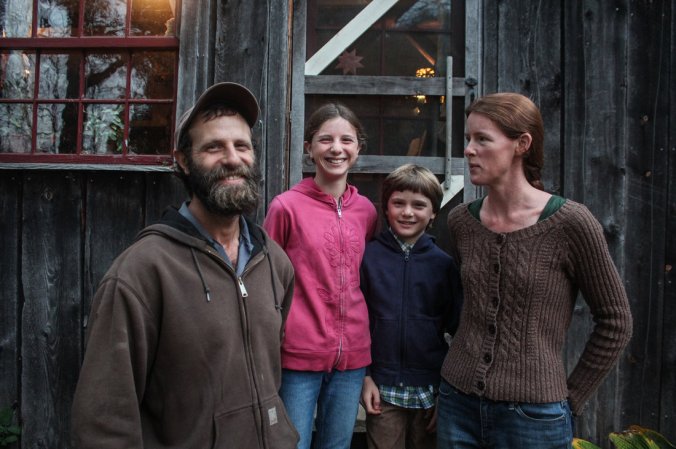
Her wish came true in a way she hadn’t expected. She and David Fisher fell in love and got married. They now have two school-age children: Leora and Gabriel.
It’s a harvest day on the farm and David and Anna have some help. They’re joined by Emmet Van Driesche, who lives nearby on his own farm, and two apprentices, Kyle Farr and Calixta Killander, who are living and working on the farm for a year. Together, they’ll need to fill a wagon with spinach, beets, broccoli and a host of other vegetables and herbs.
About two hundred customers have bought shares in the farm’s harvest. Among them is Maggie Potter. She arrives with her children to pick up her produce. “It’s not only having the vegetables – the nourishment for our own bodies. It’s creating community, making friends along the way,” she says.
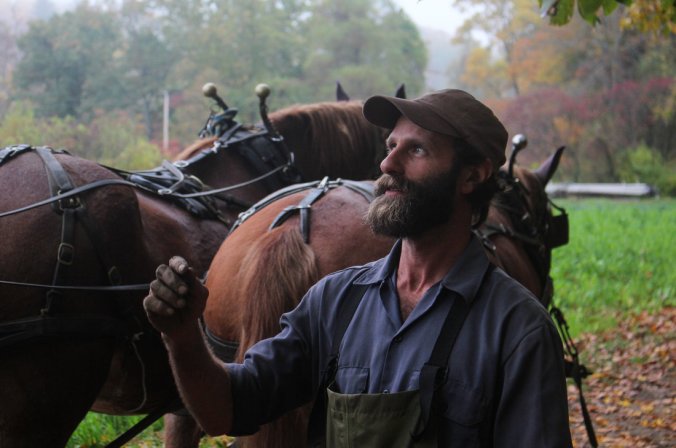
If this all sounds like a vision of peace and contentment, take a closer look. Watch David Fisher at work. While the apprentices stick together in the fields, chatting as they work, Fisher works by himself, cutting greens off just above the soil, hacking out heads of broccoli. He moves quickly, with purpose in every step, almost never stopping, from daybreak until dusk. And when you talk with him, it becomes even clearer: He’s a very driven man. He’s driven, in fact, by a kind of desperation. And to understand it, you need to know his life story.
David Fisher grew up in the suburbs north of New York City, in the village of Pleasantville, in Westchester County. He spent summers at a rustic camp in the Adirondacks. “You could only get there by boat, you couldn’t drive there,” Fisher says. “No electricity, bathe in the lake, live all summer in a tent.”
Then, at the end of every summer, he’d get on a train back to Grand Central Station and it would hit him. “Noise, steel and concrete and lights everywhere,” he recalls. It was an overwhelming sensory experience, and for young David, it wasn’t a pleasant one.
When he was 15, that end-of-summer paradigm shift was more than he could take. He was overtaken by despair over the environmental fate of the earth. “I was like – this is craziness. The whole thing. Civilization as I’m seeing it is absurd. The way that humans are living on, consuming, destroying the earth is absurd,” he says. “The only thing I could see to do was pack up and flee.”
He determined to drop out of high school; his parents forced him to get a diploma, graduating early. Then, Fisher got as far as he possibly could from houses and highways and smokestacks. He hung out in the west, skiing and backpacking, immersing himself in nature to “soothe his soul,” as he puts it. He loved it, but he still knew, in the back of his mind, that it was just an escape. It wasn’t an enduring path out of his despair about the world.
One day, when Fisher was 20 years old, he was back on the East Coast, visiting a friend at Hampshire College, here in western Massachusetts, and he wandered into the college’s small organic farm. It was another overwhelming sensory experience, but the opposite of Grand Central Station: “Autumn leaves raining down, and the lush fields of vegetables and cover crops. Open the barn door, and the tables are lined with this abundance of earthy, healthy, vital produce. And I was like, ‘Wow!'”
He felt like he was seeing, for the first time, a way to live immersed in the natural world, and also be productive. To make a living…
 Organikos