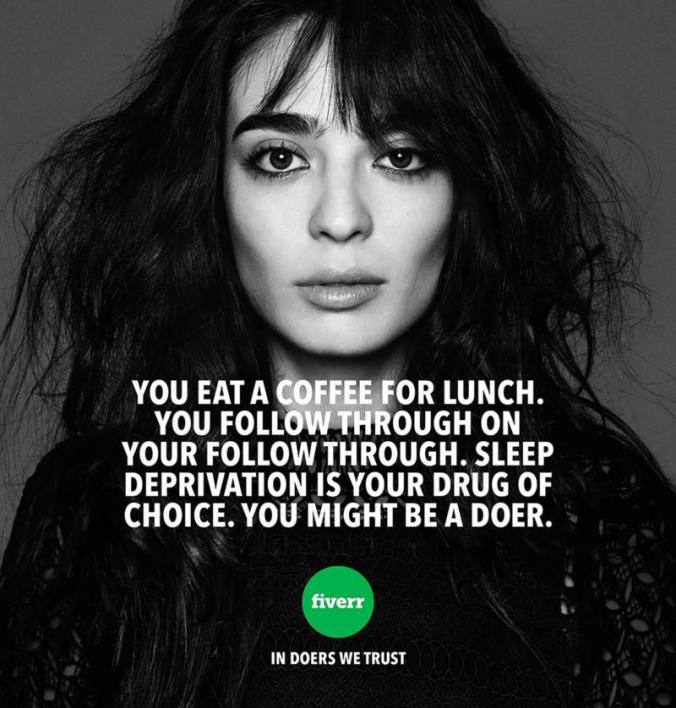
Fiverr, an online freelance marketplace that promotes itself as being for “the lean entrepreneur,” recently attracted ire for an ad campaign called “In Doers We Trust.” COURTESY FIVERR
We know from experience in the realm of sustainability, which has had its soup du jour moments in the last two decades, that whether you are leading or following, a fad or a trend can be a slippery slope. It can lead to innocuous inattention to unintended consequences, or worse. Various new forms of technology, which we tend to celebrate in recent years for their disruptive service to the economy and society through innovation and blah blah blah…Don’t just do it. That might be the counter-message as we explore the gig economy’s downside, as this post by Jia Tolentino points out:
Last September, a very twenty-first-century type of story appeared on the company blog of the ride-sharing app Lyft. “Long-time Lyft driver and mentor, Mary, was nine months pregnant when she picked up a passenger the night of July 21st,” the post began. “About a week away from her due date, Mary decided to drive for a few hours after a day of mentoring.” You can guess what happened next.
Mary, who was driving in Chicago, picked up a few riders, and then started having contractions. “Since she was still a week away from her due date,” wrote Lyft, “she assumed they were simply a false alarm and continued driving.” As the contractions continued, Mary decided to drive to the hospital. “Since she didn’t believe she was going into labor yet,” Lyft went on, “she stayed in driver mode, and sure enough—ping!— she received a ride request en route to the hospital.”
“Luckily,” as Lyft put it, the passenger requested a short trip. After completing it, Mary went to the hospital, where she was informed that she was in labor. She gave birth to a daughter, whose picture appears in the post. (She’s wearing a “Little Miss Lyft” onesie.) The post concludes with a call for similar stories: “Do you have an exciting Lyft story you’d love to share? Tweet us your story at @lyft_CHI!”
Mary’s story looks different to different people. Within the ghoulishly cheerful Lyft public-relations machinery, Mary is an exemplar of hard work and dedication—the latter being, perhaps, hard to come by in a company that refuses to classify its drivers as employees. Mary’s entrepreneurial spirit—taking ride requests while she was in labor!—is an “exciting” example of how seamless and flexible app-based employment can be. Look at that hustle! You can make a quick buck with Lyft anytime, even when your cervix is dilating.
Lyft does not provide its drivers paid maternity leave or health insurance. (It offers to connect drivers with an insurance broker, and helpfully notes that “the Affordable Care Act offers many choices to make sure you’re covered.”) A third-party platform called SherpaShare, which some drivers use to track their earnings, found, in 2015, that Lyft drivers in Chicago net about eleven dollars per trip. Perhaps, as Lyft suggests, Mary kept accepting riders while experiencing contractions because “she was still a week away from her due date,” or “she didn’t believe she was going into labor yet.” Or maybe Mary kept accepting riders because the gig economy has further normalized the circumstances in which earning an extra eleven dollars can feel more important than seeking out the urgent medical care that these quasi-employers do not sponsor. In the other version of Mary’s story, she’s an unprotected worker in precarious circumstances. “I can’t pretend to know Mary’s economic situation,” wrote Bryan Menegus at Gizmodo, when the story first appeared. “Maybe she’s an heiress who happens to love the freedom of chauffeuring strangers from place to place on her own schedule. But that Lyft, for some reason, thought that this would reflect kindly on them is perhaps the most horrifying part.”
It does require a fairly dystopian strain of doublethink for a company to celebrate how hard and how constantly its employees must work to make a living, given that these companies are themselves setting the terms. And yet this type of faux-inspirational tale has been appearing more lately, both in corporate advertising and in the news. Fiverr, an online freelance marketplace that promotes itself as being for “the lean entrepreneur”—as its name suggests, services advertised on Fiverr can be purchased for as low as five dollars—recently attracted ire for an ad campaign called “In Doers We Trust.” One ad, prominently displayed on some New York City subway cars, features a woman staring at the camera with a look of blank determination. “You eat a coffee for lunch,” the ad proclaims. “You follow through on your follow through. Sleep deprivation is your drug of choice. You might be a doer.”
Fiverr, which had raised a hundred and ten million dollars in venture capital by November, 2015, has more about the “In Doers We Trust” campaign on its Web site. In one video, a peppy female voice-over urges “doers” to “always be available,” to think about beating “the trust-fund kids,” and to pitch themselves to everyone they see, including their dentist. A Fiverr press release about “In Doers We Trust” states, “The campaign positions Fiverr to seize today’s emerging zeitgeist of entrepreneurial flexibility, rapid experimentation, and doing more with less. It pushes against bureaucratic overthinking, analysis-paralysis, and excessive whiteboarding.” This is the jargon through which the essentially cannibalistic nature of the gig economy is dressed up as an aesthetic. No one wants to eat coffee for lunch or go on a bender of sleep deprivation—or answer a call from a client while having sex, as recommended in the video. It’s a stretch to feel cheerful at all about the Fiverr marketplace, perusing the thousands of listings of people who will record any song, make any happy-birthday video, or design any book cover for five dollars. I’d guess that plenty of the people who advertise services on Fiverr would accept some “whiteboarding” in exchange for employer-sponsored health insurance…
Read the whole post here.
 Organikos