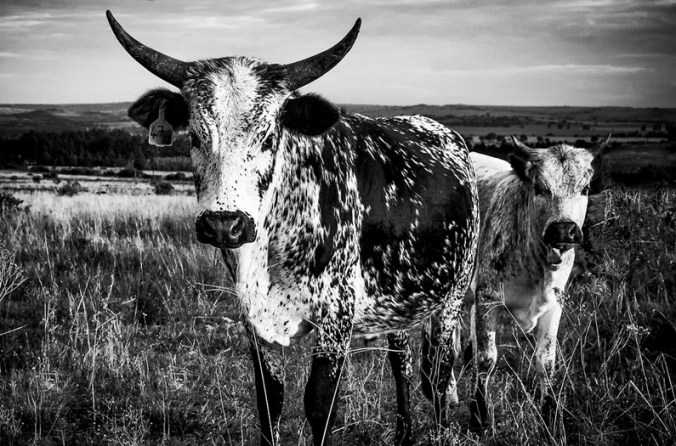
South Africa’s indigenous Nguni cattle via Flickr
Thanks to Emma Bryce at Anthropocene for this summary on how preserving climate-resilient cattle breeds can boost Africa’s food security:
Indigenous African breeds have a huge genetic diversity that has made them more resilient to regional threats like parasites and disease, and intense heat.
But, due to the spread of commercially-bred cattle and interbreeding, these valuable indigenous breeds are now slowly dying out, warns an international group of researchers, writing in the journal Genome Biology. In a race against that approaching fate, these academics—from the University Nottingham in the United Kingdom, the International Livestock Research Institute in Ethiopia, and Seoul National University in South Korea—are working to identify the precise traits that make African breeds so capable, so they can be preserved in future breeding efforts. Their study provides the first detailed analysis of the genomes of African cattle.
“African cattle populations have been subjected to strong environmental pressures including hot, dry, or humid tropical climate conditions and heavy and diverse disease challenges. Accordingly, they are expected to display unique adaptive traits,” the researchers hypothesize in their paper. To find out what those are, they took blood samples from 48 individual animals, representing five indigenous cattle breeds from across the continent. These were the N’Dama cattle from West Africa, Central African Ankole cattle, and Boran, Kenana and Ogaden zebu breeds, all from East Africa. Then they compared these indigenous genomes to 53 commercial breeds to figure out what makes the indigenous populations unique…
…Their research on the African continent is also part of a larger global initiative called the ‘10,000 Livestock Genome Project’, which seeks to build a genetic catalogue of all 10,000 domestic livestock species on earth before their unique traits are lost. As the United Nation’s Food and Agricultural Organisation puts it, protecting this genetic diversity in livestock “can help feed a hotter, harsher world.”
Source: Kim et. al. ” The genome landscape of indigenous African cattle.” Genome Biology. 2017.
Read the whole summary here.
 Organikos