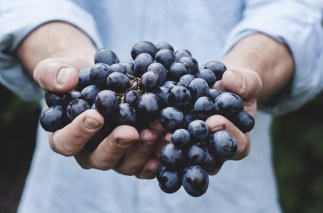
Image: Pixabay
Thanks to Emma Bryce for A more nuanced approach to reducing insecticides on our food, shared via Anthropocene:
Contrary to popular belief, moving from monoculture to smaller farms and a more diversified agricultural landscape isn’t necessarily a cure-all to the excessive use of insecticides on crops such as grapes and almonds.
Writing in the Proceedings of the National Academy of Sciences, a group of researchers from University of California Santa Barbara have carried out a fine-scale analysis shows that crop type is the most important factor in determining the amount of insecticide that farmers will apply to their land.
Teasing out the drivers of pesticide use has historically been a challenge due to the complexity of farming, with various crops, growing conditions, and pests to consider. But in the new study the researchers carried out a field-level analysis to get a more detailed view on this problem. They focused on Kern County in California, a region that produces more than 200 types of agricultural products, from almonds and pistachios to grapes and carrots. Using publicly-available data, they compiled information on crop type, land area, and insecticide application for 13,000 local fields for the period spanning 2005 to 2013.
Across this sample they discovered that on larger fields, insecticide use went up, whereas it was lower on smaller plots. This is probably because on larger fields insects benefit from continuous, undisturbed breeding habitat, and farmers would in turn require more intensive insecticide regimes to eradicate them. The researchers also noted that on farms surrounded by a diversity of cropland, there was less insecticide use. This points to the benefits of more complex and varied land use, which lowers the likelihood that single insect species will colonize the area and require intensive management…
Source: Larsen et. al. “Identifying the landscape drivers of agricultural insecticide use leveraging evidence from 100,000 fields.” Proceedings of the National Academy of Sciences. 2017.
 Organikos