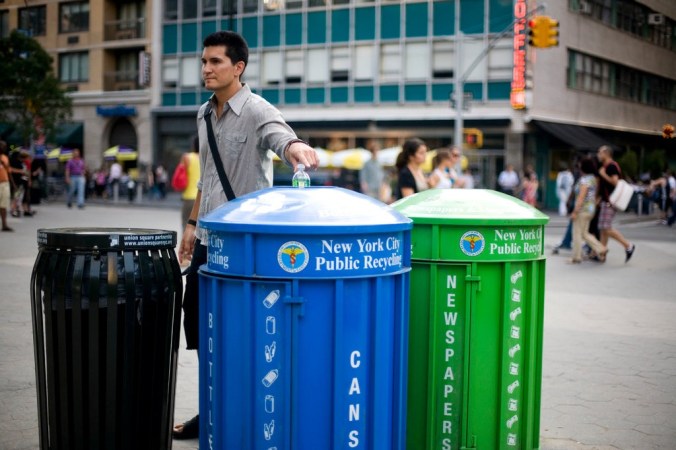
Color-coordinated waste baskets for waste recycling in New York City. Credit Ramin Talaie/Corbis, via Getty Images
Thanks for this interview full of incisive interview quetions by David Bornstein, who is co-founder of the Solutions Journalism Network, which supports rigorous reporting about responses to social problems. Thanks to Mitch Hedlund, executive director of Recycle Across America, for the explanatory answers in the interview that follows:
The Conflict of Interest That Is Killing Recycling
Some of the biggest recycling operations are owned by landfill companies whose profits improve when recycling doesn’t work well.
Mitch Hedlund, executive director of Recycle Across America. Credit Shelly Mosman/Recycle Across America
In the past few years, one of the core pillars of the environmental movement — recycling — has fallen on hard times. News dispatches reveal hundreds of cities and counties scaling back their recycling programs because of the high costs associated with processing recyclables and the lack of demand for the materials. A new conventional wisdom is gaining ground suggesting that recycling may not be worth the effort.
But is that true? And has recycling ever gotten a fair shake? After decades, less than a third of municipal solid waste is recycled — and much of that is contaminated with garbage, which diminishes or destroys its value. Almost 50 years after the first Earth Day, are we really ready to admit defeat and return to the “Mad Men”-era ethos of the “throwaway society”?
There may be another way. For most of the past decade, Recycle Across America, a nonprofit organization I covered in this column six years ago, has been demonstrating that it’s quite possible to get people to recycle properly, just as it’s possible to get most people to wear seatbelts, quit smoking and stop driving drunk. But the recycling industry has never taken the logical steps needed to create a successful societywide recycling habit — and today it may not be in the economic interest of some of the big recycling companies to build it. Recently, I spoke with Mitch Hedlund, the founder of Recycle Across America, about this dilemma and the possibility that a recycling collapse can be avoided.
David Bornstein: What’s happening to recycling today?
Mitch Hedlund: Recycling in the U.S. is in a pretty serious crisis. For example, to date, 1,000 recycling centers and processing plants have shut down in California alone.
The crisis stems from people throwing garbage in recycling bins, which contaminates the recyclables. The contamination is such an issue that China, one of the largest purchasers of U.S. recycling, has been warning the U.S. for over 10 years to start cleaning up our recyclables. But the recycling industry didn’t heed the warning, and now China has quit buying most U.S. recyclables this year.
It’s important to reiterate that China’s recent decision to no longer purchase recyclables from the U.S. is not the cause of the U.S. recycling crisis as has been widely reported.
DB: What led to this situation?
MH: The root of the crisis starts with the way recycling has been presented to the public. There are thousands of confusing recycling instructions on bins throughout the country, which makes people skeptical and apathetic about recycling, and projects the message that recycling is unimportant. And the inconsistent labels on bins lead to millions of tons of garbage being thrown into recycling bins. The contamination is extremely expensive to try to pull out of the recyclables during processing, which makes the recycled commodities less desirable to manufacturers — and, therefore, makes it less cost effective to recycle…

Read the whole op-ed/interview here.
 Organikos