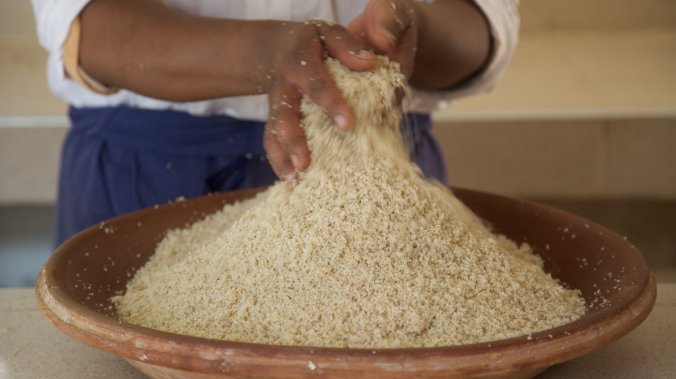
A woman prepares couscous in a small Amazigh (Berber) hamlet on the eastern slopes of Morocco’s High Atlas Mountains. Jeff Koehler for NPR
It seems ages (if only six months) since the folks of the salt, over at National Public Radio (USA), offered a story like this, so thanks to Jeff Koehler – Writer – Photographer – Cook – Traveler for bringing it:
Couscous: A Symbol Of Harmony In Northwest Africa, A Region Of Clashes
In 2016, Algeria announced that it would be applying for UNESCO Intangible Cultural Heritage status for couscous. If successful, the staple food would join a diverse list of more than 500 cultural treasures ranging from hand puppetry in Egypt and tango dancing in Argentina and Uruguay.
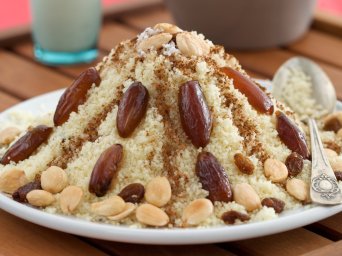
Sweet couscous is popular across the Maghreb. It is generally served with leben, a buttermilk-like fermented drink.
Jeff Koehler for NPRCouscous refers to both the tiny, hard granules typically made from crushed hard durum wheat semolina, as well as the dish itself. The tiny balls are steamed in a two-level pot with a perforated steamer basket called kiskis (known in much of the world as a couscoussier) over a stew of meat or fish, vegetables and spices, which is served on top.
While a catalog of outside influences has shaped Algeria’s cuisine over the years, it never lost its ancient traditions or uniqueness, wrote Mokhtaria Rezki in her authoritative book Le Couscous Algérian. “Algerian couscous remains in this respect the symbol of our originality and our greatest invention. … If one had to culinarily and symbolically award a medal of our national cultural identity … certainly couscous would be the star and the subject.” So key is couscous to Algerian culture that some simply refer to it as ta’am, or “food.”
Morocco was outraged by Algeria’s announcement. Along with Tunisia, it also lays claim to couscous.
But rather than allow intense rivalries to spiral out of control, the UNESCO delegations from Morocco, Algeria, Tunisia and Mauritania worked together to present the U.N. agency with a joint bid in March of 2019.
That required overcoming a history of antagonism. Relations between Morocco and Algeria have been strained since their respective mid-20th century independence from France, and their land border has been closed for the last 25 years. Despite being neighbors and the region’s largest economies, Algeria buys less than 1% of Moroccan exports, according to 2017 figures. Morocco and Mauritania fought a war in the Western Sahara from 1975 to 1991, and relations remain tense; Algeria supports the Polisario Front, a rebel national movement fighting for the liberation of the Western Sahara from Morocco…
Read the whole story here.
 Organikos