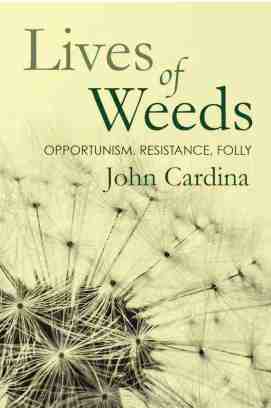
 Weeds are classified subject to norms, we have read; thanks to Rivka Galchen for reminding us, and reference to this book:
The names we call plants say more about us than they do about the greenery that surrounds us.
Steve Brill’s first stop was the greenery behind the bike racks. Brill, who is known as Wildman Steve, picked up a weed with heart-shaped seed pods and a small, four-petalled white flower. About thirty of us were gathered for a three-hour foraging tour through Prospect Park, in Brooklyn.
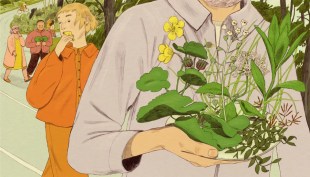
Illustration by Karlotta Freier
The plant was shepherd’s purse, a name that references the seed pods’ resemblance to the containers shepherds used to make from the bladders of sheep. “It’s in the mustard family,” Brill said. “Most all of the flowers in the mustard family are four petals in the shape of a cross.” He encouraged everyone to take a bite, and to tell him what vegetable it tasted like. Someone asked whether we should worry about pesticides. “Don’t worry, they don’t have the money for pesticides,” Brill responded. “And, anyhow, they’re pretty good at Prospect Park. In Central Park—don’t eat anything there.” He was exaggerating; he’s been doing foraging tours off and on in Central Park for some forty years, and was once even arrested there, for eating plants, after which he was brought on David Letterman’s show to make a foraged salad.
The weed tasted like carrot? Like okra? Like broccoli, almost precisely. “Shepherd’s purse is one of the more mild species in the mustard family,” Brill said, and then plucked what looked to me like a dandelion but wasn’t. “Here’s something spicier,” he said. It was another member of the mustard family, called poor man’s pepper. He drew our attention to the serrated leaves. Like shepherd’s purse, poor man’s pepper is an invasive weed, one that came from Europe. “I picked a lot of this in the Rockaways this morning,” he said. He planned to make “poor man’s potatoes”—potatoes (bland) with lots of poor man’s pepper (spicy). The common name dates back to when spices were a luxury import. Besides being tasty, spicy foods are also often a preservative and an antibacterial.
We walked deeper into Prospect Park. In a shady spot, Brill asked everyone to pause again. There was a sweet fragrance. It was the smell of . . . jasmine? Vanilla? “That’s the scent of the black locust tree in bloom,” he stated. But we couldn’t see one. Black locust is considered an invasive species in the Northeast—a big weed, one might say—but it also has flowers that taste good in salads or mixed into pancakes. “There must be one nearby,” he insisted. Someone pointed to a tree with white blooms in the distance. “That’s a dogwood,” Brill said, with a mischievous smile. “You can always recognize dogwood by its bark.”
Another weed eddied us out into history. “This one is delicious and deadly,” Brill explained, holding up an innocent-looking broad-leaved plant, called pokeweed. It’s a plant native to North America. Its poison is water-soluble, and it’s also a tremendous source of Vitamin A, which was once difficult to come by in the fall and winter. It used to be serially boiled—the poison leaches out—and then used as a treatment by Native and not-Native Americans, when the characteristic signs of Vitamin A deficiency, such as skin irritations, infections, and night blindness, would turn up.
Someone brought over a green. “Oh, that’s white snakeroot, also very poisonous,” Brill said. “Also a native plant.” When cows used to be sent to graze in the forest, they sometimes developed what was called milk sickness. The cows might live, but humans who drank their milk often didn’t. Abraham Lincoln’s mother died of milk sickness, and whole communities of settlers would move when there was an outbreak. They didn’t know what caused it. The nineteenth-century physician Anna Pierce Hobbs Bixby noticed that it was seasonal, and so deduced that it must be from something the cows were eating. In Illinois, she became friends with a Shawnee medicine woman—we know her only as Pierce did, by the name Aunt Shawnee. Aunt Shawnee had remained behind after her tribe was forced out West; she taught Pierce that the responsible weed was the one with the clusters of small, tender, white flowers. Pierce tested the theory by feeding the flowers to a young calf—which developed symptoms of milk sickness. “Do you think people believed her?” Brill asked. “No, of course not. They said it was fake news, and it was decades before her work was accepted.”
One way to think of weeds is as a plant in a place where it isn’t wanted. Ralph Waldo Emerson described weeds as plants “whose virtues have not yet been discovered,” and even the usually less exuberant Henry David Thoreau wrote, “Shall I not rejoice also at the abundance of the weeds whose seeds are the granary of the birds?” Weeds can also be thought of as taking up the sun and nutrients that other plants—and the insects, birds, and humans that rely on those plants—need. Weeds can be undervalued; weeds can be bullies.
In “Lives of Weeds: Opportunism, Resistance, Folly,” from 2021, the scientist John Cardina charts the trajectory of certain plants like figures in a Shakespearean play, as they shift from being perceived as nobodies, then as heroically medicinal or nutritious plants, then as villainous weeds, and maybe back and forth again a few times. Or perhaps the closer resonance is to the “Lives of Saints,” with the plants sometimes coercing whole new geographies into spaces devoted to their propagation while nourishing the locals, or saving the soil, or ruining other crops, or doing all these things. Weeds make for fine portraits of ambiguity. Cardina told me, “I try to make a distinction between plants that are invasive in a natural area versus plants that show up and disturb agriculture.”
“Lives of Weeds” is organized around eight plants: dandelion, Florida beggarweed, velvetleaf, nutsedge, mare’s tail, pigweed, ragweed, and foxtail. Consider the story of velvetleaf, a remarkably resilient plant with silky fibres. In the nineteenth century, velvetleaf was called American jute, and it was the hope of the maritime industry in the United States, as it was used to make rope, a key element of national defense. But that hope didn’t pan out; these days, the velvetleaf’s exceptional ability to grow in disturbed soil has made it a weed, plaguing soybean crops. Velvetleaf and soybeans both evolved, originally, in similar ecologies in China. When the Second World War increased demand for domestic sources of oils and fats, soybeans were cultivated, and velvetleaf followed. Herbicides that were developed to knock out velvetleaf led to stronger, herbicide-tolerant varieties; today, it’s among the most troublesome weeds in agriculture, often surviving what farmers sometimes call spray and pray. Cardina ends his chapter on velvetleaf by describing how its ancient seeds were found in a jar, dating to the Neolithic period. The careful collection of the seeds suggests that it must have been a valuable crop.
In conversation, Cardina said, “A peculiar irony is that the methods we have for controlling weeds are more sophisticated and better than ever in a thousand years of agriculture—but the weeds that have survived are more difficult.” Cardina grew up in rural Ohio, served in the Peace Corps, received a Ph.D. in horticulture and crop science, and worked for a time for the United States Department of Agriculture; he has witnessed many shifts in thinking about weeds. He said that once herbicide-resistant weeds began to dominate, “the response was: keep developing the technology.” He sees weeds in agriculture as “a human problem more than a weed problem. We don’t have to have farms get bigger and bigger with fewer and fewer people looking at the landscape and managing the land. It’s more of a social thing than a technological thing.“…
Read the whole article here.
 Organikos