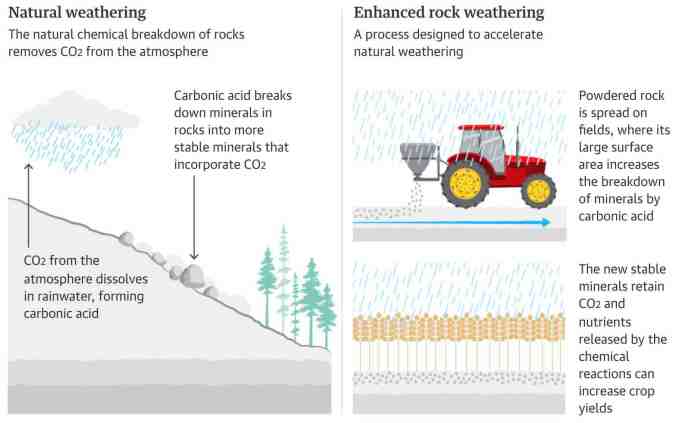
Guardian graphic. Source: Guardian research
Damian Carrington, Environment editor at the Guardian, shares these findings:
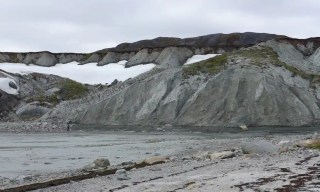
Eight-thousand-year-old marine deposits, exposed by the slow rise of Greenland after the last ice age. The cliffs are about 15 metres high. Photograph: Minik Rosing
Rock ‘flour’ from Greenland can capture significant CO2, study shows
Powder produced by ice sheets could be used to help tackle climate crisis when spread on farm fields
Rock “flour” produced by the grinding under Greenland’s glaciers can trap climate-heating carbon dioxide when spread on farm fields, research has shown for the first time.
Natural chemical reactions break down the rock powder and lead to CO2 from the air being fixed in new carbonate minerals. Scientists believe measures to speed up the process, called enhanced rock weathering (ERW), have global potential and could remove billions of tonnes of CO2 from the atmosphere, helping to prevent extreme global heating.
Soil fertility naturally depends on rock weathering to provide essential nutrients, so enhancing the process delivers an extra benefit. Spreading the Greenland rock flour on fields in Denmark, including those growing barley for the Carlsberg brewery, significantly increased yields.
Greenland’s giant ice sheet produces 1bn tonnes a year of rock flour, which flows as mud from under the glaciers. This means the potential supply of rock flour is essentially unlimited, the researchers said, and removing some would have very little effect on the local environment.
The weathering process is relatively slow, taking decades to complete, but the researchers said ERW could make a meaningful difference in meeting the key target of net zero emissions by 2050. Phasing out the burning of fossil fuels remains the most critical climate action, but most scientists agree that ways of removing CO2 from the atmosphere will also be needed to avoid the worst effects of the climate crisis.
“If you want something to have a global impact, it has to be very simple,” said Prof Minik Rosing at the University of Copenhagen, who was part of the research team. “You can’t have very sophisticated things with all kinds of hi-tech components. So the simpler the better, and nothing is simpler than mud.”…
Read the whole article here.
 Organikos