
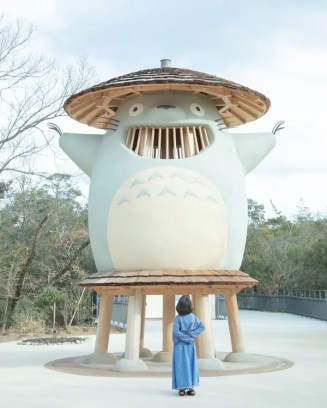
The magazine sent the Japanese photographer Rinko Kawauchi to Ghibli Park on a day when it was closed to the public, and she took along her daughter and some friends. Rinko Kawauchi for The New York Times
Links to the writings of Sam Anderson have not appeared in our pages before, and I almost missed this opportunity because at first appearance this article does not fit the norm for our themes. But if you read to the end, it does so in one clear way. It has to do with the power of nature, trees in particular, and once you read the article you will understand (if you are familiar with our platform). You can also listen to an audio version of this article here, but be sure to see the photos in the original publication:
Spirited Away to Miyazaki Land
What happens when the surreal imagination of the world’s greatest living animator, Hayao Miyazaki, is turned into a theme park?
A Totoro-like climbing structure. Rinko Kawauchi
As an American, I know what it feels like to arrive at a theme park. The totalizing consumerist embrace. The blunt-force, world-warping, escapist delight. I have known theme parks with entrance gates like international borders and ticket prices like mortgage payments and parking lots the size of Cleveland. I have been to Disney World, an alternate reality that basically occupies its own tax zone, with its own Fire Department and its own agriculture — a place where, before you’ve even entered, you see a 100-foot-tall electrical pole along the freeway with Mickey Mouse ears. This is a theme park’s job: to swallow the universe. To replace our boring, aimless, frustrating world with a new one made just for us.
Imagine my confusion, then, when I arrived at Ghibli Park, Japan’s long-awaited tribute to the legendary animation of Studio Ghibli.
Like filmgoers all over the world, I had been fantasizing about a visit to Ghibli Park since the project was announced more than five years ago. I tracked the online rumors, inhaled the concept drawings, scrutinized the maps. Ghibli’s animation has always felt destined to be turned into a theme park. Hayao Miyazaki, the studio’s co-founder, is one of the all-time great imaginary world-builders — right up there with Lewis Carroll, Jim Henson, Ursula K. Le Guin, Charles Schulz, Maurice Sendak and composers of the Icelandic sagas. Even Miyazaki’s most fantastical creations — a castle with giant metal chicken legs, a yellow bus with the body of a cat — feel somehow thick and plausible and real.
Miyazaki started Studio Ghibli in 1985, out of desperation, when he and his co-founders, Isao Takahata and Toshio Suzuki, couldn’t find a studio willing to put out their work. The films were brilliant but notoriously artsy, expensive, labor-intensive. Miyazaki is maniacally detail-obsessed. He agonizes over his children’s cartoons as if he were Michelangelo painting the Sistine Chapel. He will pour whole oceans of effort and time and money into the smallest effects: the way a jumping fish twists as it leaps, individual faces in a crowd reacting to an earthquake, the physics of tiles during a rooftop chase scene. Miyazaki insists that, although few viewers will be conscious of all this work, every viewer will feel it. And we do. Those tiny touches, adding up across the length of a film, anchor his fantasies in the actual world.
“Ghibli” is an Italian word, derived from Arabic, for a hot wind that blows across Libya. The plan was for the company to blow like a hot wind through the stagnant world of animation. It succeeded. For more than 35 years, Studio Ghibli has been the great eccentric juggernaut of anime, cranking out classic after odd classic: “Castle in the Sky” (1986), “My Neighbor Totoro” (1988), “Kiki’s Delivery Service” (1989), “Only Yesterday” (1991), “Princess Mononoke” (1997), “Spirited Away” (2001). In Japan, the release of a new Ghibli film is a national event, and the studio’s most popular characters are ubiquitous: plump Totoro, mysterious No Face, the grinning Cat Bus, googly-eyed soot sprites. As a kind of shorthand, Miyazaki is often called the Walt Disney of Japan…
Read the whole article here.
 Organikos