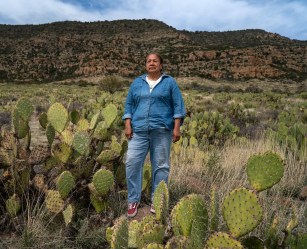
Prickly pear cacti, which produce Twila Cassadore’s favorite fruit. Photograph: Gabriela Campos/The Guardian
Samuel Gilbert was in Bylas, Arizona, on the San Carlos Apache Reservation to report this article, which contains excellent accompanying photographs by Gabriela Campos.
We thank the Guardian for this coverage of indigenous heritage:
‘It healed me’: the Indigenous forager reconnecting Native Americans with their roots
Twila Cassadore hopes teaching Western Apache traditional foodways can aid mental, emotional and spiritual health
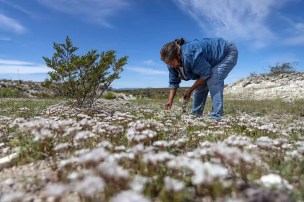
Twila Cassadore gathers wild pearl onions on a foraging trip in the San Carlos Apache Reservation in April. Photograph: Gabriela Campos/The Guardian
On a warm day in April, Twila Cassadore piloted her pickup truck toward the mountains on the San Carlos Apache Reservation in Arizona to scout for wild edible plants. A wet winter and spring rains had transformed the desert into a sea of color: green creosote bushes topped with small yellow flowers, white mariposa lilies, purple lupines and poppies in full bloom.
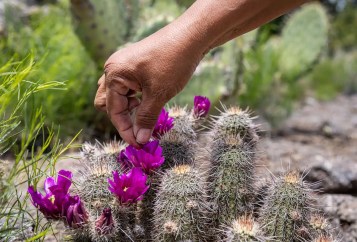
Cassadore picks the petals off a flowering cactus during a foraging trip. She uses the petals in salads. Photograph: Gabriela Campos/The Guardian
Cassadore and I drove up a rough dirt road that used to be an old cattle trail, passing through various ecosystems, moving from Sonoran desert to grasslands and piñon-juniper woodlands. In each area, Cassadore would stop to gather desert chia seeds, cacti flowers and thistles.
Cassadore stopped her truck beside a three-leafed sumac bush brimming with fruit. “If you suck on them, they taste like sour lemonade,” she said, removing the fuzzy, white unripened berries from the bush. Cassadore will make a slushy when they are ripe by blending the berries with wood sorrel and ice. “Better for you than Kool-Aid,” she said.
As a forager and celebrated food educator, Cassadore, 56, has spent the past 30 years documenting and teaching her fellow Western Apache people about the importance of wild foods in a region that’s considered one of the most biodiverse in the US – yet where diet and substance abuse are leading causes of death. Working closely with the tribe’s wellness center, the local high school and recovery groups, she often takes people out into the land to forage, cook and heal.
Foraged food accounted for up to 50% of the Western Apache diet in pre-reservation times. In spring, it’s onions, potatoes, miner’s lettuce and thistles. In summer, it’s cacti fruit, berries and acorns – “the most prized food in our community”, Cassadore said. But after being forced on to reservations, the Apache were forbidden to gather their traditional foods and became dependent on rations and later, commodities. By the time Cassadore was growing up on the 1.8m-acre reservation, she said that many people looked down on foraged food, or associated it with poverty.
So she was often teased by her elementary school classmates for bringing homemade beef jerky, acorns, pine nuts and dried mesquite pods foraged by her and her family, instead of the candy bars and sodas that everyone else had. Today the White River, San Carlos and Fort Apache reservations are considered food deserts with few grocery stores and limited access to fresh, healthy foods…
Read the whole story here.
 Organikos