
Illustration: Julia Louise Pereira/The Guardian
Our thanks to Victoria Namkung for this reporting in the Guardian, from Los Angeles:
‘Everything is natural and tastes so good’: microfarms push back against ‘food apartheid’
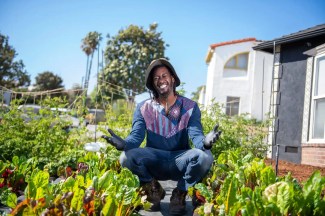
Crop Swap LA founder Jamiah Hargins in the Asante microfarm in Los Angeles, California. Photograph: Valérie Macon/AFP/Getty Images
Bipoc-led local farms in unconventional spaces decentralize systems that have produced food deserts and create food equity
On a recent Sunday morning in South Los Angeles, Crop Swap LA volunteers and staffers harvested bags of freshly picked produce from the front yard of a residence. Located just steps from Leimert Park Plaza, the Asante microfarm is the first of what will be numerous microfarms created by the organization, which is dedicated to growing hyperlocal food on unused spaces “in the neighborhood, exclusively for the neighborhood”.
“Everything we’re growing is nutrient-dense and the food remains in the neighborhood,” says Jamiah Hargins, who founded Crop Swap LA in 2018 as a small monthly swap of surplus produce. After spending years in finance and consulting, Hargins decided to create a local food distribution system to address the fact that his neighborhood was a food desert, meaning most residents have little access to healthy food. It’s now one of many Bipoc-led groups across the US that are reclaiming their agricultural heritage and redefining the local food movement by growing on traditional farms and unconventional spaces such as yards, medians and vacant lots as a way to increase food security and health in their own communities.
Crop Swap LA members live within one mile of one of the organization’s microfarms and receive their weekly bags of produce within hours of harvest – which Hargins says is far more nutritious than buying produce that’s been sitting on trucks or in storage for days and weeks – for $50 (£40) a month (Cal Fresh/EBT users pay $25).
The solar-powered microfarms feature on-site composting, beehives and rainwater harvesting, and plants are grown in long mesh containers made from upcycled polypropylene. Harvests have included Swiss chard, tomatoes, red-veined sorrel and pattypan summer squash, among other produce and herbs. A fruit tree harvesting program provides members with honey crisp apples and Asian pears.
Crop Swap LA’s third microfarm will debut its first harvest in June and its biggest project yet will be an urban farm that will provide produce for a 10,000 sq ft food incubator and grocery store at the forthcoming Marlton Square development in south Los Angeles’s Baldwin Hills neighborhood.
The local food movement has long been led by white upper-class activists, such as Michael Pollan and Alice Waters, which means the needs of diverse communities have often been neglected and the systemic racism that affects the US food system is often ignored…
Read the whole article here.
 Organikos