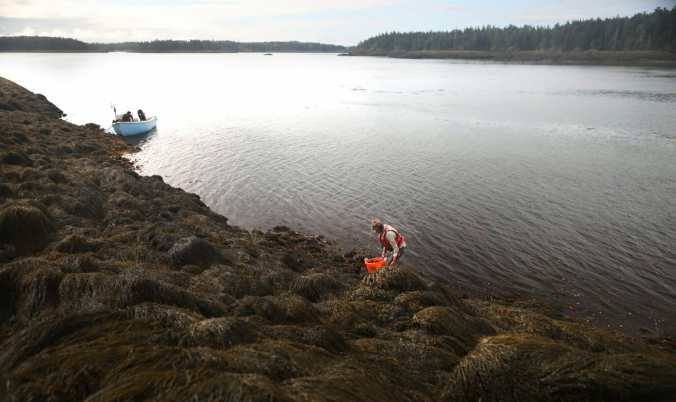
Severine von Tscharner Welcome forages for seaweed in Cobscook Bay, Maine.
Our thanks as always to Food & Environment Reporting Network. In this article by Bridget Huber, with photography by Lauren Owens Lambert, some of our earlier links to stories about farming in the sea are called into question.
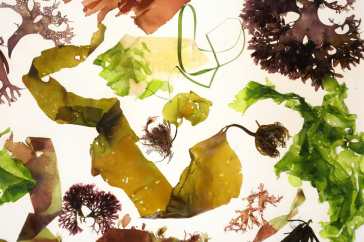
A variety of seaweed harvested from the Gulf of Maine, including sugar kelp, sea lettuce, dulse, bladderwrack, and Irish moss.
Climate savior or ‘Monsanto of the sea’
Seaweed farming is being hyped as a major weapon in the fight against climate change. But skeptics say the rush to build industrial-scale operations risks unintended consequences.
Early on a cool spring morning, in far Downeast Maine, Severine von Tscharner Welcome and her husband, Terran, scrambled along a point jutting into Cobscook Bay. The Passamaquoddy people named the bay Kapskuk after the immense tides and wild currents that make the water seem to boil. These turbulent waters support a rich array of life, including Atlantic salmon, sturgeon, and alewives, as well as many edible species of seaweed.
Harvesting in a spot that’s accessible fewer than 20 days per year, during negative tides, Welcome pulled a long strand of alaria, a golden ruffled kelp, from the riffles. She piled vivid green sea lettuce that tastes surprisingly like its earthbound namesake in a plastic fish basket, and handed me a hank of fine red strands of gracilaria algae to taste. It was slippery, al dente, and tasted a little, but not unpleasantly, like blood.
In a more sheltered part of the bay, the Welcomes farm sugar kelp and oysters. They sell the wild and cultivated seaweed dried, and use the less delicious, more abundant kinds to fertilize the saltwater farm they’re reviving nearby. For years, much of the seaweed harvest in North America looked a lot like this: Smalltimers scrabbling on rocky shores or drifting in little boats — often on both the economic and geographic margins.
But the industry is at an inflection point. While the North American seaweed industry remains tiny by global standards — 95 percent of farmed seaweed comes from Asia — it is the fastest-growing type of aquaculture in the United States. Fueling this rise is a surging appetite for seaweed as a food and an ingredient, and the hope that it could play an important role in mitigating climate change.
In recent years, seaweed has been put forth as what one writer called a Swiss Army knife solution to climate change: able to absorb atmospheric carbon, reduce cattle’s methane emissions, provide feedstock for biofuels, and feed the world — no fertilizers, fresh water, or even land required.
Now, a new crop of seaweed startups, many funded by venture capital and tech industry players, is pouring millions into projects using seaweed to mitigate climate change. They’re driven by a slew of corporate net zero pledges — which are increasing demand for carbon offsets — and the growing realization that reducing emissions won’t be enough to keep global warming at or below 1.5 degrees Celsius: carbon will also have to be removed from the atmosphere…
Read the whole article here.
 Organikos