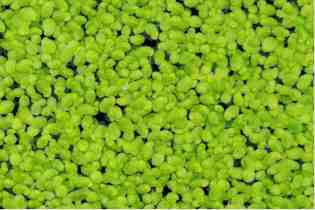
Duckweed at the Plantible Foods aqua farm in San Marcos, Calif. (Eric Thayer/for The Washington Post)
We link frequently to articles about meat replacement options, and this appears to be the first time that duckweed is the plant protein being featured. So, thanks to Michael J. Coren, a climate advice columnist at the Washington Post, for this:
The plant protein that could push meat off your plate
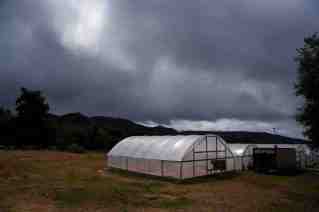
Plantible grows duckweed in ponds housed in greenhouses. (Eric Thayer/for The Washington Post)
SAN MARCOS, Calif. — I came to this aquatic farm an hour outside of San Diego because I wanted to see what could be the future of humanity’s protein supply.
At the moment, it looks more like a meth lab out of the drama “Breaking Bad,” jokes Tony Martens Fekini, the chief executive of Plantible Foods.
Debris from a machine that grinds duckweed. (Eric Thayer/for The Washington Post)
Decrepit recreational vehicles squat on the property. In one corner, people tend to vials, grow lights and centrifuges in a trailer lab. More than a dozen big ponds filled with duckweed, a tiny green plant, bask in the Southern California sunshine.
But the only thing cooking here is protein.
Within each tiny floating aquatic plant is a molecule colloquially called rubisco. Without it, most life on Earth would cease to exist.
Plants use rubisco protein — technically known as Ribulose-1,5-bisphosphate carboxylase/oxygenase — as the catalyst for photosynthesis, combining CO2 from the air with the building blocks for sugars and carbohydrates composing the base of our food chain.
Rubisco is arguably the most abundant protein on the planet. Every green leaf has it. But this tireless molecule is locked inside plants’ cells, spoiling almost as soon as it comes into contact with the outside world. At the moment, eating salads is the only way to consume much of it.
But Plantible’s farm may change that. If it succeeds, duckweed may become humanity’s first new major crop in more than a century, a skeleton key to unlock how plants replace animal protein on an unprecedented scale.
Rubisco doesn’t just provide the protein we crave. It’s one of the world’s most versatile proteins, shape-shifting into forms resembling egg whites, meat, milk, gluten or even steak — all extracted from leaves. If we can harvest enough, it may elevate plants from a side dish to the main course — and as I found, it tasted delicious.
Let’s dig in.
Protein problemThe world grows more than enough food to feed everyone on Earth. Much of it goes to livestock. About half of the corn and soybeans grown in the United States are fed to cows, pigs and chickens to support meat-rich diets.
This is not changing anytime soon. Even as protein alternatives proliferate, global meat consumption reached a record high in 2021, roughly doubling since 1990. The typical American consumed about 260 pounds of meat and 670 pounds of dairy last year, according to government statistics.
Advising people to eat less of it isn’t likely to do much. In country after country, as incomes rise, meat consumption follows virtually in lockstep…

Read the whole article here.
 Organikos