Bill McKibben gives a thorough reconsideration of what, if any, growth is helpful now:
To Save the Planet, Should We Really Be Moving Slower?
The degrowth movement makes a comeback.
John Maynard Keynes once observed that dating from “say, to two thousand years before Christ—down to the beginning of the 18th century, there was no very great change in the standard of life of the average man living in the civilised centres of the earth. Ups and downs certainly. Visitations of plague, famine, and war. Golden intervals. But no progressive, violent change.” At best, he calculated, the average standard of living had no more than doubled in the previous four millennia, essentially because, when that epoch began, we already knew about fire, banking, the sail, the plow, mathematics; we learned little new that would have accelerated economic growth; and throughout that stretch the planet mostly ran on the muscles of people and animals, supplemented by the power of wind and water. Then, in the eighteenth and nineteenth century, we started to harness the combustion of coal, gas, and oil, and everything changed. That’s because a barrel of oil contains 5.8 million British thermal units’ worth of energy. Nate Hagens, the director of the Institute for the Study of Energy & Our Future, ran the numbers: “One barrel of oil has the same amount of energy of up to 25,000 hours of hard human labor, which is 12.5 years of work. At $20 per hour, this is $500,000 of labor per barrel.” A barrel of oil costs about seventy dollars at this week’s market price.
To call that energy revolution liberating hardly suffices. Suddenly, people could easily venture beyond their villages, or build dwellings large enough to afford some privacy, or stay up all night if they wanted to read. After four thousand years of economic stasis, we were suddenly in a world where the average standard of living doubled in a matter of decades, and then doubled again and again and again and again. And we liked it so much that it became the raison d’être of our political life. In the United States, the per-capita G.N.P. grew twenty-four per cent between 1947 and 1960, when Jack Kennedy, campaigning for President, pointed out that Russia’s growth rate was “three times as fast,” a gap he tried to narrow while in office. Between 1961 and 1965, the G.N.P. grew at a rate greater than five per cent a year, and the percentage of Americans living in poverty dropped by nearly half by the end of the decade. If there was anything Americans agreed on, it was that they wanted more, please. In the 1996 campaign, for instance, the Republican Vice-Presidential nominee, Jack Kemp, demanded that we double the rate of growth, while Bill Clinton’s Secretary of the Treasury, Larry Summers, said that we “cannot and will not accept any ‘speed limit’ on American economic growth. It is the task of economic policy to grow the economy.”
But a critique of growth was emerging in the postwar years as well, most concisely in a 1972 report commissioned by the Club of Rome titled “The Limits to Growth.” A team of M.I.T. economists used computer models (then something of a novelty) to show that, if we kept growing at the then-current rate, the planet could expect ecological collapse sometime toward the middle of the twenty-first century. That prediction turns out to have been spot-on: a report published in Nature on the last day of May concluded that we have already exceeded seven of eight “safe and just Earth system boundaries” that it studied—from groundwater supplies and fertilizer overuse to temperature. “We are moving in the wrong direction on basically all of these,” Johan Rockström, the paper’s lead author and the director of the Potsdam Institute for Climate Impact Research, told reporters.
And so the “Limits to Growth” critique has reëmerged, fifty years on, and with new vigor. In May, twenty members of the European Parliament sponsored a three-day Beyond Growth workshop in Brussels. As The Economist pointed out, while a similar gathering five years ago was “sparsely attended” and confined to a few committee rooms, this time “thousands packed into the EU’s vast hemicycle and beyond,” and “the big beasts of Brussels came to pay homage,” beginning with the president of the European Commission, Ursula von der Leyen, who offered the opening address. When the “Limits to Growth” report came out, she said, “Our predecessors chose to stick to the old shores and not lose sight of them. They did not change their growth paradigm but relied on oil. And the following generations have paid the price.”
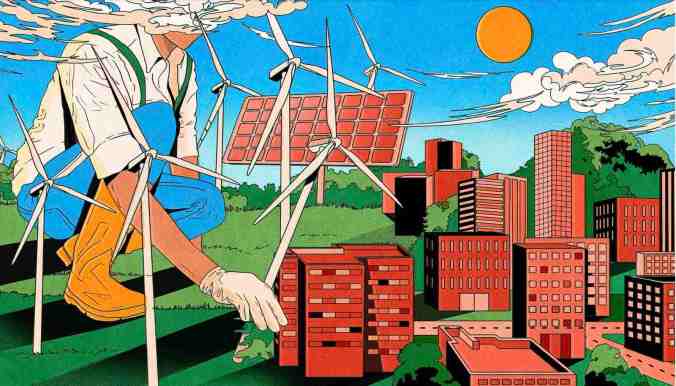
The Economist’s take was predictably sardonic, quoting a participant who called the gathering a “Woodstock for system-changers” that came in “50 shades of red.” But the article did raise a reasonable point—indeed, a crucial one: Isn’t the only way “to mitigate the effects of human activity” to invest in green technologies that actually take us beyond the world of fossil fuels? Shouldn’t we make an all-out push for electric vehicles, heat pumps, and cooktops, not to mention solar panels and wind turbines to supply the necessary electricity? The degrowth movement’s answer is, at the least, a muted no. A green-energy boom, the Canadian journalist Andrew Nikiforuk wrote, would come with “monstrous ecological costs,” because of the mining for the minerals needed to produce and use electricity at the required scale. He cited the energy ecologist Vaclav Smil, who recommends that we return “to living standards of the 1960s” so that we can “consume less, travel less, build less, eat less wastefully.” It’s a view with power: those opposed to new lithium mines or transmission corridors or solar farms are increasingly basing some of their argument on the idea that we should consume less. “If we are to avoid ecological collapse,” the journalist Christopher Ketcham maintains, we must pursue “contraction and simplification, a downsizing of the economy and population, so that Homo sapiens can prosper within the regenerative and assimilative capacity of the biosphere. In other words, we must live within our planet’s biophysical limits.”
I’m sympathetic to both viewpoints. Fifteen years ago, I wrote a book, “Deep Economy,” arguing against endless economic growth both on ecological grounds and because there’s considerable evidence it doesn’t make us happier, and I’ve campaigned against wasteful consumerism, helping organize one of the first protests against the S.U.V. But I have also argued for a major-scale build-out of renewable energy. So I wonder if there isn’t a way to do both: to see green technology as a way to reduce the deadly hangover of the fossil-fuel era and also to help us move toward a more stable and stabilized civilization…
Read the whole article here.
 Organikos