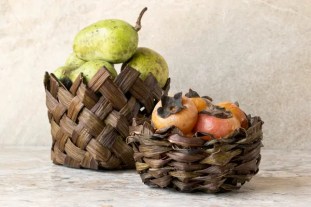
Your first taste of a ripe pawpaw, left, or American persimmon, right, may convince you to plant the trees, which can serve as the centerpiece of a permaculture food forest. J.B. Douglas
It is a relief, always, to read a Margaret Roach article when given the choice between her advice and any given news of the world:
Or just start by planting a few pawpaw or persimmon trees. Chances are, you’ll want more.
At a permaculture site planted by Michael Judd, an edible landscape designer, each fruit tree is underplanted with beneficial companion plants, so “you’re not leaving your poor little fruit tree in a sea of grass,” he said. Michael Judd
Your first taste of a ripe pawpaw or persimmon can leave you hungry for more. That’s why Michael Judd is confident that he can persuade you to make room for several of these trees in your front yard — or even to surrender your lawn altogether.
Turning your yard into a meadow or blanketing it in an expanse of alternative ground covers aren’t the only ecologically viable options for replacing conventional grass.
Mr. Judd, an edible landscape designer and permaculturist, suggests you consider starting a homegrown food forest instead — perhaps a mix of easy-care, mostly native fruiting trees or shrubs and pollinator-attracting plant companions.
But if you’re not ready to go that far, he’s flexible: A narrow strip along the fence line will do. Or a sunny spot with enough room for two pawpaw trees (to ensure cross-pollination) or a self-fruitful American persimmon, possible centerpieces of what permaculturists call a “guild,” joined by carefully chosen plants beneath.
“It’s the idea that you’re not leaving your poor little fruit tree in a sea of grass, with marauding weed-whackers and lawn mowers and a dinky little mulch ring,” he said. “You’re setting the stage for it to be sustainable.”
Such a planting — whether you’re starting a food forest or content with just one underplanted tree — is inspired by the vegetation layers of the forest ecosystem, Mr. Judd said. The tree canopy, middle layer of shrubs and vines, and the herbaceous one covering the ground all live, and work, together…

Read the whole article here.
 Organikos