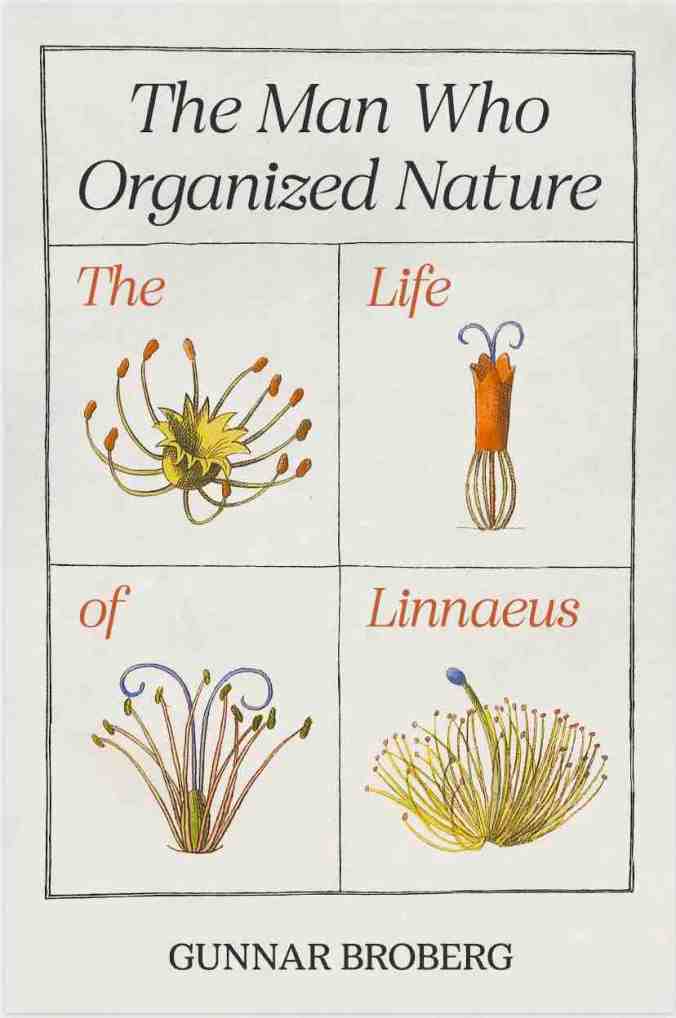
Thanks to Kathryn Schulz for this review:
The sexual system Linnaeus favored for classifying plants brought a whiff of scandal, which helped spread his name. Illustration by Karlotta Freier
How Carl Linnaeus Set Out to Label All of Life
He sorted and systematized and coined names for more than twelve thousand species. What do you call someone like that?
For the Tyrannosaurus rex, as for Elvis and Jesus, being extremely dead has proved no obstacle to ongoing fame. Last seen some sixty-six million years ago, before an asteroid wiped out three-quarters of the life-forms on earth, it is nonetheless flourishing these days, thanks in large part to Michael Crichton, Steven Spielberg, and elementary-school children all over the world. In my experience, such children not only can rattle off the dinosaur’s vital statistics—fifteen feet tall, forty feet long, twelve thousand pounds—but will piously correct any misinformation advanced by their paleontologically passé elders. And here is the most surprising thing that all those ten-year-olds plus pretty much everyone else on the planet know about T. rex: the creature’s proper scientific name.
That name is itself properly called a binomen, the smallest unit in the vast system known as binomial nomenclature. You’ll remember the gist from basic biology: to eliminate any possible overlap or confusion, every species on the planet, whether extant or extinct, is assigned a full name, consisting of its genus (used here as a surname of sorts, indicating to what other creatures it is related) followed by its species, with both halves Latinized, and the genus sometimes reduced to just an initial, like Josef K. Thus: Tyrannosaurus rex, or T. rex, of the genus Tyrannosaurus and the species rex, known in full translation as King of the Tyrant Lizards.
Binomial names are extremely important to scientists but rarely used by the rest of us. Apart from T. rex, I am aware of only a few that crop up in everyday conversation. We know our own full name, of course—Homo sapiens, the last surviving species in a genus that once included Homo habilis, Homo floresiensis, Homo neanderthalensis, and several others—as well as that of the boa constrictor, a snake of the genus Boa, and E. coli, a bacterium of the genus Escherichia. You could argue based on those two examples plus T. rex that we speak respectfully of species that are potentially dangerous to us—not a bad policy, but also not a good argument, since a fourth example that comes to mind is Aloe vera. Also, almost no one outside scientific circles calls the great white shark Carcharodon carcharias.
Inside scientific circles, however, binomial nomenclature still rules the day, lending concision and clarity to fields ranging from molecular biology to evolutionary ecology. It was developed, as you might also remember from your school days, by the Swedish botanist Carl Linnaeus in the middle of the eighteenth century, an era that was in thrall to the mighty project of trying to systematize all of nature. Appropriately for his line of work, Linnaeus’s name remains widely known, and he is hailed in his country of origin as his own kind of rex—the King of Flowers. But the details of his life and the nature of his scientific contributions are both less contemplated and more complicated, with his staunchest defenders characterizing him as an Enlightenment-era genius who paved the way for Charles Darwin, and his fiercest critics casting him as one of history’s most influential racists. A new biography, “The Man Who Organized Nature” (Princeton), written by Gunnar Broberg and translated from the Swedish by Anna Paterson, attempts to provide the fullest possible account of his life yet fails to grapple with the fundamental question it raises: if categorization is crucial to making sense of the world, how should we classify Carl Linnaeus?
The future father of modern taxonomy was born in Råshult, a village in southern Sweden, in 1707. His own father had originally been called Nils Ingemarsson, because he was the son of a man named Ingemar and most Swedes used a patronymic, but when Nils went off to university to study theology he was required to choose a new surname. For inspiration, he turned to a venerable linden tree on the land where he grew up—a lin, as it was known in the local dialect. Reborn as Nils Linnaeus, he was ordained in the Lutheran Church, got married, and had a son, Carl. Thus did the man who would name species get his name from a species.
It is a pretty bit of backstory, part and parcel of a thematically tidy childhood. Nils, himself an amateur botanist and an avid gardener, decorated his infant son’s crib with buds and blossoms. As the boy grew older and prone to the outbursts of toddlerhood, he could be calmed by being handed a flower, and from an early age he began helping in the garden. After his father reprimanded him for forgetting the name of a plant, he vowed never to do so again, and, soon enough, he could identify virtually everything that grew in his native region. Nonetheless, he was a middling student, and his parents were distraught when his teachers informed them that he was not fit to follow his father into the ministry. Linnaeus decided to study medicine instead, chiefly because it served as a side door into the study of botany. As Broberg writes in his biography, “Medicine demands two kinds of knowledge, of the body and of what cures ailments,” and the latter amounted to a mandate to continue learning about plants.
That proved difficult at Uppsala University, where Linnaeus got most of his higher education, and where he found the quality of the teaching abysmal; in all his time there, he never managed to hear a single lecture on botany. He did, however, meet someone who would change his life: Peter Artedi, a fellow-student and a budding ichthyologist, who, like Linnaeus, had disappointed his parents by failing to enter the ministry. The two became instant and devoted friends, and soon hatched, in the words of the twentieth-century botanist William Stearn, “the grand plan of revealing the works of the creator in a systemic, concise, and orderly fashion.” Like Spain and Portugal in the Treaty of Tordesillas, they divided up the world between them: Artedi, by many accounts the greater intellect, would take the fish, reptiles, and amphibians, while Linnaeus would take the birds, insects, and the majority of the plants, and the two men would collaborate on mammals and minerals. If either of them died before the project was completed, they pledged, the other would finish his work. That was in 1729. Six years later, Artedi, then thirty years old and temporarily living in Amsterdam, was out walking late one night when he fell into an unfenced canal and drowned…

Read the whole review here.
 Organikos