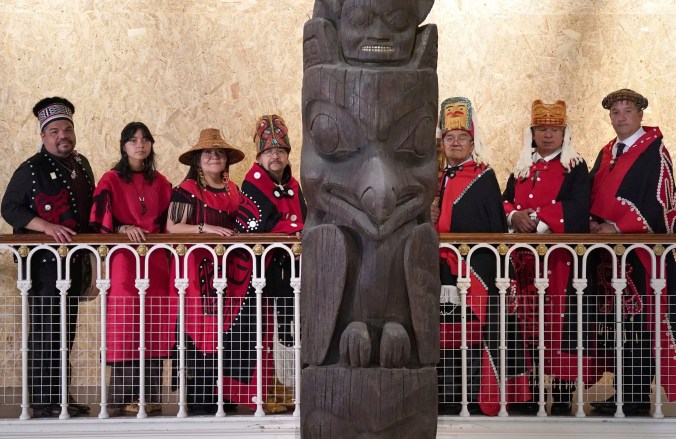
Earl Stephens, who goes by the Nisga’a cultural name Chief Ni’is Joohl, center left, and members of a delegation from the Nisga’a nation pose beside a 36-foot tall memorial pole during a visit to the National Museum of Scotland on Monday. Andrew Milligan/Press Association, via Associated Press
The legitimacy of museums possessing artifacts from other cultures is not inherently dubious, but as the Parthenon marbles example has demonstrated, there are plenty of reasonable questions. This story about a museum’s move to the better side of history is worth a read:
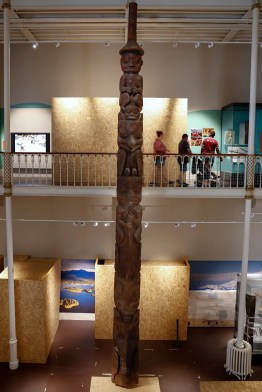
The pole is soon to be moved to British Columbia on the west coast of Canada. Jeff J Mitchell/Getty Images
Totem Pole Taken 94 Years Ago Begins 4,000-Mile Journey Home
The 36-foot tall memorial pole has spent almost a century in a Scottish museum. Now it will be returned to the Nisga’a Nation in Canada.
Almost 100 years ago, a hand-carved totem pole was cut down in the Nass Valley in the northwest of Canada’s British Columbia.
The 36-foot tall pole had been carved from red cedar in the 1860s to honor Ts’wawit, a warrior from the Indigenous Nisga’a Nation, who was next in line to become chief before he was killed in conflict.
A Canadian anthropologist, Marius Barbeau, oversaw the removal of the memorial pole in the summer of 1929, while the Nisga’a people were away from their villages on an annual hunting, fishing and harvesting trip, according to the Nisga’a government.
Mr. Barbeau sent the pole to a buyer more than 4,000 miles away: the Royal Scottish Museum in Edinburgh — today known as the National Museum of Scotland.
This week, after a decades-long campaign by members of the Nisga’a Nation, the memorial pole finally began its long journey home.
A Nisga’a delegation in traditional red and black robes crossed the grand gallery of the museum on Monday, passing a Japanese Buddha, a Sudanese sculpture and a feast bowl from the Pacific, before finally reaching the totem pole, where they performed a spiritual ceremony to prepare it for its journey back to Canada.
The Nisga’a believe that the pole has a spirit embedded in it, and do not consider it an object but a living being, according to Amy Parent, whose Nisga’a name is Noxs Ts’aawit. Monday’s ceremony consisted of putting it to sleep before it started its journey home.
“We have a living family member that’s been imprisoned within a museum,” said Dr. Parent, an associate professor of education at Simon Fraser University. She added that the pole deeply connects them to their history.
Read the whole article here.
 Organikos