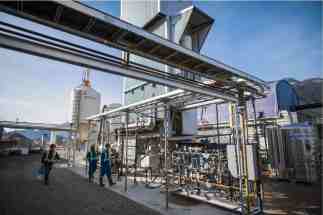
A direct air capture system at the Carbon Engineering pilot facility in Squamish, British Columbia, Canada. Photograph: Bloomberg/Getty Images
Carbon capture technology has its skeptics, but it has steadily improved and is closer to proof of concept. Next step, scaling to Texas:
The world’s biggest carbon capture facility is being built in Texas. Will it work?
The plant will inject 500,000 tons of carbon dioxide into the ground each year – but is it just greenwashing from big oil?
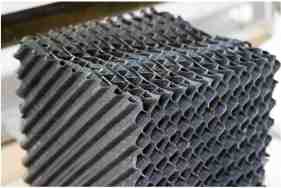
Plastic membrane used in the direct air capture system. Photograph: Bloomberg/Getty Images
Rising out of the arid scrubland of western Texas is the world’s largest project yet to remove excess carbon dioxide (CO2) from the atmosphere, a quest that has been lauded as essential to help avert climate catastrophe. The project has now been awarded funding from the Biden administration, even as critics attack it as a fossil fuel industry-backed distraction.
Proponents of setting up enormous fans to gulp in huge amounts of air and remove planet-heating carbon from it, a process called direct air capture (DAC), are basking in their greatest breakthroughs yet in the US. In June, ceremonial shovels were plunged into the dirt in Ector county, Texas, to mark the start of a $1bn project called Stratos, which aims to remove 500,000 tons of CO2 from the atmosphere a year once fully operational in 2025.
The advent of the 65-acre (26-hectare) site, which will be marked by a vast network of pipes, buildings and fans to scrub CO2 from the air and then inject it into underground rock formations, was solemnly likened to the Apollo 13 moon mission by Lori Guetre, vice-president of Carbon Engineering, the Canadian-founded company spearheading Stratos, during the groundbreaking.
“This time the Earth has some serious complications, and it needs the brightest minds,” Guetre said, adding that “that the world is watching and counting on us … The team’s will to overcome is quiet, steady and unwavering.”
This milestone was followed, in August, by Biden’s energy department announcing that two facilities – one a separate venture by Carbon Engineering, in the southern reaches of Texas – will be given $1.2bn to act as DAC “hubs” to help jumpstart the carbon-removal industry in the US while also purging more than 2m tons of CO2 from the atmosphere between them. A further two hubs will be chosen by the federal government, as part of a $3.5bn effort to help create a market for carbon that will be “crucial to tackling climate change”, according to Jennifer Granholm, the US secretary of energy.
The commitments to remove such volumes of CO2 is a step change for a direct air capture industry still nascent, small-scale and unproven in its capacity to curb the worsening climate crisis, even as hope, and dollars, are ladled upon it. “It’s an extraordinarily big moment for carbon removal right now and for direct air capture in particular,” said Erin Burns, executive director of Carbon180, a climate NGO that works on a range of different carbon-removal options.
“There’s too much CO2 in the atmosphere. People are already feeling the impacts of climate change. We need to address legacy emissions and direct air capture could play a big role in that.”..,
Read the whole article here.
 Organikos
Though good, carbon capture, as many would agree, is expensive. Thank you 🙏🌍
It seems every carbon mitigation approach is expensive, so the question is which is the most efficient. The jury still seems out on that question. Thanks for your comment.
Yes. You are welcome 🙏🌍