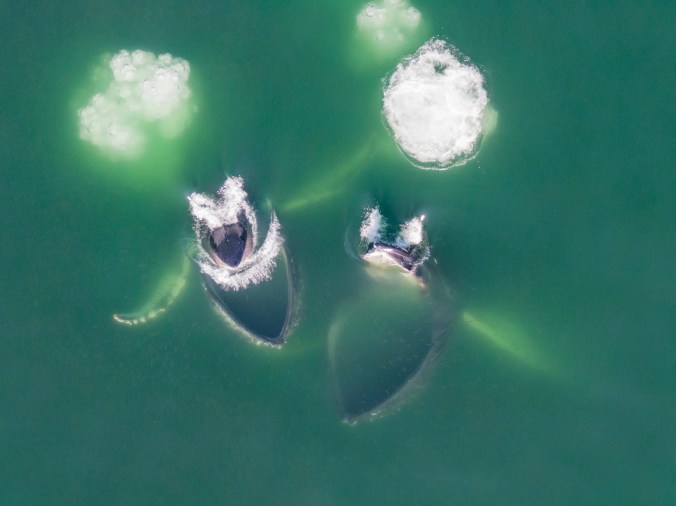
A pair of humpback whales synchronized the release of bubbles to corral and consume sand eels.
This article by Ellie Duke, with photographs and video by Sutton Lynch, is a sort of bookend to another recent article. It makes one wish for more people skilled with cameras in the oceans, and fewer skilled in placing nets:
A school of bluefish forming a circle in shallow water.
The photographer Sutton Lynch is documenting a dramatic turning point off the coast of Long Island — a resurgence of sea life after decades of depletion.
Sutton Lynch rises most days before the sun, arriving at Atlantic Beach in Amagansett, N.Y., for the early-morning calm. It’s the same beach he’s been going to since he was a child, and where he worked as a lifeguard for years as a teenager. Now 23, he spends his mornings surveying the horizon. When he spots activity on the water’s surface, he sends out his drone.
Mr. Lynch has earned a devoted following on Instagram for his remarkable footage of marine life off the coast of the East End of Long Island. Alongside images and videos of humpbacks, hammerheads, dolphins, bluefish and many other species, he writes captions that range from childhood memories and research on the effects of fishing policy to explanations of animal behavior. Across the board, his work exudes a reverence for the ocean and the creatures that call it home.
Mr. Lynch’s followers often express surprise that this abundance of species exists just out of sight. The truth is, the resurgence is fairly new. And so the photographer is documenting a dramatic turning point in the East End’s environmental and cultural history — a renewal of sea life after decades of depletion.
As recently as 10 years ago, a whale or dolphin sighting was an uncommon occurrence on the East End. The overfishing of Atlantic menhaden — a keystone species that is essential to a healthy ecosystem — led to a huge drop in marine life off the coast of Long Island in the latter part of the 20th century. (Bony and oily, menhaden are harvested for their nutrient-rich oil and are rarely eaten by humans; they feed on plankton and algae and serve as prey to dozens of larger animals.)…

Read the whole article here.
 Organikos