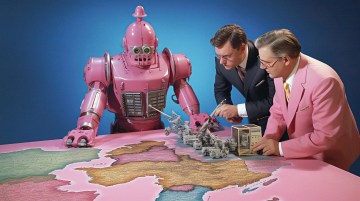
 Virginia Heffernan has appeared in our pages only once before, also reviewing a book. She is one of the great writers in the English language, but often on topics not connected to our themes here. While we mostly are interested in topics related to the natural world, and we know that this topic is a whole other realm, we can guess that AI’s impact on the natural world is part of what the title of this issue of Wired will mean to us pretty soon:
What If the Robots Were Very Nice While They Took Over the World?
First it was chess and Go. Now AI can beat us at Diplomacy, the most human of board games. The way it wins offers hope that maybe AI will be a delight.
THE MORRISSEY HAD the right melodrama in his limbs, and his voice was strong and pained. I was at Gramercy Theatre in Manhattan to see a Smiths tribute band. I tried to get Morrissey’s acid yodel in my throat, to sing along. I am human and I need to be loved / just like everybody else does. But it didn’t feel right to copy a copy.
Most tribute bands don’t practice outright impersonation, so the way this fake-Smiths singer captured everything about Morrissey was messing with my mind. I’d hoped to be able to savor the music’s maudlin glory without the headache of the flesh-and-blood Morrissey, who seems to have aligned himself with white supremacists. The contempt in Morrissey’s lyrics and politics was presumably not native to Seanissey, as the tribute singer called himself. Seanissey’s performance probably didn’t, as they say, “come from a bad place”—or a misanthropic place, or a far-right place, or even a vegan one.
What place did it come from? I’ve had this no-there-there anxiety with ChatGPT dozens of times. When it uses idioms like “in my life”—when it doesn’t have a life—I go cold. Likewise, to invest into Seanissey, a gentle Manhattanite who happened to sing and dance as Moz did, the passions that were first aroused in me by the Smiths 30 years ago felt like a bad emotional bet.
Maybe AI that aims to seem human is best understood as a tribute act. A tribute to human neediness, caprice, bitterness, love, all the stuff we mortals do best. All that stuff at which machines typically draw a blank. But humans have a dread fear of nonhumans passing as the real thing—replicants, lizard people, robots with skin. An entity that feigns human emotions is arguably a worse object of affection than a cold, computational device that doesn’t emote at all.
When I got home, stuck in an uncanny valley scored with Smiths Muzak, there was an email from Andrew Goff, widely considered the greatest Diplomacy player of all time.
This lifted my spirits. Diplomacy, a 69-year-old American strategy game, is, by many estimates, the most human game ever imagined. Mechanically, it’s simple: Seven players compete to control supply centers on a map, and a player wins by controlling more than half of these centers. But it’s played almost entirely in a series of conversations, often complex and impassioned ones. Agony and ecstasy—Moz-like agony and ecstasy, no less—commonly enter the negotiations. In the live game, players are known to yell, end friendships, throw the game, or simply sit by themselves and sob…
Read the whole essay here.
 Organikos