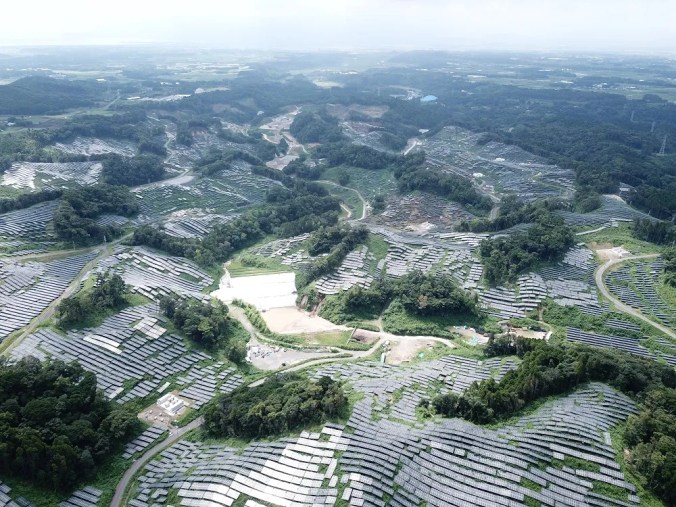
Once a golf course, now a solar farm supplying tens of thousands of homes in Japan
If you know a bit about Japan’s love of golf, the photo above says alot about leadership there in moving away from fossil fuels in the direction of alternative energy. But it is too little too late compared to what is happening elsewhere. Thanks as always to Bill McKibben for his newsletter:
Energy from Heaven
and not from Hell/Exxon.
Amid the torrent of hideous news last week, one item might have skipped your notice: Exxon announced the acquisition—its biggest since picking up Mobil a quarter century ago—of one of the largest fracking operators in the world. As the AP reported, “including debt, Exxon is committing about $64.5 billion to the acquisition, leaving no doubt of the Texas energy company’s commitment to fossil fuels.” In fact, it’s the declaration of conviction that they think they have enough political juice to keep us hooked on oil and gas for a few more decades, even in the face of the highest temperatures in 125,000 years.
Our job is to stop them (see, for instance, the gathering fight to block new export terminals for LNG).
And one way to do that is to point out, over and over, the sheer wonder of the replacements we have on hand. Which is to say, the sun, and also the wind that the sun produces by heating the earth more in some spots than others, creating the breezes that turn the turbines. I wrote last week that we were now adding a gigawatt of solar power daily around the planet, most of it in China. That’s great, but we need more and we need it fast—and so let’s just concentrate for a moment on the almost absurd beauty of the idea that we have learned to power the things we need from the rays of a burning orb that lies 93 million miles distant across the vastness of space. Let me provide just a few facts about where we lie right now with that transition.
#Every week new data emerges about the rapid fall in the price of solar, which as PV magazine reported this week seems to have “no end in sight.” This is incredibly good news for the poorest people on the planet, almost all of whom live in places with abundant sunlight, and where they are currently shipping huge amounts of money off to the US, Russia, Saudi Arabia and other hydrocarbon exporters: something like 80% of humans live in countries that have to import fossil fuels. The sun, by contrast, delivers its rays for free each morning.
#So far, the suddenly rapid spread of solar has not dramatically cut the use of fossil fuels, but analysts at the Rocky Mountain Institute said last week that that is coming fast. They reminded us to focus on “flows, not stocks.”…
Read the whole newsletter here.
 Organikos