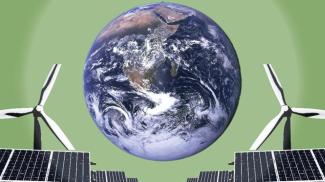
The energy transition will lead to wide-ranging transformations across economies. | MONTAGE ILLUSTRATION BY NIKO YAITANES/HARVARD MAGAZINE; PHOTOGRAPHS BY UNSPLASH
We applaud the Fund, especially for this work, even if the source of their money is problematic:
How the Bezos Earth Fund hopes to seed economic transformation
WHAT ARE THE BIGGEST economic obstacles to the needed rapid transition in energy supplies and the challenges of deforestation driven by climate change? Leon Clarke, director of decarbonization pathways at the Bezos Earth Fund, provided a brief philanthropic perspective on that question in a talk about energy policy at the Harvard Kennedy School during the last week of November. Founded in 2020 with $10 billion, the Earth Fund, Clarke said, is the largest philanthropy focusing on climate and nature. But not for long—the Fund aims to spend down that entire sum within 10 years and has already disbursed $2 billion.
Clarke, formerly research director for the University of Maryland’s Center for Global Sustainability, began by pointing out that “The transition to a low-carbon energy system” is already underway. The principal reason for the rapid shift to clean energy is obvious, he observed: in many parts of the world, wind and solar energy is now cheaper than fossil fuel-based production. The paradigm that once dominated environmental economics—that clean (low-carbon) energy would be costly, but bring other benefits—is no longer true. Putting aside the problem of periodic lack of sun or wind “The rhetoric around this,” Clarke said, “is moving into this space of economic opportunity.” And capital is following, by flowing to investments that produce energy less expensively. The private sector has already taken note by investing in clean energy, and now countries have also begun thinking about the clean energy transition as a potential economic opportunity.
Clarke therefore thinks about the shifts in the energy system less in terms of carbon mitigation—the kinds of issues (such as control of methane, a powerful greenhouse gas) that are the focus of the international COP 28 climate meeting scheduled to convene in Dubai on November 30—and more in terms of overcoming obstacles to economic transformation. That, he said, is where the greatest challenges and needs lie. Because changing the sources of energy production from fossil fuels to wind and solar will impact trade, industry, government finance, and the labor force, “climate policy is not just environmental policy” any more. The energy transition will lead to wide-ranging transformations across economies. “Those are the issues that are important now,” and they have implications for the field of economics as well, he argued, as the need for policy expertise in these areas has grown faster than the profession can move to meet the demand.
The “challenges we face now are how to rapidly evolve our economies, because this is not just about mitigation. It’s about economic transformation… and that is not easy.”
The cost of the energy transformation just in emerging and developing economies has been estimated at $1.3 trillion to $1.7 trillion annually. “If you think about all of the funding that’s needed for climate” change response, including resilience and adaptation measures, and preserving forests, the cost rises to perhaps $3 trillion to $4 trillion a year. These sums dwarf the scale of climate philanthropy, Clarke said, which totals less than $13 billion.
Therefore, “A lot of the work…in philanthropy now is trying to figure out how to incentivize private investment in a much more effective way,” he continued, “particularly in emerging and developing economies.” One of the Earth Fund’s investments has been in Allied Climate Partners, an $825 million philanthropic investment platform that aims to increase the number of climate-related projects and businesses in emerging economies by providing development capital and expertise to regional investment managers in Southeast Asia, Africa, India, the Caribbean, and Central America. The investors take an equity share in the early financing phase of projects, Clarke explained, and then sell that off as the projects advance in order to fund new projects in what they hope will be a self-sustaining cycle.
Another area of focus has been the especially difficult problem of political economy that arises from transitioning away from the old, fossil-fuel based regime. When clean energy is cheaper, Clarke pointed out, there is “a sense of let’s just build this” and the older infrastructure will “go away.” But that is not true. Abandoning fossil fuel-fired power plants, for example, will have large impacts on industry, trade, government revenue, and the labor force, for instance. (See “Preparing for the Energy Transition,” November-December 2023, page 11.)…
Read the whole article here.
 Organikos