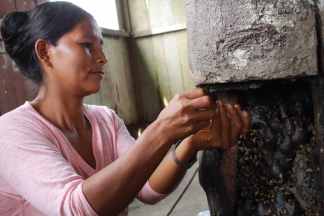
Tarkis Ríos Ushiñahua harvesting honey from stingless bees in a tree-trunk hive, at her home in Puerto Huamán in the Peruvian Amazon, 2019. [Hannah Hutchinson]
To begin, let this bring some joy:
A Sweet and Potent Harvest
For the Maijuna of the Peruvian Amazon, harvesting honey from stingless bees is bringing prosperity and empowerment. Local beekeeping might also help preserve a vast ancestral forest.When Tarkis Ríos Ushiñahua collects honey from one of her beehives, she wears no protective clothing and uses just one tool, a large plastic syringe. 1 As she lifts the lid from the wooden box housing the hive, the bees swarm. They buzz around her face, land on her back, and settle in strands of her straight black hair, but they do no harm — these bees are stingless.Tarkis Ríos Ushiñahua teaches her daughter to divide a hive, 2022. [Dylan Francis]
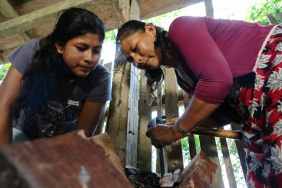

The bee yard of Loida Ríos Tamayo and Saúl Peterman Mosoline, 2021. [Enrique Redondo Navarro]
The slender tip of Ríos Ushiñahua’s syringe fits neatly inside the hive’s honeypots, brownish, papery-looking pouches that the bees have fashioned from wax and plant resins. Ríos Ushiñahua pulls the syringe’s plunger to move a tablespoon or so of honey from each honeypot into a clear glass jar. Her method is clean and efficient. In comparison to the viscous, sticky goo produced by Apis mellifera, the aggressive, stinger-toting honeybees native to Europe, stingless bee honey is thin, even watery.The honeybees buzz around her face, land on her back, and settle in strands of her hair. But they do no harm — these bees are stingless.
Apis mellifera supply nearly all commercial honey in the Global North, to the degree that the word “honey” is nearly synonymous with a food that is thick and golden, cloying and dense. Stingless bee honey, on the other hand — produced by bees of the Meliponini tribe, labeled “meliponines” by Western science — is a distinctly different substance. The honey’s color ranges from pale amber to deep saffron to dusky bluish green, though it can also be as clear as water. The flavor profile is delicate, singular. Discerning palates compare the nuanced character of stingless bee honey to that of fine wine or artisanal whiskey. Sweetness is but a single note in a complex that can include citrus, caramel, nuts, smoke, salt, and even musty earth and sour fruit, each in unique combinations and at varying levels of intensity. As with single-origin cacao or coffee, the honey’s flavor is tied to the place where it was sourced, both through the species of bee — there are 550 different varieties of meliponines worldwide — and the surrounding flora.A 43-year-old mother of five, Ríos Ushiñahua is a member of the Maijuna Indigenous group in the Peruvian Amazon. Stingless bees are culturally important to the Maijuna, and have been for countless generations. The Maijuna and other Indigenous peoples of the Amazon basin consume the honey produced by stingless bees as part of their diet, and use it medicinally to treat respiratory illness, skin ailments, arthritis, and other maladies. 2 Fifteen different species have unique names in Máíhiki, the language still spoken by most elders, and the Maijuna have a sacred traditional dance that mimics the motions and sound of bees swarming near their hive: the dancers expand and contract in a cluster, as they shake palm leaves and chant in deep, droning voices. Maijuna elders have extensive traditional knowledge about where and how the bees build hives, the uses of their honey, wax, and resin, and how to distinguish the various species.In recent years, however, the bees native to Maijuna lands have assumed a power even greater than Ríos Ushiñahua’s ancestors could have imagined. Maijuna beekeepers have begun to cultivate, harvest, and sell stingless bee honey, and the resultant income has transformative potential. There is a vast, ecologically intact rainforest landscape that sustains the Maijuna, physically and culturally; the tiny stingless bee may be key to protecting it…
Read the whole article here.

