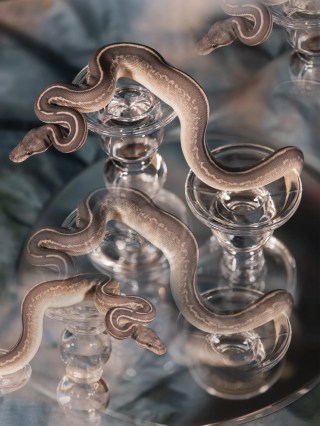
A “leopard blackhead Mojave hypo black axanthic” ball python: what sounds like an incantation is a catalogue of desirable mutations. Photograph by Delaney Allen for The New Yorker
Breeding animals in captivity is a topic we have pointed to in several posts. Sometimes the topic is ethics; other times it is about conservation of a species on the brink of extinction. Pythons somehow show up in our pages more frequently than captive breeding. Almost 15 years since Burkhard Bilger brought to our attention the topic of pythons and other animals invading new habitats that set off our python fascination, here is one at the intersection of captive breeding and ethics:
The Snake with the Emoji-Patterned Skin
In the wild, ball pythons are usually brown and tan. In America, breeding them to produce eye-catching offspring has become a lucrative, frenetic, and—for some—troubling enterprise.
“Sometimes your odds are one in two hundred and fifty-six, or one in five hundred and twelve, to make the snake you’re thinking about,” Justin Kobylka, a trendsetting breeder and the owner of Kinova Reptiles, said. Photograph by Delaney Allen for the New Yorker
On a fall day in Gainesville, Georgia, Justin Kobylka, the forty-two-year-old owner of Kinova Reptiles, was preparing to cut open two clutches of snake eggs. He was hoping to hit upon some valuable, beautiful reptiles. Kobylka is a breeder of designer ball pythons—one-of-a-kind, captive-bred snakes whose skin features colors and patterns not usually found in nature. “I think of myself as an explorer,” he told me. Nicking an egg with a pair of surgical scissors, he exposed a live hatchling in its goo. “Even when they haven’t yet touched air, you can sometimes see the tongue going,” he said, making a flicking gesture with his thumb and fingertip.
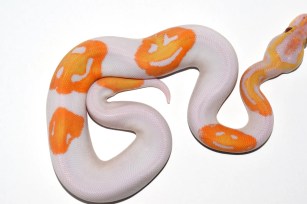
Kobylka had been trying to produce a “dreamsicle”—a white ball python with splotches of tangerine—but three of the circular markings on the snake looked like smiley faces. His video of the “emoji python” went viral. Photograph courtesy Kinova Reptiles
We were standing in a six-thousand-square-foot climate-controlled outbuilding that housed some two thousand pythons, which were kept in individual plastic trays slotted into tall metal racks. The space, which cost nearly a million dollars to build and outfit, was immaculate and well lit, with corner-mounted industrial fans and glossy floors. A vague odor of musk and Clorox was all that hinted at the daily chores of snake husbandry.
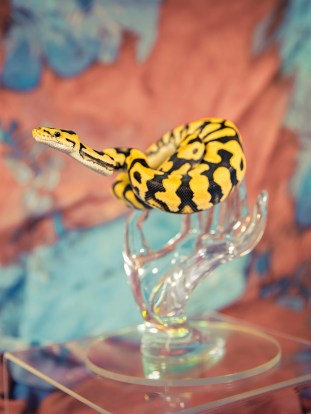
Ball pythons originated in Africa, and in the wild they are typically dark brown with tan patches and a pale underbelly. Those bred for their appearance, as Kobylka’s have been, often have a brighter palette, from soft washes of pastel to candy-colored bursts of near-fluorescence. Their patterns, too, have been transformed: a snake might be tricked out with pointillist dots, or a single dramatic stripe, or colors dissolving into one another, as in tie-dye. One captive-bred ball python’s splotches and squiggles show up only under a black light. These changes reflect genetic mutations, which breeders call morphs. (The term is also used as shorthand for the snakes themselves.) World of Ball Pythons, a repository of information related to breeding, has catalogued more than seven thousand morphs in the past thirty years—though the actual number likely exceeds that by several thousand. “Evolution can go very fast,” the animal-domestication expert and paleobiologist Marcelo Sánchez-Villagra, a professor at the University of Zurich, told me, adding that the variety of “ball pythons may be extreme even among reptiles.” Arguably, no other snake, lizard, or turtle has been so sweepingly restyled by human effort.
The animals Kobylka breeds at Kinova are sold to collectors, independent pet stores, and élite breeders who want to replicate, or even improve on, their design. The launch of a new morph is sometimes called a “reveal” or a “drop,” echoing the language of luxury-sneaker culture, and there are ball-python Internet forums that roil with opinion about which morphs are the hottest, and which ones aren’t worth the hype. The most coveted morphs have commanded higher prices than giraffes, lions, and tigers have at auction. “I’ve had offers of over a hundred thousand dollars on a snake,” Kobylka said. “But the way I operate, it’s important to keep those snakes for my future work. You actually lose money long-term if you sell the most amazing thing at the time.”
Kobylka, who is six feet two, was wearing a gray Lacoste polo, charcoal-colored jeans, and Adidas Sambas; he has dark hair, which he keeps short. In the first clutch, which had nine eggs, he was aiming, he said, for an “orange dream, yellow belly, enchi, leopard, desert ghost, carrying axanthic and clown genes.” What sounded like an incantation was a catalogue of desirable mutations. (“Clown,” for example, is named for teardrop shapes that show up under the eyes, like the stylized tears of a clown.) As a breeder, Kobylka always has a “goal snake” in mind. “You’ve done a lot of mental work to imagine it, usually years in advance,” he told me, describing a process of zeroing in on specific traits using the known heritability and interaction of genes. “Sometimes your odds are one in two hundred and fifty-six, or one in five hundred and twelve, to make the snake you’re thinking about,” he said. “The thing that makes it so addicting for me is the fact that there’s a large amount of chance involved.”
Kobylka has been breeding snakes for more than twenty years and is known as a trendsetter in the field, which is both close-knit and competitive. Courtney Capps, a co-founder of Leviathan Snakes, in South Carolina, observed that buyers are sometimes so proud of owning a Kinova python that, when it comes time to sell its offspring, they’ll note in the listing, “Mom was produced by Justin.” Kobylka gained an even wider audience in 2016, after he opened up an egg to find a white snake patterned with three orange smiley faces along its body. He had been trying to produce a “dreamsicle”—a white ball python with splotches of tangerine—but most of the circular markings on this snake had two eyes and a grin. Kobylka posted an image on his company’s Facebook page, and, when someone suggested in a comment that the photograph had been edited, he made a fifteen-second video that showed him turning the baby python from side to side to display its distinctive motif. The video of the “emoji python” went viral, and the story of the unusual snake was covered by Esquire, Business Insider, and the New York Post, among other outlets…
Read the whole article here.
 Organikos