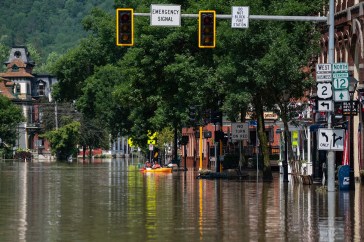
Vermont’s capitol city, underwater in epic July flooding that wrecked most of Montpelier’s retail district
Holding the responsible accountable is part of Bill McKibben’s objective; he also provides sunshine. Subscribe to this newsletter if you can:
States are considering ‘climate superfund’ laws to hold Big Oil accountable
One prong of the climate fight involves installing so much renewable energy that fossil fuel use actually declines dramatically—a few places are finally showing that’s possible, like sunny Germany which last week said emissions in 2023 dropped more than ten percent.
But if that’s going to happen everywhere, and fast enough, it’s going to require the other prong: holding back the fossil fuel industry. The problem is that the politics of oil-producing countries don’t allow it—that’s why the Inflation Reduction Act was all carrots/no sticks. And it’s not just DC—in Lula’s progressive Brazil the national oil company, already Exxon-sized, said last week it plans on outproducing all its peers except Saudi Arabia and Iran by 2035.
So you need a mechanism for places where there is no oil in the ground to inflict some hurt on Big Oil—and get some justice at the same time. Like, Vermont. And New York, and Maryland, and Massachusetts.
In a just world, Big Oil would be criminally prosecuted, since investigative reporting has made it abundantly clear that it knew what it was doing (Aaron Regunberg and David Arkush last week laid out an excellent argument as to why these companies could be charged with homicide). In civil court, jurisdictions can simply sue the fossil fuel industry, and that’s actually been happening more and more often (on Wednesday a Belgian farmer sued French energy giant Total for making his life harder). Suits like that—many premised on the fact that Big Oil clearly knew about the dangers they were causing—are wending their way through the American courts, but our justice system is a) slow and b) bent in the direction of the powerful.
So legislators are opening up another front—”climate superfund” laws that treat disasters like Vermont’s summer flooding as if they were a toxic dump whose cleanup can be charged to the corporation that caused them. That would have been hard even a few years ago, but “climate attribution” science is now robust: it’s increasingly easy to prove that absent global warming we wouldn’t have the endless downpours/droughts/fires. If a chemical company pollutes a site, the superfund law has been a way to make it pay for the remediation—so if Vermont’s flooding cost its taxpayers $2.5 billion to repair, why should they be on the hook?
I’m talking about Vermont because it might be the first state to adopt such a law, as it was the first to abolish slavery or allow civil unions—the legislature and the governor will decide in the next few weeks. And I’m talking about it because I live here, in a town that is struggling to pay for the repairs to its roads after last summer’s record flooding. We heard the sobering litany at town meeting earlier this month; every culvert makes it that much harder to keep our school open. New York is also close to passing such a law, and perhaps Maryland and Massachusetts, as Katie Meyers pointed out in Grist recently—all of them states without significant hydrocarbon production, and all of them states with a lot of climate damage…
Read the whole newsletter here.
 Organikos