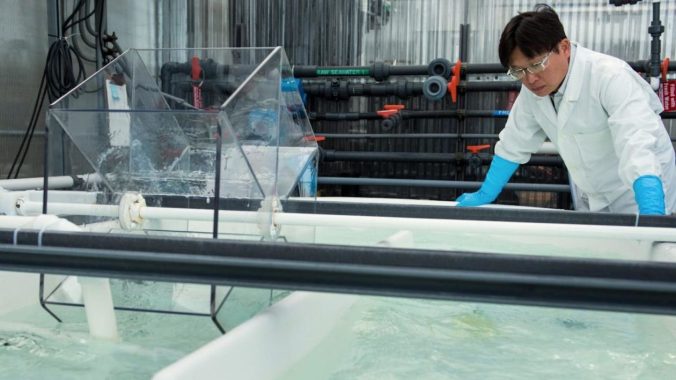
A system for testing technology to draw minerals from seawater at the Pacific Northwest National Laboratory in Sequim, Washington. PACIFIC NORTHWEST NATIONAL LABORATORY
Thanks as always to Jim Robbins and Yale e360:
In Seawater, Researchers See an Untapped Bounty of Critical Metals
Researchers and companies are aiming to draw key minerals, including lithium and magnesium, from ocean water, desalination plant residue, and industrial waste brine. They say their processes will use less land and produce less pollution than mining, but major hurdles remain.
Can metals that naturally occur in seawater be mined, and can they be mined sustainably? A company in Oakland, California, says yes. And not only is it extracting magnesium from ocean water — and from waste brine generated by industry — it is doing it in a carbon-neutral way. Magrathea Metals has produced small amounts of magnesium in pilot projects, and with financial support from the U.S. Defense Department, it is building a larger-scale facility to produce about 200 tons of the metal a year. By 2028, it says it plans to be operating a facility that will annually produce more than 11,000 tons.
Magnesium is far lighter and stronger than steel, and it’s critical to the aircraft, automobile, steel, and defense industries, which is why the government has bankrolled the venture. Right now, China produces about 85 percent of the world’s magnesium in a dirty, carbon-intensive process. Finding a way to produce magnesium domestically using renewable energy, then, is not only an economic and environmental issue, it’s a strategic one. “With a flick of a finger, China could shut down steelmaking in the U.S. by ending the export of magnesium,” said Alex Grant, Magrathea’s CEO and an expert in the field of decarbonizing the production of metals.
“China uses a lot of coal and a lot of labor,” Grant continued. “We don’t use any coal and [use] a much lower quantity of labor.” The method is low cost in part because the company can use wind and solar energy during off-peak hours, when it is cheapest. As a result, Grant estimates their metal will cost about half that of traditional producers working with ore.
Magrathea — named after a planet in the hit novel The Hitchhiker’s Guide to the Galaxy — buys waste brines, often from desalination plants, and allows the water to evaporate, leaving behind magnesium chloride salts. Next, it passes an electrical current through the salts to separate them from the molten magnesium, which is then cast into ingots or machine components.
While humans have long coaxed minerals and chemicals from seawater — sea salt has been extracted from ocean water for millennia — researchers around the world are now broadening their scope as the demand for lithium, cobalt, and other metals used in battery technology has ramped up. Companies are scrambling to find new deposits in unlikely places, both to avoid orebody mining and to reduce pollution. The next frontier for critical minerals and chemicals appears to be salty water, or brine…
Read the whole article here.
 Organikos