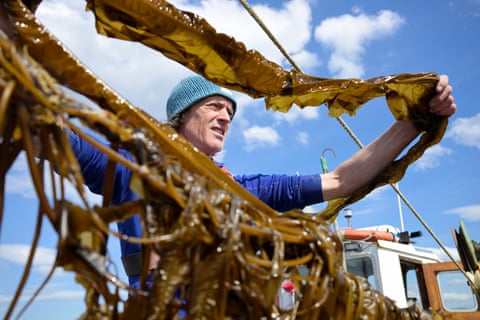
Alex Glasgow of KelpCrofters harvesting the seaweed on Skye
Most of us in the Americas and the European region have not yet had the opportunity to try seaweed, except perhaps in Japanese or other Asian ethnic restaurants. So hearing what the folks who grow seaweed in Scotland are doing with their product to get more of us interested in it–that’s interesting. For these photographs by Christian Sinibaldi and words by Joanna Moorhead we thank the Guardian:
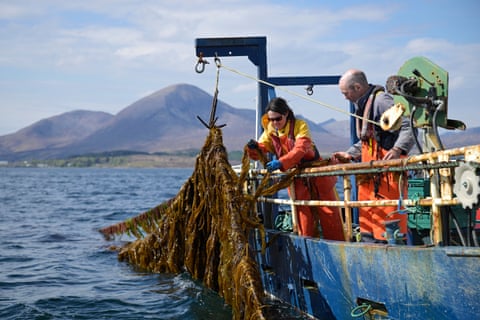
Kyla Orr and Martin Welch of KelpCrofters check the crop from their boat. Photograph: Christian Sinibaldi/The Guardian
Kelp help? How Scotland’s seaweed growers are aiming to revolutionise what we buy
Farmed kelp could produce plastic substitutes, beauty products and food supplements. Just steer clear of seaweed chocolate
Think sun, sea, Skye – and seaweed. It’s early summer off the west coast of Scotland, and Alex Glasgow is landing a long string of orangey-black seaweed on to the barge of his water farm. It emerges on what looks like a washing line heavy with dirty rags, hoicked up from the depths. And yet, this slippery, shiny, salty substance might, just might, be going to save the planet.
When it comes to sustainability, seaweed is about as shipshape as it gets. Minimal damage to the environment, check. No use of pesticides, check. Diversifies ocean life, check. Uses no land, check. And, in the case of Skye’s seaweed farm, spoils no one’s view, check.
Indeed, a few minutes earlier, as we sped across the Inner Sound between Skye’s second-biggest settlement, Broadford, reputedly the birthplace of Drambuie, and the tiny island of Pabay, it was hard to work out the seaweed farm’s location. Eventually the boat slows as we near a few floats bobbing around on the water. They are the only visible sign that anything is happening here, yet below the surface is an underwater grid stretching 500 metres by 200 metres, growing about 8km worth of lines of kelp. The annual yield of seaweed, Glasgow explains, is now about seven tonnes. “It’s perhaps the quickest-growing biomass on the planet,” he says. “At this time of year, peak growing season, it can double its size in a fortnight – so five tonnes of seaweed today will be 10 in two weeks.”…
Read the whole article here.
 Organikos