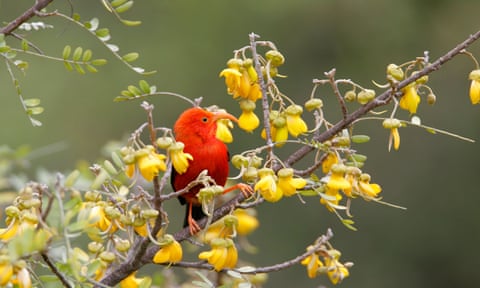
The scarlet honeycreeper, or ‘i’iwi, has a 90% chance of dying if bitten by an infected mosquito. Thirty-three species of the bird are already extinct. Photograph: Photo Resource Hawaii/Alamy
We had not heard of such risk to birds before, but this may be the rare case of mosquitoes potentially serving a good purpose:
Millions of mosquitoes released in Hawaii to save rare birds from extinction
Conservationists hope insects carrying ‘birth control’ bacteria can save honeycreeper being wiped out by malaria
Millions of mosquitoes are being released from helicopters in Hawaii in a last-ditch attempt to save rare birds slipping into extinction.
The archipelago’s endemic, brightly coloured honeycreeper birds are dying of malaria carried by mosquitoes first introduced by European and American ships in the 1800s. Having evolved with no immunity to the disease, the birds can die after just a single bite.
Thirty-three species of honeycreeper have become extinct and many of the 17 that remain are highly endangered, with concerns some could be extinct within a year if no action is taken. Now conservationists are urgently trying to save them with an unusual strategy: releasing more mosquitoes.
Every week a helicopter drops 250,000 male mosquitoes with a naturally occurring bacterium that acts as birth control on to the islands of the remote archipelago. Already, 10 million have been released.
“The only thing that’s more tragic is if [the birds] went extinct and we didn’t try. You can’t not try,” said Chris Warren, the forest bird programme coordinator for Haleakalā national park on the island of Maui.
The population of one honeycreeper, the Kauaʻi creeper, or ʻakikiki, has dropped from 450 in 2018 to five in 2023, with just one single bird known to be left in the wild on Kauaʻi island, according to the national park service.
Honeycreepers have a canary-like song and incredible diversity: each species has evolved with special beak shapes, adapted to eating different foods, from snails to fruit to nectar. They are an important part of the ecosystem, helping to pollinate plants and eating insects…
Read the whole article here.
 Organikos