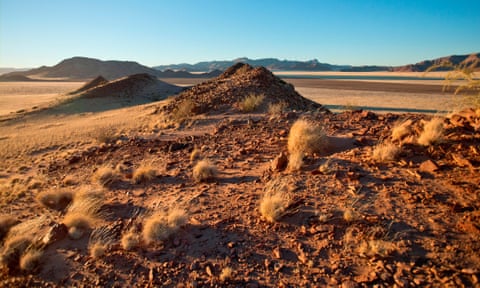
Namibia has a severe housing shortage, with woody encroacher bush reducing the amount of land available for building. Photograph: Hoberman Collection/Universal Images Group/Getty
Mycological options for solving problems are abundant. We had not considered odor as a key potential obstacle, so thanks to Ester Mbathera for this reporting from Namibia:
‘People think they’ll smell but they don’t’: building homes from mushroom waste and weeds
A sustainable project aims to repurpose encroacher bush to create building blocks to solve Namibia’s housing crisis
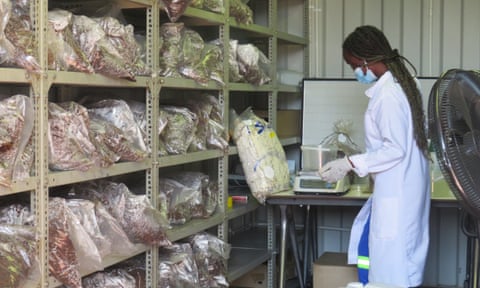
The remnants of the oyster mushrooms grown on weeds of encroacher bush will be used to create building blocks. Photograph: Ester Mbathera
People think the house would smell because the blocks are made of all-natural products, but it doesn’t smell,” says Kristine Haukongo. “Sometimes, there is a small touch of wood, but otherwise it’s completely odourless.”
Haukongo is the senior cultivator at the research group MycoHab and her job is pretty unusual. She grows oyster mushrooms on chopped-down invasive weeds before the waste is turned into large, solid brown slabs – mycoblocks – that will be used, it’s hoped, to build Namibian homes.
“We wanted a new, better way to curtail the housing crisis and a sustainable way to curb the negative effects of the encroacher bush on our environment,” said Magreth Mengo, the head of brand and marketing at Namibia’s Standard Bank. The bank worked with MycoHab – when it was affiliated with the Massachusetts Institute of Technology, the architecture firm Redhouse Studio and the Shack Dwellers Federation of Namibia (SDFN) – to find a sustainable way to deal with several issues. “This project is a first of its kind and is still very much in the experimental phase but shows a lot of promise,” said Mengo.
Namibia, with a population of about 2.7 million, urgently needs at least half a million new homes to address its severe housing shortage. Nearly 90% of households earn less than N$2,700 ($144.69) a month, according to 2016 figures, and can’t afford a home. One in five people live in makeshift homes made out of waste materials or zinc sheets…
Read the whole article here.
 Organikos