A Tiger’s Tale

Photo credit: Sudhir Shivaram

A few months ago I wrote about the RAXA Collective and Pixetra Photography master bird photography class held at Cardamom County. It was an amazing experience in and of itself, but it also gave us the opportunity to meet the instructor, wildlife photographer Sudhir Shivaram, and some talented participants, one of whom is now a contributor to our site. (I’m always keeping my hopes up that others will join her!)

During the 3 day workshop, between treks in the Periyar Tiger Reserve, the Megamalai Wildlife Sanctuary and a private 200 acre cardamom plantation, I spoke with Sudhir about his experiences as a photographer and an ambassador for Indian wildlife conservation.

He’s been photographing wildlife in India for well over a decade, so I asked him to describe his most memorable “capture”. He shared this experience from 2006 in the Bhadra Tiger Reserve:

10 years of wildlife photography and I had never seen a tiger in the wild, let alone photographing one. Many of my friends advised me to go to Bandhavgad if I wanted to see a Tiger. But I always had the wish to see my first Tiger in the wild in the south Indian forests. On March 17th 2006, I had seen my first tiger at BRT Wildlife Sanctuary- just the body and the tail. That too for a fraction of a second. And this visit to Bhadra along with Vijay and Yathin proved to be a lucky one. I had shot my first Leopard at Bhadra on 31 Oct 2004 (which is my website logo). And 2 years later, I was seeing and photographing my first Tiger at the same place. Here’s the sequence of events which followed then. Continue reading
Collaborative Poaching-Patrol

The Hindu— File Photo

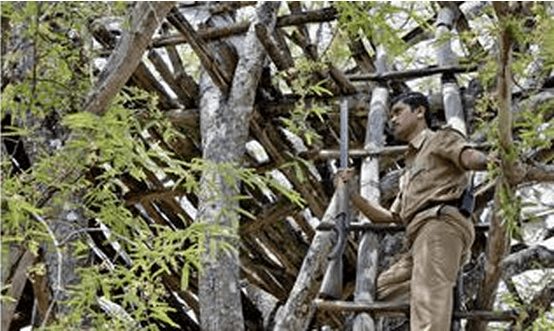
We’ve written about the importance of forest stewards before, primarily because in many cases they straddle the roles of guard and guide within the territories they protect. But many of those protected areas in India are suffering from severe shortages of qualified field staff, putting enormous areas of land, not to mention the wildlife that call it home, at risk.

But the Karnataka Eco-Tourism Development Board is initiating an innovative plan to train volunteers to be forest naturalists who will assist the forestry department a minimum of two weeks per year in their anti-poaching activities.

In order to create this pool of trained volunteers, the Karnataka Eco-Tourism Development Board is offering, for the first time in the country, three- and four-day Naturalist and Volunteer Training. The board is offering the training programme in association with Jungle Lodges and Resorts Ltd. Continue reading

Lonesome George Makes His NYC Debut

There’s something unsettling about taxidermy and the lifelike diaramas that I grew up seeing at museums.  But the research that goes into each zoological and botanical detail serves a monumental educational purpose for visitors and scientists alike. And in a “Last Chance to See” context, there are cases where those diaramas are the only way both current and future generations are able to have a face to face experience with extinct species.

A little over a year ago the icon of Galapagos conservation “Lonesome George” died of natural causes. Although property of the people of Ecuador, he is considered an example of World Heritage Patrimony. Researchers froze his body and shipped it to the American Museum of Natural History for preservation and a temporary exhibition in New York. Continue reading

WED 2013: The Fourth “R”

WED 2013 - Raxa Collective

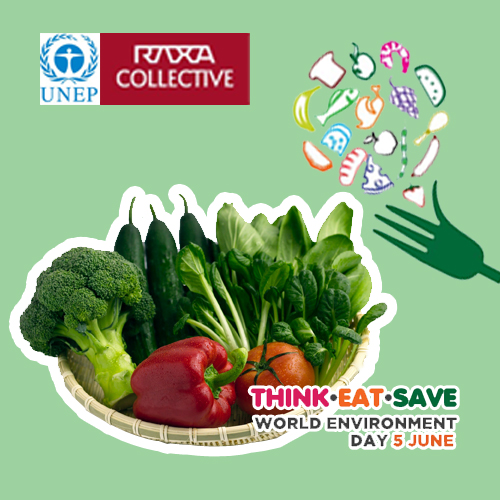
On June 5, we’ll celebrate World Environment Day. This year UNEP focuses on the theme Food waste/Food Loss. At Raxa Collective we’ll be carrying out actions and sharing experience and ideas. Come and join us with your ideas and tips to preserve foods, preserve resources and preserve our planet.

Recently when thinking about the universal recycling symbol it occurred to me that many of our expectations on how basic human needs are met can be influenced by the three concepts of Reduce, Reuse and Recycle.

Continue reading

“Nature, Red In Tooth and Claw”

Photo credit: Srinivasa Addepalli

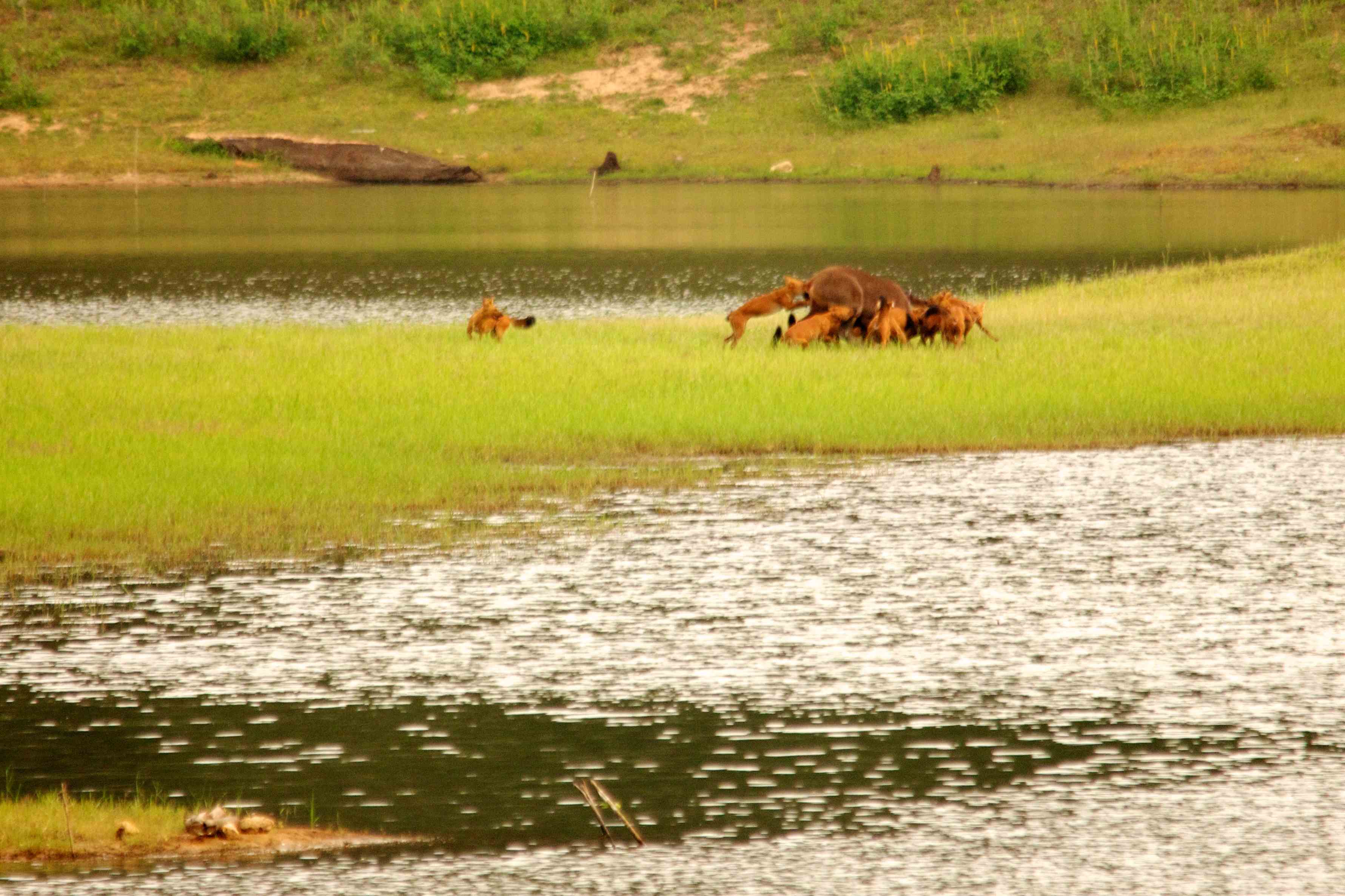
One of the things I love most about the Periyar Tiger Reserve is the knowledge that it’s a vibrant ecosystem whose 900+ square kilometers supports a small but healthy population of tigers. For many people actually seeing a tiger is their primary goal when trekking in PTR. I would be lying if I said that I wouldn’t care to see one, but it would be just as much a lie to say that’s all I care about. The forests and grasslands that form the habitat for the many animals that the tigers prey on astounds me each time I’m there, and tigers aren’t the only predators who make PTR their home. Leopards, sloth bear, wild cats and Indian dhole (wild dog) hunt  sambar deer, Indian gaur, wild boar, porcupine, and even the majestic elephant — all part of the natural food chain and the drama of the hunt is played out daily in the Periyar Tiger Reserve. Continue reading

Lost and Found In Ghana

White-necked Picathartes - Photo Credit: David Shackelford Rockjumper Birding Tours

White-necked Picathartes – Photo Credit: David Shackelford Rockjumper Birding Tours

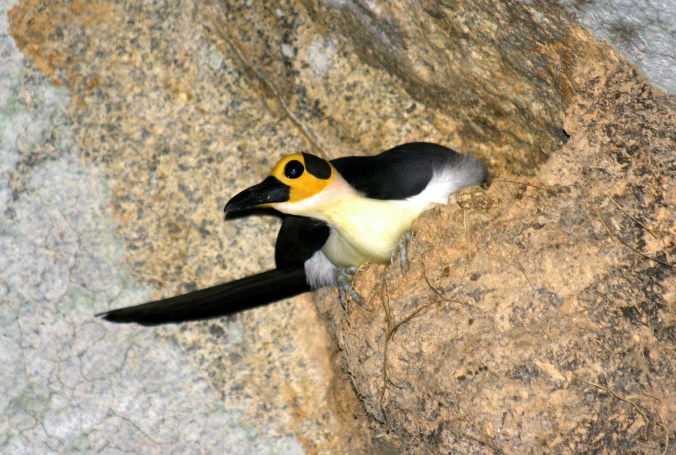
In March we’d introduced the White-necked Rock Fowl in our Bird of the Day series, and then neglected to tell the full story behind this charismatic bird. Shame on us! But better late than never I’m happy to share it now.

West Africa’s Upper Guinean forest block stretches along the coast from Sierra Leone to Ghana, and along with the Congolian forest block is considered a biodiversity hotspot. Up until the mid-1960s-early 1970s it is believed there were at least 200-300 breeding pairs of the endemic white-necked picathartes in Ghana alone. But up until 10 years ago there hadn’t been reports of the bird for nearly 4 decades, leading conservationists to believe it eradicated from the region.

Our colleague John Mason from the Nature Conservation Research Centre (NCRC) in Ghana has provided us with this fascinating story:

Efforts to locate rockfowl were not successful until 2003, when a research team from Louisiana State University, working in collaboration with NCRC and WD, re-discovered rockfowl in Ghana.  A single individual was mist-netted and one breeding site was recorded in the Subim Forest Reserve.  Subsequently the Ghana Wildlife Society located two additional colonies near this first site.  Continue reading

Nano-Journey

India is unique, says Thomas Chacko after his mega carathon

India is unique, says Thomas Chacko after his mega carathon

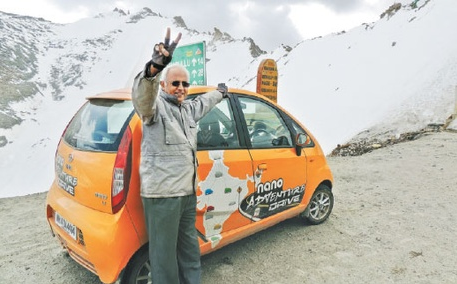
When Jules Verne wrote his novel Around the World In 80 Days 140 years ago the protagonist Phileas Fogg has to manage a circumnavigation of the globe by myriad types of transport, including by elephant during his crossing of India. He wouldn’t have dreamt of a tiny motorized vehicle like the one pictured above.

Author and motorcar enthusiast Thomas Chacko didn’t try to mange the world in 80 days, only India herself. Chacko, a Keralite, documented his journey in “real time” using the entertaining blog Mano et Nano, as well as a book, Atop the World, after the conclusion of his 26,500-km journey in a Nano car to all the state capitals, as well as the Union Territories, and the far corners of India. The journey, which began on May 3,  2012, concluded on July 20, last year.

In an interview with The New Indian Express Chacko commented:

Only one other country can compare with India, in terms of terrain, and that is the USA. We have beaches, mountains, hills, forests, deserts, swamps and canyons. You don’t have to go out of India to see and experience all this. Apart from that, no country has as many languages or communities. India is unique. Continue reading

Washington D.C.’s Green Carpet

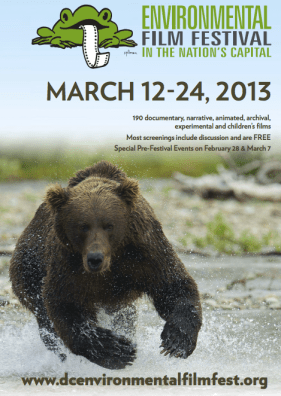
When our new contributor ÉA Marzate wrote about a recent film festival it had the added benefit of providing the incentive to explore similar festivals worldwide. I’d nearly missed the DC Environmental Film Fest, which boasted documentaries that overlapped with those screened in Paris as well as some that touch a direct personal chord with RAXA Collective. (As I live in India, I use the word “missed” figuratively of course!)

I’m referring to the U.S. Premier of the 2012 BBC film Lonesome George and the Battle for the Galapagos. Continue reading

Metal, Craftily Crafted

This slideshow requires JavaScript.

Brazilian artist Vik Muniz has been on our radar for quite some time.  Partially because his work redefines the concepts of waste and the proper “mediums” in art, but mostly because his work is just plain fun. While some previous series have used medium as bizarre as dust, granulated sugar or  melted chocolate, the prints exhibited at the 2013 New York Armory Show were created with the metal waste of the modern world.

Muniz is not only a master at recycling but at keeping his viewer completely off balance with his sense of scale. His 3 dimensional collages, whether made of scrap metal like the ones in the slideshow above, or with more “generalized garbage” as in the pieces depicted in the documentary The Waste Land, are orchestrated piece by piece from a 20 meter vantage point. For example, at first glance the hummingbird image looks as shimmeringly delicate as a Hupert Duprat/caddisworm collaboration, but wait! Are those paint cans, bed springs and automobile tire hubs I see? Continue reading

Exoskeletal Bling

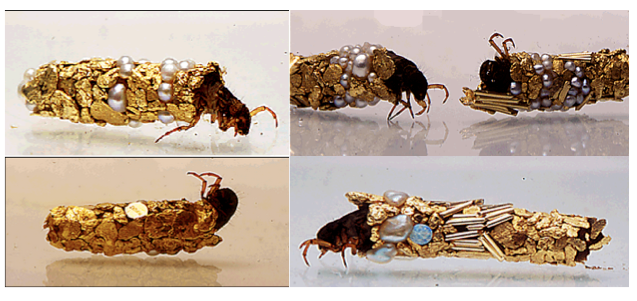
The caddis worm (order Trichoptera) may not be as popular as its famous shiny cousin, the scarab beetle, but it carries the extra charisma of an intrinsic aesthetic behavior.

French artist and science enthusiast Hubert Duprat took his natural curiosity to an elaborate level when he began providing these case building larva with gold spangles and semi-precious materials in lieu of the bits of sand and gravel they would normally use.

An amazing observation is that the worms seem to approach their work with an artistic eye, choosing the color and quality of the materials they use. In the 1930s an American entomologist observed in a Nevada river that “among all the little particles of sand and minerals swept along by the water, the Trichoptera make meaningful selections of bright blue opals—in other words, the most conspicuous or garish materials.” Continue reading

Kochi’s Foodways Celebrated

Joan Nathan's Cochin Coriander-Cumin Chicken for Passover, adapted from Queenie Hallegua and Ofera Elias - cooked and styled by Andrew Scrivani  NYTCREDIT: Andrew Scrivani for The New York Times

Joan Nathan’s Cochin Coriander-Cumin Chicken for Passover, adapted from Queenie Hallegua and Ofera Elias – cooked and styled by Andrew Scrivani NYTCREDIT: Andrew Scrivani for The New York Times

We are always pleased to see Raxa Collective’s hometown in the news, but especially when the coverage focuses on cultural history in the part of town where we are developing a new property. Fort Kochi’s harbor area, including Bazaar Road where Spice Harbour (a waterfront hotel opening later this year, more on which in a future post) is located and where the spice trade is centered, completes the domestic route of the Malabar Coast’s spice trade. Spices are grown throughout the Western Ghats, they make their way down to sea level for transport in the coastal backwaters, and a large percentage end up on Bazaar Road where merchants, traders, godown (warehouse) keepers and others prepare them for shipment.  This has been the way of the spices for millennia, though Fort Kochi’s harbor has played its role in the spice route only in recent centuries. The New York Times writer Joan Nathan describes a culinary-religious heritage motivation for her visit here (minutes from our office location):

KOCHI, India — Dreaming of spices described in the Book of Kings, I came to this southern port city built in the 14th century to learn about its longstanding but tiny Jewish presence and its food, which some believe dates back to the time of the Bible. Continue reading

Gangsta Guerilla Gardening

Food activist Ron Finley campaigns to “change the composition of the soil” in his hometown of South Central LA. In place of the “food desert” made up of liquor stores and fast food (not to mention drive-by shootings) he and his volunteer organization LA Green Grounds plants “food forests” in abandoned lots, traffic medians and sidewalk parkways.

Finley’s point of view is a call to arms to change our conversation about food.

The city of LA leads the United States in vacant lots. They own 26 square miles in vacant lots. That’s the equivalent of 20 New York Central Parks. That’s enough space to plant 724,838,400 tomato plants.

As a combination vegetable graffiti artist and gardening gangster, Continue reading

Conservation Literacy

Photo Credit: John Mason

Photo Credit: John Mason

We’ve mentioned how an interpretive guide can bring the rainforest to life before. We’ve even touched on the fact that sometimes the best of those guides have “poacher” on their resumés, which follows a similar logic to the observation that often the most devoted practitioners of a religion are the newly converted. Here I’d like to point out a recent study by researchers from Wageningen University, along with Kenyan and British colleagues, published in a recent article in the journal Biological Conservation that correlates the levels of literacy and education with general conservation and the long-term protection of local wildlife.

The team of ecologists evaluated the number of elephants across Africa’s continental range, irrespective of political boundaries. The analysis included the numbers of individual elephants and determined the relation with 19 ecological variables, including rainfall, forage and water availability, and 15 human variables, including human density, welfare, literacy rate, and habitat fragmentation.

Although environmental factors such as the availability of food and water were obviously important, it appears that human factors—including policies, corruption, or the country’s economy—are even more important than environmental factors.

The authors write that:

…even for such charismatic species as the African elephant (Loxodonta africana)…we show through continent-scale analysis that ecological factors, such as food availability, are correlated with the presence of elephants, but human factors are better predictors of elephant population densities where elephants are present. These densities strongly correlate with conservation policy, literacy rate, corruption and economic welfare, and associate less with the availability of food or water for these animals. Continue reading

A Man. A Plan. A Canal. Gujarat.

Canal solar power: Gujarat has attracted investments of Rs 9,000 crore so far on solar energy projects.

To some it might seem odd to compare Gujarat’s innovative solar canal project to Panama’s nearly 100 year old global game changer. Although there are obvious and vast differences, there is also something powerfully familiar about the ultimate impact of the two projects.

While the 48 mile (77 km) Panama Canal saved ships traveling between the Pacific and Atlantic Oceans from taking the 8000 miles (12,875 km) journey around the southern tip of South America, the Solar Canal Project provides a duel purpose alternative energy system that both creates clean energy and conserves water. Continue reading

Rainforest Primer

Statistics:

  •   .03% of the world’s surface with 5% of the world’s biodiversity.
  •   130 species of freshwater fish
  •   160 species of amphibians
  •   208 species of mammals
  •   220 species of reptiles
  •   850 species of birds, including 52 species of hummingbirds alone
  •  1,000 species of butterflies
  •  1,200 varieties of orchids
  •  9,000 species of plants
  •  34,000 species of insects
  • twelve climatic zones
  • 5 types of forest: mangrove, rain forest, cloud forest, lowland tropical dry forest, deciduous forest
  • Landmass of 19,730 square miles – approximately the size of West Virginia

But statistics only tell a rather 2 dimensional story. Continue reading

Happy Birthday Ansel!

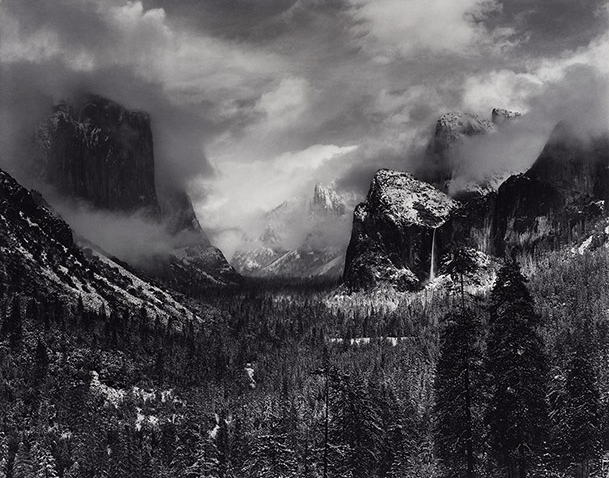
Clearing Winter Storm, Yosemite national park, California, about 1937

Clearing Winter Storm, Yosemite national park, California, about 1937

Ansel Adams has become almost synonymous with the environmental movement in general and Yosemite National Park in particular. He first visited the park when he was 14 and the impression he had at that age would last a lifetime. His photographs played a seminal role in convincing Congress to place that amazing landscape under federal protection.

Yosemite Valley, to me, is always a sunrise, a glitter of green and golden wonder in a vast edifice of stone and space. I know of no sculpture, painting or music that exceeds the compelling spiritual command of the soaring shape of granite cliff and dome, of patina of light on rock and forest, and of the thunder and whispering of the falling, flowing waters…

— Ansel Adams, The Portfolios Of Ansel Adams Continue reading

Tiffin Oeuvre

Subodh Gupta, Sara Hildén Art Museum, Tampere, Finland, 2011Photo: Jussi Koivunen

Subodh Gupta, Sara Hildén Art Museum, Tampere, Finland, 2011
Photo: Jussi Koivunen

One thing that the Nelson-Atkins Museum of Art and the Kochi-Muzuris Biennale 2012 have in common is the artist Subodh Gupta.

The Bihar born sculptor/painter/installation artist has been at work for twenty years but is currently at the vanguard of modern Indian art. He has taken the ubiquitous metal articles of India and followed the tenets of the 19th century conceptualist artists who elevated the ready-made and everyday into objets d’art. 

As Gupta describes his work

“All these things were part of the way I grew up. They are used in the rituals and ceremonies that were part of my childhood. Indians either remember them from their youth, or they want to remember them… Continue reading

Happy 75th Anniversary Caldecott!

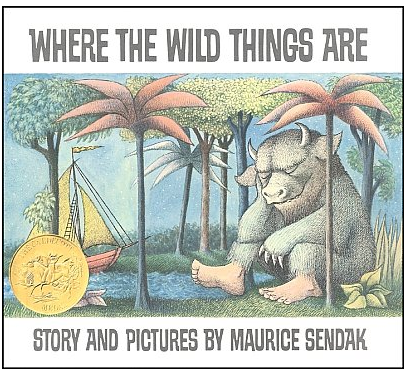
I’ve always loved books, and in many contexts those with fine illustrations are all the more powerful. That’s why I’m so grateful for the American Library Association’s Caldecott Medal for honoring the most distinguished American picture books.

The beloved titles are timeless – many are the same books that were read to me as I child, which I in turn read to my own children. I am confident this pattern will continue.

Listen to the story about this year’s winners here

Gravity and Grace

Arsenale installation from the Venice Biennale

Arsenale installation from the 2007 Venice Biennale

During a recent visit to the Nelson-Atkins Museum of Art in Kansas City I was struck by a 3-dimensional piece that combines the opulence of a Gustav Klimt painting and the earthy elegance of Ghanian Kente cloth. The comparison isn’t as bizarre as it might appear when it’s understood that its creator is the Ghanian artist El Anatsui. Over a decade ago the sculptor found a bag of thousands of colorful aluminum screw tops discarded by a local distillery. The artist began by cutting and folding the bottle tops into flat pieces then used copper wire to stitch them together, creating patterns inspired by his country’s iconic cloth. Continue reading

There’s Something About Audrey

Screen Shot 2013-01-06 at 8.56.14 AM

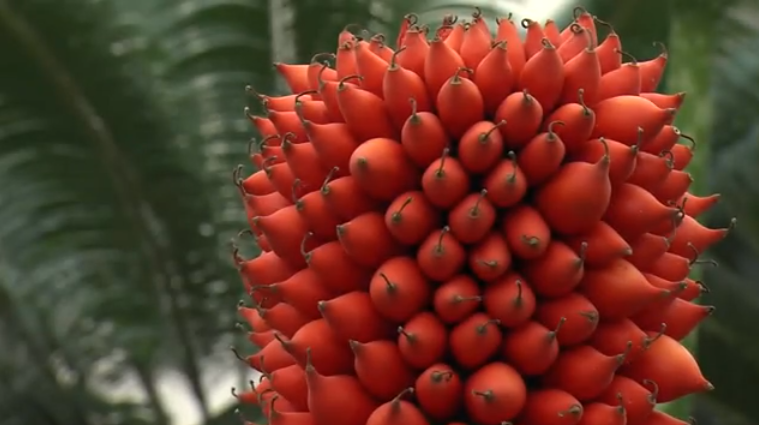
Last year I wrote about the eminent blooming of the rare Titan Arum, more fondly known as the corpse plant or in my posts “Audrey”, at Cornell University’s Kenneth Post Lab Greenhouse. The event was followed with quite a bit of fanfare, as these blooms allow for the assisted cross pollination of the various specimens around the world, thus hopefully insuring the survival of the species that is becoming more and more rare in the wild. Continue reading