Five Minutes Related To Taste

Screen Shot 2016-04-27 at 7.54.16 PM

By NATALIA V. OSIPOVA. Image by Joshua Thomas for The New York Times.

Thanks to the New York Times for continuing to reach for our attention (click above to go to the video):

Eduardo Rivera, a Mexican-born farmer living in Minnesota, is striving to make organic vegetables accessible to the Latino community.


The Intelligence Of Clever Animals

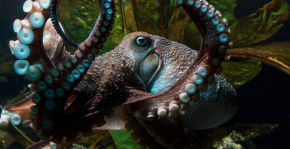
Riederer-Inky-the-Octopus-290x149-1461702146We are susceptible to stories that spotlight animal intelligence, and challenge our assumptions about the unique capacities of humans. Cleverness and intelligence can be difficult to parse, so the details of the story matters.  This one is better than most such stories for reasons we cannot quite explain:

Earlier this month, under the cover of night, an octopus named Inky hauled his basketball-sized body out of the tank he shared with a companion at the National Aquarium of New Zealand, heaved himself across the floor, and squeezed his gelatinous mantle into a narrow drain leading to the Pacific Ocean. Continue reading

Plants Attracting Pest Predators

Illustration by Dr. Otto Wilhelm Thomé via Wikimedia Commons

We’ve discussed ants living with plants in the past, actually in the context of acacia trees like Ed Yong mentions in his post. And there’s proof of plants sending pheromonal signals to wasps that will parasitize the caterpillars eating the plant’s leaves; this article in the NatGeo Phenomena blog reminds us of that:

Six years ago, Anke Steppuhn noticed that the bittersweet nightshade, when attacked by slugs and insects in a greenhouse, would bleed. Small droplets would exude from the wounds of its part-eaten leaves. At the same time, Steppuhn and her colleagues saw that the wild plants were often covered in ants.

These facts are connected. Steppuhn’s team from the Free University of Berlin, including student Tobias Lortzing, have since discovered that the droplets are a kind of sugary nectar, which the beleagured nightshade uses to summon ants. The ants, in return for their sweet meals, attack the pests that are destroying the plant. And this discovery provides important clues about the evolution of more intimate partnerships between ants and plants.

Continue reading

If You Happen To Be In Japan

27tb-fireflysquid1-superJumbo

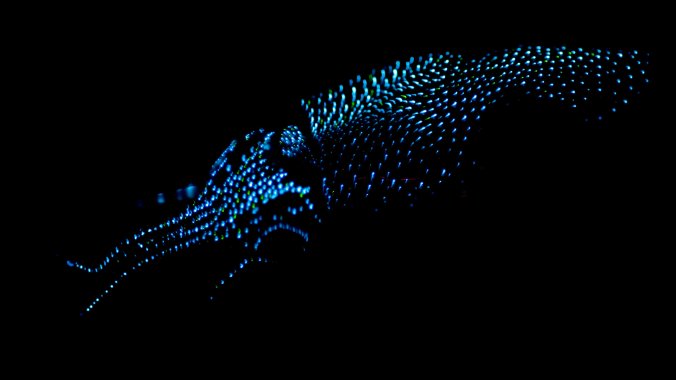
A firefly squid in Japan. The best time to see them is between March and June. Credit Michael Ready/Visuals Unlimited, Inc., via Getty Images

It is Science section day in the New York Times, and this story doubles as a travel recommendation:

Hop on a fishing boat in Toyama Bay, Japan, in the wee hours of the morning and you may feel as if you’re in a spaceship, navigating through the stars. That’s because each year, between March and June, millions of firefly squid transform the water into a galactic landscape. Lucky for you, all you need is a reservation to come aboard, your eyes and perhaps a really good camera.

The firefly squid may bring to mind a lightning bug. But the cephalopod is three inches long and flies through the sea, not the sky. And instead of a single light on its belly, it has five around each eye, three each on the tips of two of its arms and even more covering its body. Continue reading

South Australia’s Renewable Energy

Wind turbines at the Snowtown Facility.

Any story regarding the expansion and encouragement of renewables to promote sustainable development is a good story in our book, and we’re impressed by the Clean Energy Council policy manager’s statement, “If South Australia was a nation, it would be second only to Denmark [in renewables].” South Australia is a state in the middle of the southern coast of the country, about a hundred square miles larger than the US state of Texas, so it’s great to hear that such a large area relies so much on innovation. Kathy Marks reports for the Guardian:

In a state that leads the country – in fact, much of the world – in producing electricity from renewable sources, Snowtown is wind central. The first stage of a $660m, 270-megawatt farm, with 47 turbines, opened in 2008, 5km west of the town; the second, adding another 90 turbines, came on stream in 2014.

Developed by New Zealand’s Trustpower, South Australia’s biggest wind facility – and Australia’s second biggest – created hundreds of construction jobs and 21 permanent positions.

Continue reading

Good News for Manatees

Florida manatee Credit: Carol Grant/Getty Images via Scientific American

When we wrote about “sea-cows” before here it was in a post about water hyacinth. Now Scientific American is sharing some good news on the species that we weren’t aware about, with great increases in their population’s numbers. Sean Carroll reports:

Good news seems to be rare these days, and good news about the environment even rarer.

But in January this year, after fifty years on the endangered species list, the US Fish and Wildlife Service (FWS) proposed to remove the manatee as its numbers in Florida have increased 400% in the past 25 years. And just this month, the FWS proposed to delist the Greater Yellowstone grizzly population as the number of bears has increased from 136 in 1975 to about 700 today.

Continue reading

Reforesting the Amazon

NEW VENTURE: Deniston Mariano Dutra and his son Matheus Correia Dutra harvest cacao seeds. After giving up on cattle, the family replanted their farm with these indigenous trees. © Kevin Arnold via TNC

We care deeply about Amazonia, and Brazil is the country with the most deforestation in the river region, specifically from cattle ranching. But good news is coming from The Nature Conservancy in the April/May issue, where, as the article’s subtitle reads, “After decades of turning forests into pastures and fields, Brazilian landowners have begun reversing the trend.” Julian Smith reports for the TNC Magazine:

Lazir Soares de Castro stands amid white and gray Nelore cattle on his ranch in São Félix do Xingu, a remote and sprawling county on Brazil’s northeastern Amazon frontier. Beyond a wooden fence, high grass and scrub brush fade into sporadic trees in the distance.

Still vital at 70, Soares describes how different this area looked when he arrived in 1984, when it was all virgin rainforest. “It was the poorest area. There was no electricity, no telephone, no TV, no roads, nothing.” The military dictatorship then running the country was encouraging settlers to occupy the Amazon in the name of national security. “There was no organized environmental policy,” Soares says.

Continue reading

Private Property in the US

The sand hills of Alberta © Ken Ilgunas via NYTimes

We’d never given this issue much thought, but the idea of private property remaining accessible to others who will act responsibly as passersby is an interesting one. If nothing is damaged and the goal is simply to get from one place to the other, or enjoy nature without borders, then why not? Ken Ilgunas writes an opinion editorial for the Sunday edition of the New York Times:

A COUPLE of years ago, I trespassed across America. I’d set out to hike the proposed route of the Keystone XL pipeline, which had been planned to stretch over a thousand miles over the Great Plains, from Alberta, Canada, to the Gulf Coast. To walk the pipe’s route, roads wouldn’t do. I’d have to cross fields, hop barbed-wire fences and camp in cow pastures — much of it on private property.

I’d figured that walking across the heartland would probably be unlawful, unprecedented and a little bit crazy. We Americans, after all, are forbidden from entering most of our private lands. But in some European countries, walking almost wherever you want is not only ordinary but perfectly acceptable.

Continue reading

Re-Use That Amazing Phone

21techfix1-master675

Vincent Lai with the Treo he rescued. “A phone can last for a very, very long time,” he said. CreditNicole Bengiveno/The New York Times

No one on our team is exempt from the temptation to have the latest, greatest whatever. But we have gotten into the habit of reminding each other it is not always necessary. Frequently not. Almost never, actually. We never tire of sharing, and hope you never tire of reading, new stories about re-use, recycle and up-cycle options in our every day lives:

Choosing to Skip the Upgrade and Care for the Gadget You’ve Got

By

Vincent Lai was working at a recycling facility in New York and sorting through a bin of used cellphones a few years ago when he dug up a Palm Treo, a smartphone that was discontinued last decade.

Mr. Lai, 49, tested the Treo and found it still worked. So he took the device home and made it his everyday mobile companion, much as one would adopt an abandoned animal on its way to being euthanized. Continue reading

Eavesdropping on Primate Poachers

Preuss’s Red Colobus, one of the 25 most endangered primates in the world

We hate poaching, so any novel method of preventing it is good news in our opinion. From Claire Salisbury for Mongabay’s Great Apes series, on a new project to particularly protect the Preuss’s Red Colobus, a severely endangered primate in Africa:

Cameroon’s Korup National Park is home to elephants, chimpanzees, red colobus monkeys, drill, and a myriad of noisy species, whose squawks, squeals and howls fill the forest air. For more than two years, twelve acoustic monitors were deployed there and recorded every sound covering a 54 square kilometer (21 square mile) area of protected tropical forest.

They were tuned to listen around the clock for just one sound: gunshots.

“Our ultimate goal is to improve the effectiveness of anti-poaching patrols in African tropical forest protected areas,” Joshua Linder, one of the lead scientists working on the acoustic monitoring project, told Mongabay.

Bushmeat is a major source of protein in Central Africa, with 4.5 million tons extracted from the Congo Basin each year. Taking bushmeat itself is not always illegal, and it can be a vital source of protein for the poor and a valued commodity for the rich. But hunting endangered species, especially within protected areas, is against the law. It can pose a real threat to the survival of animal populations, and particularly to rare species.

Continue reading

New Mouse Lemur Species Found

Microcebus ganzhorni is named in honor of the Hamburg ecologist Prof. Jörg Ganzhorn who has worked on ecology and conservation in Madagascar for more than thirty years. Photo by G. Donati via Mongabay.

Madagascar is a place of wonder and near-fantastical wildlife, though sadly many of their ecosystems are at risk, as referenced in this UNESCO World Heritage Site post. So it’s no surprise to read that new species are being found there. Mike Garowecki reports for Mongabay:

There are now 24 known species of mouse lemur, all of them found in Madagascar.

Scientists with the German Primate Center (DPZ), the University of Kentucky, the American Duke Lemur Center, and Madagascar’s Université d’Antananarivo have found three new species of mouse lemurs that live in the South and East of Madagascar. They described the new species — Microcebus boraha, Microcebus ganzhorni, and Microcebus manitatra — in the journal Molecular Ecology.

Though their name and appearance might suggest that they are rodents, mouse lemurs are in fact primates. What’s more, all mouse lemur species look extremely similar: they are small, nocturnal animals with brown fur and large eyes. It was only through the use of advanced methods that allow for more precise measurements of genetic differences that the team of researchers was able to establish the three new species.

Continue reading

Solar Improvements Increase Output Estimates

Update: Check out The Guardian‘s coverage of a new San Francisco law requiring solar panels on new buildings for 2017.

We’re always happy to see photovoltaics in the news, whether they’re installed in old golf courses, floating on rafts, powering an airport in Kerala, or remotely charging your phone via adaptor. So we’re not surprised to see that since 2008, US rooftop solar potential has doubled. From Conservation Magazine:

To take advantage of the sun’s energy to satisfy our ever-increasing need for electricity, Americans will have to take a fresh look at their roofs. A report by the National Renewable Energy Laboratory shows that if all suitable roof areas in the United States were plastered with solar panels, they would generate about 1,118 gigawatts of solar power. That is 40% of the power that Americans consume every year.

And that isn’t the half of it. The study only estimates the solar power potential of existing, suitable rooftops, and does not look at the immense potential of ground-mounted photovoltaics, said NREL senior energy analyst Robert Margolis in a press release. “Actual generation from PV in urban areas could exceed these estimates by installing systems on less suitable roof space, by mounting PV on canopies over open spaces such as parking lots, or by integrating PV into building facades. Further, the results are sensitive to assumptions about module performance, which are expected to continue improving over time.”

Continue reading

The Law Of Unintended Consequences

Google

A Google self-driving car. Photo © Grendelkhan / Wikimedia through a Creative Commons license

From Cool Green Science:

Why Driverless Cars May Make Cities Sprawl Even More

Continue reading

Snapshots In The Interest Of Our Environment

1170 (1)

@kellydelay captures a tornado-warmed supercell outside of Courtney, Oklahoma. Photograph: Kelly Delay

This story in the Guardian’s Environment section is told mostly with pictures, and is worth a minute’s review to consider how much more value we might extract from social media:

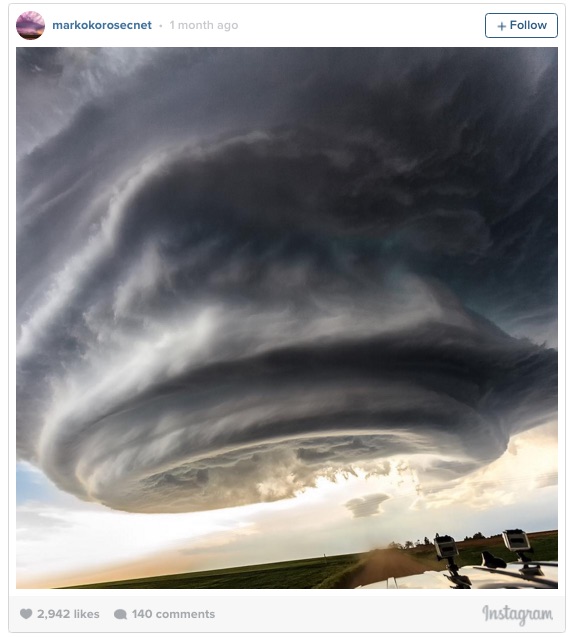
Sometimes, the best way to understand what’s happening on the other side of the world is to see it for yourself. Here are some of our favorite Instagrammers who focus on capturing our changing planet

Screen Shot 2016-04-21 at 7.45.44 AM

A storm chaser from Slovenia, Marko Korosec (@markokorosecnet) has been researching severe weather events through forecasting, chasing and analysis since 2000. He counts the above capture of a “spaceship” supercell storm in Colorado among his most memorable chases. It was like “an UFO landing on Earth”, he writes.

Read/view the whole article here.

US Currency Change Coming

We’ve reported on the positive alterations of currency before, when it was the British five-pound note that was becoming plastic instead of plant fiber. That was good news in terms of ecological footprint, because the plastic notes should live longer and thereby save materials in the long run. In the case of the US change with the five-, ten-, and twenty-dollar bills, the impact is less on the environment and more in the social arena: women would feature on paper currency for the first time in modern history. From the New York Times:

WASHINGTON — Treasury Secretary Jacob J. Lew on Wednesday announced the most sweeping and historically symbolic makeover of American currency in a century, proposing to replace the slaveholding Andrew Jackson on the $20 bill with Harriet Tubman, the former slave and abolitionist, and to add women and civil rights leaders to the $5 and $10 notes.

Mr. Lew may have reneged on a commitment he made last year to make a woman the face of the $10 bill, opting instead to keep Alexander Hamilton, to the delight of a fan base swollen with enthusiasm over a Broadway rap musical named after and based on the life of the first Treasury secretary.

Continue reading

If You Happen To Be In New York City

Screen Shot 2016-04-21 at 5.28.08 AM

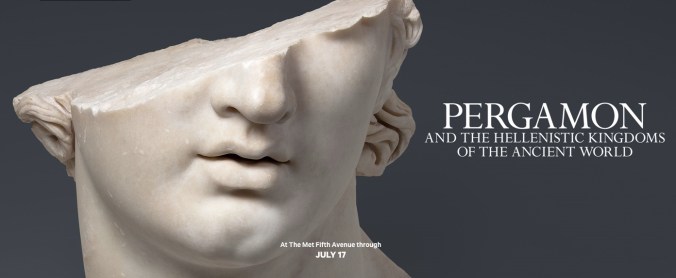
History can be dry, except when in the hands of masterful story-tellers. Which reminds us of James, and other scholars who have graced these pages in recent years with practical stories of the past linked to our present day lives. The value of this Pergamon exhibition (click the image above to go to the museum’s description of the exhibition) catches our attention because this review, which exemplifies the sort of interpretation that allows history to jump into our present tense:

…This tidal wave of wealth sloshed all around the eastern Mediterranean during the three centuries that followed, the era known today as the Hellenistic Age. It soaked the shores of the half-dozen new kingdoms carved out of Alexander’s conquests…

Read the description of this exhibition below, in the words of the Met’s curators, to get a renewed sense of the important role museums play in our civic lives.

The conquests of Alexander the Great transformed the ancient world, making trade and cultural exchange possible across great distances. Alexander’s retinue of court artists and extensive artistic patronage provided a model for his successors, the Hellenistic kings, who came to rule over much of his empire. For the first time in the United States, a major international loan exhibition will focus on the astonishing wealth, outstanding artistry, and technical achievements of the Hellenistic period—the three centuries between Alexander’s death, in 323 B.C., and the establishment of the Roman Empire, in the first century B.C. Continue reading

Treetops Teeming

19REDWOODS-master1050-v2

Climbers, including a master instructor, made their way up Grandfather, an 800-year-old, 200-foot-tall redwood near Los Gatos, Calif., last month. Credit Steve Lillegren

A topic we have been coming back to on a regular basis for years–the value of biodiversity in general (we are not averse to stating the obvious in these funny times we live in) and in particular the as-yet still to be explored forest treetops–appears in the Science section of this week’s New York Times. Apart from reminding us of a tree-inclined scientific friend (Meg, of treetop science fame, we have just recently learned you are now out in the vicinity of these redwoods, and so we shout this one out to you!), and reminding us of one of the great long-form pieces of journalism on the same topic, it is worth a read:

An Orchidean Cryptid

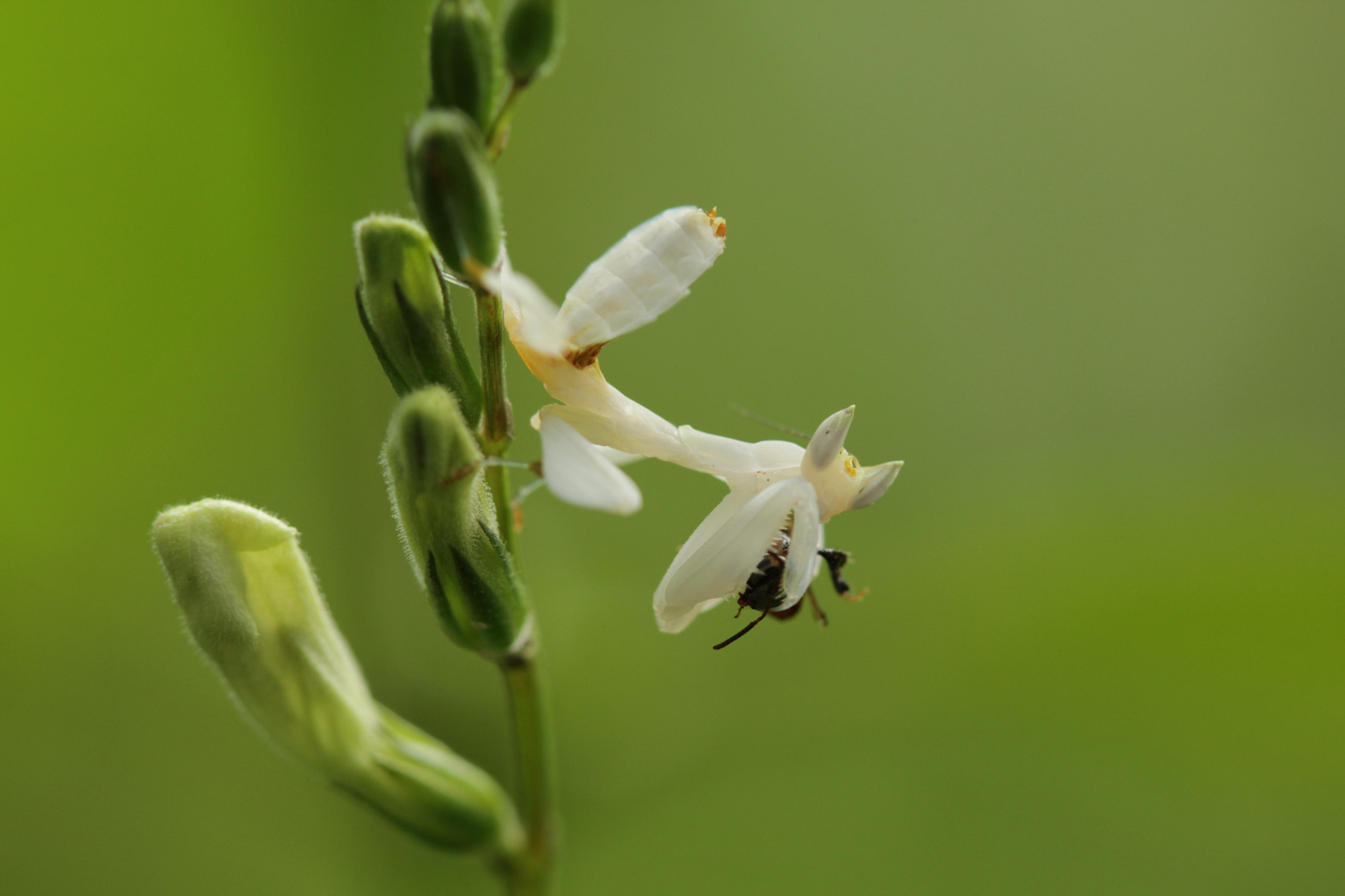
A female juvenile orchid mantis chows down. Photo courtesy of James O’Hanlon via Science Friday

A few days ago we shared about the clade of flowers known as orchids, and how people in the UK can become citizen scientists regarding them. Now, Science Friday writer Julie Liebach (who also edits the site’s content online) explores the research of an entomologist studying a type of “praying” mantis that, as a juvenile, mimics the general feeling of the average orchid – but not a particular species or genus of the flowers, interestingly enough:

They’re predominantly white with pink or yellow accents, similar to some orchids and other flowers, and their four hind legs are lobed, like petals. But if you search for an exact floral counterpart, as behavioral ecologist James O’Hanlon did, you probably won’t find one. “I spent forever looking for a flower that they look just like,” he says, to no avail.

As it turns out, rather than mimicking one floral species, the insect instead may embody a “generic or an average type of flower” in order to attract bees and other pollinating insects as prey.

Continue reading

Bad News for Lionfish in Costa Rica, Good News for Costa Rica

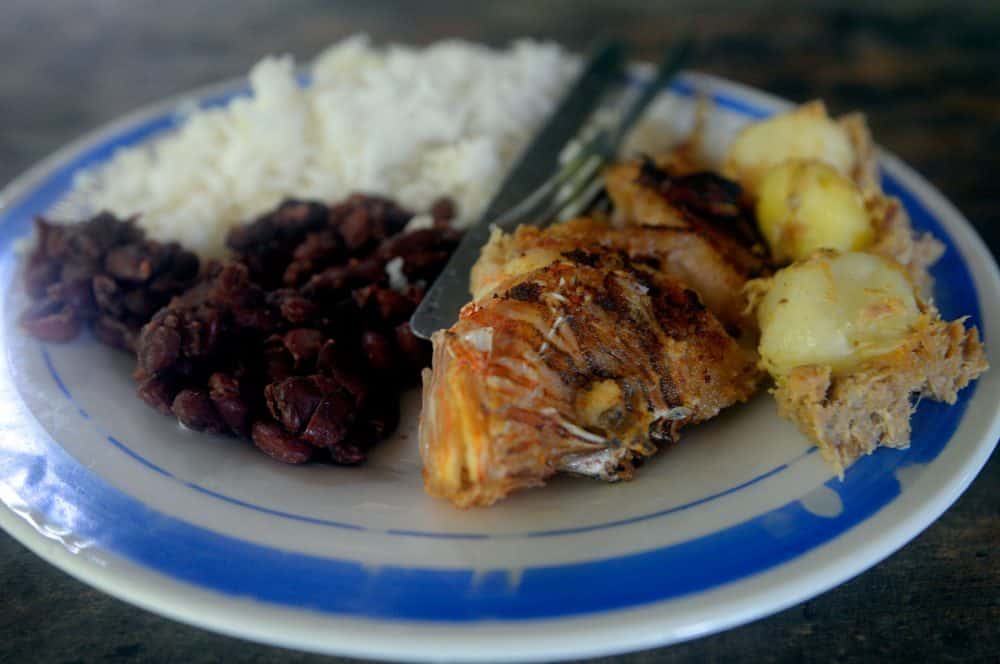
After a long day of fishing, the lionfish are fried and served up with rice and beans. Lindsay Fendt/The Tico Times

We’re always keeping our eye out for updates on the lionfish situation, and that’s why we’re happy to see that some more efforts are being made in Costa Rica to control a problem that is pretty out of control. More from Lindsay Fendt from the Tico Times:

Local efforts to curb the encroachment of invasive species in Costa Rica’s Caribbean got a big boost this week with the formation of a National Commission for the Management and Control of Lionfish. The new commission will provide government support for Caribbean fishing associations that are already actively combatting the proliferation of lionfish (Pterois).

Introduced to the Atlantic Ocean from the Indo-Pacific sometime in the 1980s, the lionfish has been wreaking havoc on Caribbean fish populations. The fish can gobble up two smaller fish every minute and lay up to 30,000 eggs each year, depleting catches for fishermen and damaging the ecosystem. Though not the hardest hit country in the region, Costa Rica has approximately 90 lionfish per hectare and fishermen have reported an 80-87 percent decline in their catches since 2009 when the fish began to appear off the country’s coast.

Continue reading

National Park Week

On August 25th this year, the United States National Park Service will turn 100 years old, and this week, from April 16th to the 24th, it’s National Park Week, when the US celebrates its natural and cultural heritage with special events and free admission to any national park.

Continue reading