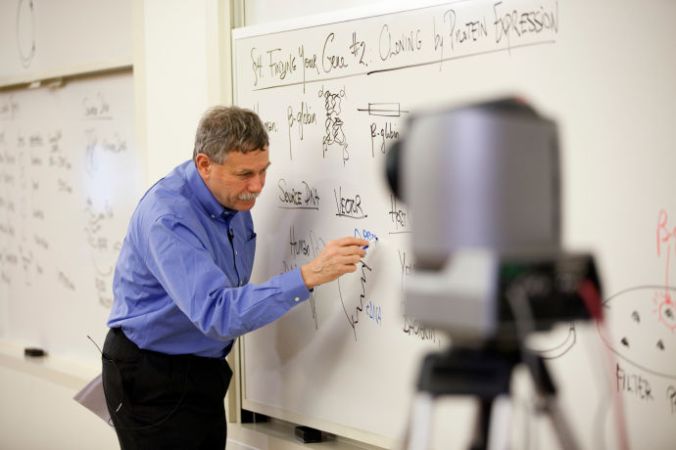
Online education is a technology with potentially revolutionary implications—but without a precise plan for realizing that potential. CREDIT PHOTOGRAPH BY MELANIE STETSON FREEMAN / THE CHRISTIAN SCIENCE MONITOR VIA GETTY
If the first post of today was rather too depressing, here is an interesting puzzle to take your mind off that subject. In honor of all of this year’s interns, many of whom are probably thinking about MOOCs for various reasons, we thank the New Yorker’s Elements writer Maria Konnikova for this intriguing distraction:
On July 23rd, 1969, Geoffrey Crowther addressed the inaugural meeting of the Open University, a British institution that had just been created to provide an alternative to traditional higher education. Courses would be conducted by mail and live radio. The basic mission, Crowther declared, was a simple one: to be open to people from all walks of life. “The first, and most urgent task before us is to cater for the many thousands of people, fully capable of a higher education, who, for one reason or another, do not get it, or do not get as much of it as they can turn to advantage, or as they discover, sometimes too late, that they need,” he told his audience. “Men and women drop out through failures in the system,” he continued, “through disadvantages of their environment, through mistakes of their own judgment, through sheer bad luck. These are our primary material.” He then invoked the message emblazoned on the Statue of Liberty: Open University wanted the tired, the poor, the huddled masses. To them, most of all, it opened its doors. Continue reading →

















 Organikos