Cats Caught Candid

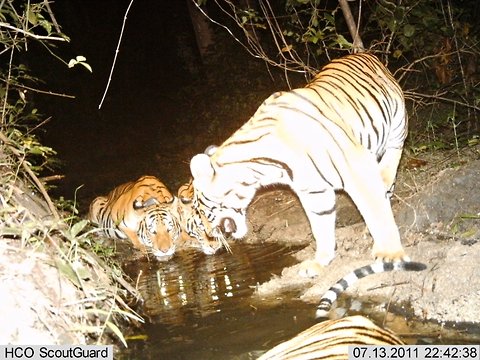
Thanks to Green Blog for attention and link to some rather unexpected news, and to Rachel Nuwer for titling her news–“Protected Tigers, Burning Bright”–in a manner we appreciate for its allusion as much as its information:

Tigers have delivered a bit of holiday cheer: populations are on the upswing, it turns out, in some protected areas in India and Thailand. In a field often dominated by news of felled forests and population declines, wildlife conservationists have taken heart from this development, while noting that tigers have a long, long way to go if they are to claw their way off the endangered species list. Continue reading

Newly Discovered Species

This slideshow requires JavaScript.

A bit of synchronicity accompanies this post, following Seth’s post about Quagmire, and the post just prior to that about our efforts to balance out doom and gloom with as much evidence as we can find of “how to” or “there is still time and it is worth making the effort” stories.

Case in point: while Seth’s book review covers a certain delta in a certain country at a certain moment in history–all with pretty challenging consequences environmentally–the Guardian had just posted a sampling of 12 images of the 126 species of animal and plant life newly identified by biologists working in the same region  in the last year or so.  Those came from a new publication of WWF, whose press release we quote here:

126 new species have been discovered in the Greater Mekong in the past year. The total newly identified by scientists in 2011 includes 82 plants, 21 reptiles, 13 fish, 5 amphibians, and 5 mammals.

Continue reading

Mayan-Like Patterns

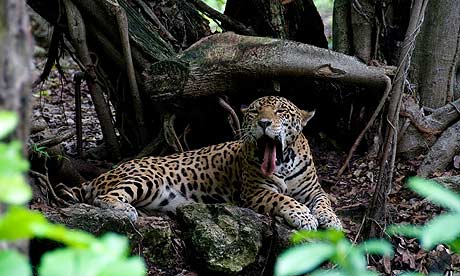
A jaguar – a symbol of Mayan royalty – is endangered but roams free in the Maya Biosphere Reserve, Guatemala. Photograph: Larry Larsen/Alamy

A jaguar – a symbol of Mayan royalty – is endangered but roams free in the Maya Biosphere Reserve, Guatemala. Photograph: Larry Larsen/Alamy

We make frequent links and comment on topics meant to raise awareness about innovative, fun and sometimes loony efforts—from the humble to the grand– to avert environmental collapse.  The dangers are real enough that we assume readers get enough of the doom and gloom elsewhere, so that we can focus our efforts on evidence of potential solutions, and encourage collective action.

The photo above accompanies a story in the Guardian worth a read, to put in perspective why it is that the Mayan calendar doomsdate hoopla, or at least some of the accompanying history, was worth a bit of attention:

…Today, much of the Mayans’ ancient homeland is a 7,700-square mile protected area in Guatemala called the Maya Biosphere Reserve. With an area greater than the states of Connecticut and Rhode Island combined, the reserve protects the largest remaining forest in Central America. Beneath the canopy, monumental vestiges of temples and palaces attest to past splendour. Similar magnificence is found in the reserve’s wildlife. The jaguar, once a symbol of Mayan royalty, still roams free in one of Central America’s last wild places. Continue reading

Alternate Views Of The World We Live In

Click the map above to go to the explanation:

Tigers and pandas live in Asia, kangaroos and koalas in Australia and polar bears and snowy owls in the Arctic. The world can be divided into regions based upon the unique types of animals that live there. Or so the thinking went when Alfred Russel Wallace published the scientific world’s first global biodiversity map in 1876. Continue reading

Marine Sanctuaries Expanding

The ocean bluff at Vista Point, seven miles south of Elk on California’s Mendocino Coast (Thomas R. McDonough/Knight-Ridder News Service Archives)

Among our favorite type of stories:

In a move that would permanently ban oil drilling along more than 50 miles of Northern California coast, the Obama administration announced plans Thursday to expand two Northern California marine sanctuaries, extending them up the rugged Sonoma and Mendocino coast. Continue reading

Balanced Man

One of the world’s great business leaders, whose commitment to core values we admire, prepares to hand over the reins and talks about India and its prospects:

…I take a bite of my plum cake. Tata hasn’t touched his but sips tea quietly as I ask for his views on India and its rapid recent changes. “I feel India is a country that really has an enormous amount of potential, has the human capital to succeed. But if you sit down and say, ‘Will it succeed?’, you see imbalances.”He mentions various policy problems that hamper businesses, from energy shortages to land acquisition. Such things have been part of the reason his group has sought growth overseas, initially in Europe but, he says, Continue reading

Quirky Choices About Living With A Smaller Carbon Footprint

Thanks to Green Blog for the attention to research showing the quirkiness of decision-making among consumers when it comes to investing in ecoefficiency:

Why do people buy inefficient refrigerators and clothes washers when spending a little more for an efficient one would save them money over time through lower electricity or water bills? There are a variety of reasons, but one that is persistently cited is that people are not necessarily buying these appliances for themselves. Often the buyer is a landlord, and the user is a tenant who does not make the choice but faces the consequences because he receives the energy bill. Continue reading

Green Energy Prestidigitation Undermining Confidence In Alternative Pathways To Reducing Our Carbon Footprint

A CN freight train is shown leaving Sarnia for Port Huron in Michigan. (Dave Seglins/CBC)

Thanks to the CBC for some old fashioned investigative journalism.  Click the image to go to their report. In the macro view, considering the scope and scale of the challenge of weaning off of fossil fuels, the credits at the center of this story are small and seemingly minor parts of a bigger puzzle.  Perhaps.  But playing with smoke and mirrors and mystery trains crossing borders in the night?  Time to bring back tar and feathers for these Enron-ish slick vendors:

…”If the facts in your story bear out, there needs to be some people go to prison,” said Joe Jobe, CEO of the U.S. National Biodiesel Board. “It’s not a victimless crime. [RIN fraud] has impacted the livelihoods and jobs of absolutely everybody in this industry, and it has cost the folks in the petroleum industry who have to comply with this, millions and millions of dollars and it has put small- and medium-sized biodiesel producers completely out of business. Continue reading

They Always Get Their Man

Fresh maple syrup in two maple leaf-shaped bottles, with other bottles behind. Police officials have arrested three men who allegedly siphoned the sweet treat from 16,000 storage barrels stored in a Quebec warehouse.

Fresh maple syrup in two maple leaf-shaped bottles, with other bottles behind. Police officials have arrested three men who allegedly siphoned the sweet treat from 16,000 storage barrels stored in a Quebec warehouse.

We were not sure what to think at first, and were not sure anyone would believe it either.  But seeing is believing thanks to this NPR follow up story:

After months on their sticky trail, Canadian police have finally fingered the people allegedly involved in the great Canadian maple syrup caper Bill Chappell told us about in August. Continue reading

Pedal Power


Read the Scientific American blog post from the beginning by clicking the image to the left:

… It costs $5,500, recharges its battery with its own rooftop solar panels, can legally take you on the road, on the sidewalk,* and on greenway trails, and has a 30-mile-per-charge range. Then you can either rely on those solar panels or you can take the little battery out and plug it in. And though it’s designed to carry me and up to 800 pounds of payload (guitar, amp, and groupie?), I can retrofit a little jumpseat so I can just haul around the groupie if I need to. You can read all about it in this story by the News & Observer of Raleigh. Continue reading

Farming Future For Fast-Fading Phenotypes

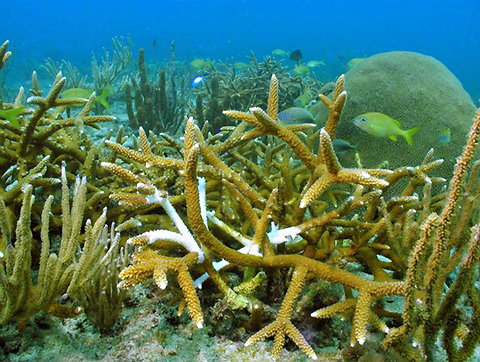
Image: NOAA. Staghorn coral afflicted by whitening, which is associated with ocean acidification and rising ocean temperatures.

We care about both genotypes and phenotypes when it comes to finding solutions to endangerment.  And in case you are reading this you should hear the truth: we selected the word phenotype among many possibilities for the post title, mainly for its alliterative value. We need a bit of lingual levity from time to time to balance out the accumulated weight of the days’ environmental news. This particular wordplay is nonetheless a fine fit to the purpose of the story. Thanks to Green Blog for the view on farming as one solution to the various types of endangered coral whose traits, including their morphology and development, may be replicated using techniques from agriculture:

In the international trade in live coral, most of which ships to the United States for ornamental marine aquariums, the source is quickly shifting from wild harvesting to farming, researchers report in a new study. Continue reading

What’s The Matter With Memes?

Memes matter. You know it.  Know why:

Yes we can! Ermahgerd. Occupy. I had a dream. Haters gonna hate. Tear down this wall! Gangnam Style. Drill, baby, drill.

We are constantly bombarded by memes in our daily lives. Some spontaneously flare up and then burn out as quickly as they appeared, while others stick around for decades. We hardly consider their presence, much less contemplate their possible influence on our lives. Continue reading

Foxes, Henhouses And Old Watchdogs Learning New Tricks

We believe governments and NGOs, supported by research in academia and elsewhere, are the institutions best designed to establish, enforce and monitor environmental protection schemes.  NGOs can also play a philanthropic role.  Enterprises such as ours have evolved in the last couple decades to approach conservation challenges better suited for market solutions.  Now, another random variation in this never-ending evolution of ideas.

What is the implication of conservation NGOs getting into business deals with the very businesses that are causing environmental problems?  We favor innovation, but also evaluation of those new approaches.  We have only recently been paying attention to this relatively new phenomenon, so do not have the answers, but each time we see questions being raised we take note (and will share them here).  This, from the excellent Yale Environment 360 site:

Like plastic bags, coal, and SUVs, beef has few friends in the environmental community. Most environmentalists would point to beef — in particular, beef cattle that spend their final days in confined feedlots — as being responsible for an array of ills — the greenhouse gas emissions that the cattle generate; the groundwater pollution from their manure; the use of antibiotics in animal feed; the vast quantities of monoculture corn grown to feed the cattle; and the enormous amount of chemical fertilizers and water needed to grow the corn. As advocacy group Food and Water Watch put it in a 2010 report, “The significant growth in industrial-scale, factory-farmed livestock has contributed to a host of environmental, public health, food safety and animal welfare problems.” Continue reading

Mongering Marine Merchandise Mendaciously

Click here to go to Oceana’s report, which documents a study in which, through sampling and DNA testing, it is found that 39% of seafood peddled in major metro markets is fraudulently labeled:

Executive Summary

Seafood fraud can happen anywhere – even in the Big Apple. Fraud includes any false information accompanying seafood, from short weighting to swapping out one species of fish for another. Oceana’s investigation focused on species substitution, or the swapping of a lower value or lower quality fish for a more desirable species. This “bait and switch” hurts our oceans, our health and rips off consumers. And most importantly, it is illegal. Continue reading

Refreshing Airflow With A Smaller Footprint

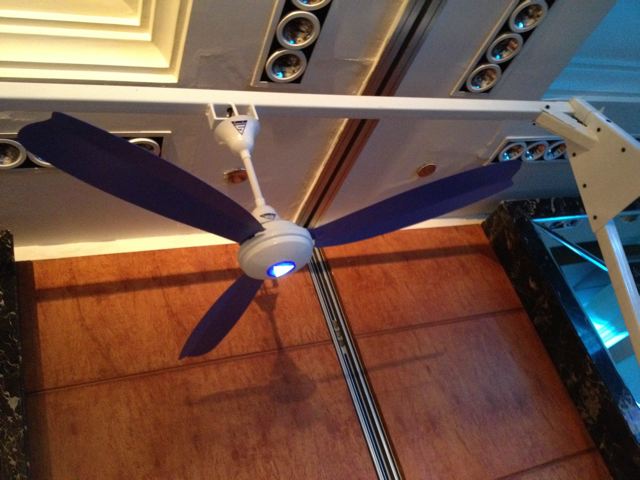
The Superfan, complete with colorful blades and LED power indicator. Photo credit: David Ferris

One of the least likely publications to cover ecological or social issues with any true concern, to our pleasant surprise occasionally runs an interesting story like this one (click the image above to go to the source):

…The fan is the first venture into consumer products for Versa Drives, a Indian manufacturer of alternating-current drives. Managing Director Sundar Muruganandhan said that the Superfan uses 35 watts of electricity in a country where the standard efficient fan is rated at 75 watts. In fact, Muruganandhan said, the fan blows past the country’s existing ratings system so thoroughly that a new index might be required. Continue reading

Thank You, Mr. Who Did Not Have To

Jeremy Irons is comfortable enough, surely, that he could rest on his laurels and not give a hoot about all this.  He is more than likely removed from the subject of the film he has just completed, most if not all the time.  So why bother?  But he got off his duff and did something, and for that we are impressed and give thanks:

A new documentary about the ultimate fate of just about everything we lug home from the mall opens on Friday in limited release in the United States. “Trashed,” directed by Candida Brady and starring Jeremy Irons, delves into the less festive side of consumerism and waste disposal — overflowing landfills in England, a toxic trash incinerator in Iceland, a hospital for children with birth defects in Vietnam.

We sat down recently with Mr. Irons to talk trash. Following are excerpts, edited for brevity and clarity. Continue reading